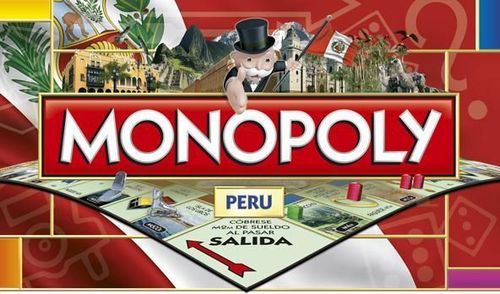
Monopoly Peru
Monopoly Peru Rulebook
Table of Contents
Table of Contents
- Objective
- Equipment
- Setup
- The Banker
- The Bank
- The Play
- "GO" (Adelante)
- Buying a Property
- Landing on a Property with an Owner
- Landing on Chance or Community Chest
- Tax
- Jail
- Free Parking (Parada Libre)
- Houses (Las Casas)
- Hotels (Los Hoteles)
- Shortage of Buildings (La Escasez de Edificios)
- Property Sales (Venta de Propiedades)
- Mortgages (Hipotecas)
- Bankruptcy (Quiebra)
- Miscellaneous (Miscelanea)
- Short Game (Reglas para un Juego Corto)
- Another Good Short Game (Otro Buen Juego Corto)
Objective
The object of the game is to become the richest player through buying, renting and selling property.
Equipment
The equipment consists of a board, two dice, tokens, 32 houses and 12 hotels. There are decks of cards for the CASUALIDAD (Chance) and ARCA COMUNAL (Community Chest) spaces. There is a Title Deed card for each of the properties, and bills representing money.
Setup
Place the board on a table, placing the Chance and Community Chest cards face down in the spaces provided for them on the board. Each player is given a token representing that player on his travels around the board.
Each player is also given $1500 divided as follows: two $500 bills, two $100, two $50; six $20, five $10, five $5 and five $1. The rest of the money is held by the Bank.
The Banker
A player who is also able to be a good auctioneer shall be chosen as Banker. If the Banker also takes part in the game, he is obliged to keep his personal funds apart from the funds of the Bank. When more than five players are playing, the Banker sometimes prefers to limit himself to acting only as Banker and auctioneer.
The Bank
The Bank holds, in addition to the Bank's money, the Title Deed cards and the houses and hotels before the players acquire and use them. The Bank pays salaries and bonuses, sells and auctions properties to the players and gives them their Title Deed cards; it sells houses and hotels to the players and lends them money, when necessary, against mortgages of properties.
All taxes, fines, loans and interest, and the price of all properties that the Bank sells and auctions, are paid to the Bank.
The Bank never "goes broke." If it runs out of money it may issue as much of its own currency as it needs, simply by writing it on any ordinary paper.
The Play
Beginning with the Banker, each player rolls the dice in turn. The player who rolls the highest total starts the game. After placing his token on the corner marked "GO" (Adelante), he rolls the dice and moves his token in the direction of the arrow the number of spaces indicated by the dice. When he has finished his turn, he passes the turn to the player on his left. Tokens remain on the spaces they have occupied and continue moving from that point when each player's turn comes around again. Two or more tokens may be on the same space at the same time.
Depending on the space on which his token lands, the player will have the right to buy land or other properties, will be obliged to pay rent or taxes, to draw a Chance (Casualidad) or Community Chest (Arca Comunal) card, to "Go to Jail" ("Vayase a la Cárcel"), and so on.
If a player rolls doubles, he moves his token normally, or as many spaces as the points he rolled, and is subject to the rights or penalties that correspond to the space he has reached. After this he rolls the dice again and moves his token in the same way. If a player rolls three doubles in a row, instead of moving his token he places it immediately on the space marked "In Jail (Cárcel)" (see JAIL).
"GO" (Adelante)
Each time a player's token lands on or passes the "GO" (SALIDA) space, regardless of whether it arrived at or passed that space as a result of rolling the dice or drawing a card, the Banker pays him a "salary" of $200.
However, the $200 is paid only once for each trip around the board in which the space "GO" is reached or passed. If a player who passes "GO" the first time he rolls the dice lands on "Community Chest" (Arca Comunal) two spaces further on, or on "Chance" (Azar) seven spaces further on, and draws the card "Advance to GO" (Avance hasta GO), he receives $200 for passing "GO" the first time and another $200 for going to "GO" the second time, following the instructions on the card.
Translation note: the sheet calls the Chance spaces and cards both "Casualidad" and "Azar"; both are rendered here as Chance.
Buying a Property
When a player's token lands on an unowned property, this player has the option of buying that property from the Bank at the price printed on it. The player receives a Title Deed card certifying him as owner, which he must place face up in front of himself.
If the player elects not to buy, the property is immediately put up for auction by the Banker and sold to the highest bidder. The buyer pays the Bank the amount stipulated in the bidding and receives the corresponding Title Deed card. All players may bid, including the player who declined the option to buy at the printed price. Any price may serve as the starting bid.
Landing on a Property with an Owner
If a player's token lands on a property that has an owner, the owner of that property collects the rent stipulated in the list printed on that property's Title Deed card.
If the lot is mortgaged, no rent may be collected. The mortgage of a property is shown by turning the Title Deed card that represents it face down in front of its owner.
Note: If there is one or more houses on the lot, the rent is greater than that corresponding to an unimproved lot.
It is highly advantageous to own the Title Deed cards of all the properties of a complete group of a given color (for example: Paseo Tablado and Plaza del Parque; or the Avenidas Connecticut, Vermont and Oriental), because this entitles the owner to collect double rent on the unimproved lots of that group. This rule applies to unmortgaged lots, even if some other lot of the same group is mortgaged.
It is much more advantageous to own houses and hotels than unimproved lots, because the rents on the former are much higher than the rents on unimproved lots.
If the owner stops demanding payment of rent before the second player who follows in turn rolls the dice, he may not collect that rent.
Landing on Chance or Community Chest
When this occurs, the player draws the top card from the deck indicated, and after following the instructions printed on it, puts it face down again at the bottom of that deck.
The "Get Out of Jail Free" card (Salir libre de la Cárcel) is kept until it is used, and once used it is put back at the bottom of the deck. If the player who holds it does not wish to use it, he may sell it at any time to another player at whatever price they agree.
Tax
When a player lands on the tax space he has two options: estimate his tax at $200 and pay it to the Bank, or pay 10% of his total net worth to the Bank. Total net worth is calculated by adding up the cash on hand, the printed price of all properties (whether mortgaged or not) and the cost price of all buildings he owns.
The player must decide what to do before he begins to add up the value of his assets.
Jail
A player goes to Jail when: (1) his token lands on the space marked "Go to Jail" (Vayase a la Cárcel); (2) he draws a card marked "Go to Jail"; (3) on rolling the dice he rolls doubles three times in a row.
When a player is sent to Jail he may not collect the $200 salary on that move, because regardless of where his token is on the board he must move it directly to Jail. Whenever a player is sent to Jail, his turn ends.
If during a normal move a player's token lands on the space "Just Visiting" (De Visita No Mas), the player suffers no penalty and moves ahead in the normal way when his turn comes around again.
A player may get out of Jail in any of the following ways:
- By rolling doubles on any of the three turns following his entry into Jail. If he succeeds, he immediately advances his token the number of spaces indicated by the doubles; in this case, despite having rolled doubles, he does not take the other turn.
- By using the "Get Out of Jail Free" card (Salir libre de la Cárcel Gratis), if he holds one.
- By buying the "Get Out of Jail Free" card from another player and using it.
- By paying a fine of $50 before rolling the dice on either of his two following turns.
If on reaching the third turn the player has not rolled doubles, he must pay the $50 fine. He then leaves Jail and must move his token the number of spaces indicated by his roll of the dice.
Even while in Jail, the player may buy and sell properties, houses and hotels, and collect rents.
Free Parking (Parada Libre)
The player whose token lands on this space receives no money, property or prizes of any kind. It is simply a resting place, "free of charge".
Houses (Las Casas)
When a player owns all the properties of a group of the same color, he may buy houses from the Bank and erect them on those properties.
If he buys a single house, he must place it on any of the properties of the group. The second house he buys and erects must be placed on one of the unoccupied lots of this complete group of one color, or of some other such group that he owns.
The price the player must pay the Bank for each house is indicated on the lot's Title Deed card.
Even on unimproved lots belonging to a complete group of one color that he owns, he may collect double rent from any opponent whose token lands on them.
The player may buy and build, in accordance with the rules above and at any time, all the houses he judges convenient and his financial situation allows. But he must build evenly (that is, he may not build more than one house on a lot of a group of a certain color until he has built a house on every lot of that group). When he has done so, he may then begin to build the second row of houses, and so on successively, up to the limit of four houses per lot. For example, he may not build three houses on one lot while there is only one house on another lot of the same group.
In the same way that houses must be built evenly, they must also be removed evenly when they are sold back to the Bank (see PROPERTY SALES).
Hotels (Los Hoteles)
Before a hotel can be bought, the player must have four houses on each lot of a complete group of one color. When he achieves this he may buy a hotel from the Bank to erect on any lot of that one-color group, handing the Bank in exchange the four houses there and the price of the hotel indicated on the Title Deed card. No more than one hotel may be built on each lot.
Shortage of Buildings (La Escasez de Edificios)
When the Bank has no houses to sell, players wishing to build will have to wait until some other player returns or sells his houses to the Bank. If only a small quantity of houses and hotels is available and two or more players wish to buy a number greater than the Bank has, the houses and hotels must be sold at public auction to the highest bidder.
Property Sales (Venta de Propiedades)
Any player who owns unimproved lots, railroads and utilities (but not buildings) may sell them to any other player in a private transaction, for whatever sum both agree. However, no lot may be sold if it belongs to a color group in which any other lot contains buildings. Before the owner may sell a lot of that color group, he must sell those buildings to the Bank.
Players may sell houses and hotels back to the Bank at any time, at half the price they paid for them.
All the houses in a color group must be sold one at a time, evenly, in the reverse of the order in which they were built.
All the hotels in a color group may be sold at the same time, whole, or one house at a time (a hotel equals five houses). They must be sold evenly and in the reverse of the order in which they were built.
Mortgages (Hipotecas)
Unimproved properties may be mortgaged at any time, and only through the Bank. Before a lot with buildings on it can be mortgaged, all buildings erected on that lot and on all the other lots of the same color group must be sold to the Bank at half price. The mortgage value of each property is printed on its Title Deed card.
No rent may be collected on mortgaged lots or utilities, but rent may still be collected on the unmortgaged properties of the same group.
To lift a mortgage, the owner must pay the Bank the amount of the mortgage plus 10% interest. When all the properties of a color group are no longer mortgaged, the owner may buy back the houses from the Bank at the full price.
The player who mortgages his property retains possession of it, so that no other player may obtain it by lifting the mortgage the Bank holds on it. However, that owner may sell his mortgaged property to another player at any price they agree. The new owner may, if he wishes, lift the mortgage immediately, but to do so he must pay the Bank the principal of the mortgage plus 10% interest. If he does not wish to lift the mortgage immediately, he must pay the Bank the 10% interest at the moment he buys the property from the other player; and if he later decides to lift the mortgage, he must pay the Bank the corresponding mortgage amount plus another 10% interest.
Bankruptcy (Quiebra)
A player goes bankrupt when he owes more to another player or to the Bank than he can pay.
If he is in debt to another player, he must hand over all his assets to that player and withdraw from the game. In making this settlement, if he owns houses or hotels he must return them to the Bank in exchange for money, in an amount equal to half the price he paid for them, and hand that money to the creditor. If he owns mortgaged properties, he also hands those properties to his creditor, but in this case the new owner must immediately pay the Bank the interest on the loan, which is 10% of the value of the property. After doing so, the new owner may, at his choice, pay the amount corresponding to the principal and end the mortgage, or retain the property and decide to lift the mortgage later. If he retains the mortgage in this way until a subsequent turn, then when he lifts the mortgage he must pay the interest again.
If the player is in debt to the Bank, instead of to another player (because he cannot pay taxes or fines even after selling buildings and mortgaging properties), he must hand all his assets over to the Bank. In that case the Bank immediately sells at public auction all the assets so acquired, except buildings. The bankrupt player must withdraw immediately from the game. The last player remaining in the game wins.
Miscellaneous (Miscelanea)
Players may only borrow money from the Bank by mortgaging their properties. No player may borrow money from, or lend money to, another player.
Short Game (Reglas para un Juego Corto)
The sheet gives these rules for a short game of 60 to 90 minutes. There are three differences from the rules above:
-
Setup. During SETUP the Banker shuffles the deck of Title Deed cards. The deck is then cut by the player on the left, and the Banker deals the Title Deed cards, two at a time, to each player (including himself, if he is both a player and the Banker). The players who receive the cards must immediately pay the Bank the printed price of the two properties thus acquired. The game then begins in the same way as the standard game.
-
Hotels. In this short game it is only necessary to have three houses (instead of four) on each lot of a complete color group in order to buy a hotel. The rent received for a hotel is the same as in the standard game. The value of a hotel when returned to the Bank is always half its purchase price, which in this game is one house less than in the standard game.
-
End of the game. The first player to declare bankruptcy withdraws from the game, as in the standard game. However, when a second bankruptcy occurs, the game ends, and the bankrupt player hands over to his creditor everything of value he owns, including buildings and other properties, whether the creditor is a rival player or the Bank.
Each of the remaining players then calculates the value of his assets as follows: (1) cash on hand; (2) lots, utilities and railroads he owns, at the value printed on the board; (3) any property he has mortgaged, at half the price printed on the board; (4) houses, at the purchase price; (5) hotels, at the purchase price, including the value of the three houses given in exchange for them.
THE RICHEST PLAYER WINS!
Another Good Short Game (Otro Buen Juego Corto)
Timed Game (El Juego con Límite de Tiempo)
Before starting, set a finishing time. When that time arrives, the player who is richest at that moment wins. Before the game begins, the deck of Title Deed cards is shuffled and cut, and the Banker gives two Title Deed cards to each player. The players immediately pay the Bank the price of the properties obtained.
The sheet's closing consumer-relations contact address and the manufacturer's logo are omitted; they are not rules.