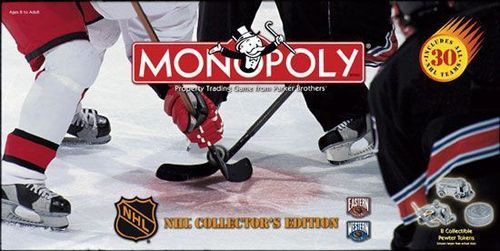
Monopoly: NHL Collector's Edition
Monopoly: NHL Collector's Edition Rulebook
Table of Contents
Table of Contents
- Common and Distinctive Elements
- History
- Object
- Accessories
- Preparation
- The Banker
- The Bank
- Playing the Game
- Buying a Property
- Paying Rent
- Chance and Community Chest
- Income Tax
- Jail
- Free Parking
- Houses
- Hotels
- Building Shortage
- Selling a Property
- Mortgages
- Bankruptcy
- Miscellaneous
- Shortened Game Rules
- Shortened Game, Second Version
Common and Distinctive Elements
Here is the list of the distinctive elements and the common elements of this NHL® Edition.
Common Elements
- The goal and the rules of the game are the same. Own everything and bankrupt your opponents.
- Property cards: these are the "title deeds" of the classic game. All the values and colours are the same as those of the classic game.
- Play money and the bank's tray: the bills look slightly different, but the denominations are the same.
- 2 dice: the dice will always be the same!
Distinctive Elements
- Game board: the action on the board is the same. However, you will notice that it features the 30 franchises of the Eastern and Western Conferences, classified in their order of admission to the league.
- Expansion clubs have replaced the traditional railroads. Television stations replace the utilities.
- Franchise rights work like the income tax in the standard game. The penalty space works like the luxury tax.
- The eight pewter tokens will delight hockey fans. Which will you choose? The skates, the puck, the player, the goalie, the goalie mask, the net, the Zamboni® or the glove?
- Build your own league by acquiring luxury boxes and arenas instead of the traditional houses and hotels.
- Western Conference cards replace the traditional Chance cards. Eastern Conference cards replace the traditional Community Chest cards. All the cards are used in the same way, except that they bear messages relating to hockey, and Mr. Monopoly™ wears thematic clothing.
Victory is achieved in the usual way. The player who is still in the game when all the others have gone bankrupt wins!
Contents
Game board · Title deeds · Play money and bank tray · 2 dice · 8 thematic pewter tokens · Eastern and Western Conference cards · 32 luxury boxes and 12 arenas
History
In 1934, Charles B. Darrow, of Germantown in Pennsylvania, submitted a game called MONOPOLY to the executives of Parker Brothers. As many Americans did at that time, Mr. Darrow was out of work. To pass the time and entertain himself, he often played this game, which gave each player the chance to acquire power and fortune. It was this that first led him to produce the game for his own enjoyment.
Helped by a printer friend, Darrow succeeded in selling 5,000 units of his game to a department store in Philadelphia. But demand soon became so great that Darrow could no longer meet it. He therefore sold his rights to Parker Brothers in 1935.
Since then, the game MONOPOLY has been a hit not only in the United States but throughout the Western world. In 1995, the game MONOPOLY celebrated its 60th anniversary. It is now sold under license in 43 countries and printed in 26 languages. In addition, the Hispanic-American edition is sold in 11 other countries.
Object
BUT . . . The object of the game is to become the richest player by buying, renting and selling land.
Accessories
ACCESSOIRES . . . The game includes a game board, 2 dice, pawns, 32 houses and 12 hotels, Chance cards and Community Chest cards, a title deed for each property, and play money.
Preparation
PRÉPARATION . . . Place the board on the table. Place the Chance and Community Chest cards on their respective spaces on the board. Each player chooses a pawn to represent them on their journey around the board. Each player receives a total of 1,500 $, divided as follows: 2 bills of 500 $, 2 of 100 $ and 2 of 50 $, 6 bills of 20 $, 5 bills of 10 $, 5 of 5 $ and 1 of 1 $ each.
All remaining money and accessories remain the property of the bank.
The Banker
LE BANQUIER . . . Choose a player to fill the roles of banker and auctioneer. The banker must keep their own money separate from that of the bank. If there are more than five players, the banker may choose not to play and act only as banker and auctioneer.
The Bank
LA BANQUE . . . In addition to money, the bank holds the title deeds and the houses and hotels that have not yet been bought by players. The bank pays salaries and bonuses. It sells properties or puts them up for auction and hands their title deeds to the new owners. It also sells houses and hotels to players and lends them money on demand through a mortgage.
The bank collects taxes, fines, loans and interest, in addition to the sale price of all properties that it sells or auctions.
The bank never goes bankrupt. If it runs short of money, the banker may supply as much as needed by signing cheques on plain paper.
Playing the Game
JOUER LE JEU . . . Starting with the banker, each player, in turn, rolls the dice. The player who obtains the highest total begins the game. They place their pawn on the GO corner, roll both dice and advance their pawn in the direction indicated by the arrow, by as many spaces as the total of the dice shows. Once this is done, it is the turn of the player on the left to play. Pawns stay on the spaces they occupy and resume from there on the next turn. Two or more pawns may occupy the same space at the same time.
Depending on the space their pawn lands on, a player may buy the property on which they stop or other properties, pay rent or tax, draw a Chance or Community Chest card, go to jail, and so on.
If a player rolls a doublet, they advance their pawn as usual according to the total shown by the two dice, and enjoy all the privileges of, or must pay all the penalties of, the space they reach. Then they roll the dice again and advance their pawn once more, as before. However, if they roll a doublet three times in a row, they must go to jail immediately. (See JAIL.)
"GO" . . . Each time a pawn stops on the GO space or passes it, whether by a roll of the dice or by drawing a card, the banker pays the player a salary of 200 $.
The 200 $ is paid only once per trip around the board. However, if a player, following a roll of the dice, passes GO and stops two spaces further on a Community Chest space, or seven spaces further on a Chance space, and draws a card that tells them to advance to GO, they receive 200 $ for having passed GO the first time, and another 200 $ because they must go there a second time, as the card instructs.
Buying a Property
ACHETER UNE PROPRIÉTÉ . . . Whenever a player lands on an unowned property, they may buy it from the bank at the stated price. The bank then gives them the corresponding title deed, which the player places in front of them.
If they do not wish to buy the property, the banker sells it at auction to the highest bidder. The buyer must pay the bank the amount offered and receives the title deed for the property. All players, including the one who declined to buy at the stated price, may bid. An auction may start at any price.
Paying Rent
PAYER UN LOYER . . . When a player lands on another player's property, the owner claims the rent shown on its title deed.
If the property is mortgaged, its owner must turn the corresponding title deed face down in front of them and may not claim rent.
It is very advantageous to own all the title deeds of a colour group (for example Promenade and Place du Parc, or Connecticut, Vermont and Oriental avenues), because at that point the owner may charge double rent on any unmortgaged vacant property of that colour group, even if one of the properties in the group is mortgaged.
It is even more advantageous to build houses and hotels on your properties, because this considerably increases the rents.
The owner may no longer claim rent if they forget to ask for it before the next player rolls the dice.
Chance and Community Chest
CHANCE ET CAISSE COMMUNE . . . When a player lands on one of these spaces, they take the top card from the corresponding pile, follow its instructions, and place the card face down at the bottom of the pile.
If they draw the "Get Out of Jail Free" card, they keep it until they use it, then place it face down at the bottom of the pile. The player may also choose not to use it and instead sell it to an opponent at an agreed price.
Income Tax
IMPÔT SUR LE REVENU . . . The player who lands on this space has two choices: they may pay 200 $ to the bank as their tax, or pay the bank 10% of their total net worth. Net worth consists of their liquid cash, the value of their properties whether mortgaged or unmortgaged, and the purchase price of all buildings they own. The player must make this choice before totalling their net worth.
Jail
PRISON . . . A player is sent to jail when: (1) their pawn stops on the GO TO JAIL space; (2) they draw a card that tells them to go to jail; or (3) they roll a doublet three times in a row.
A player who goes to jail may not collect the 200 $ salary that turn, regardless of where their pawn is on the board, since they must go there directly without passing GO. Their turn ends as soon as they enter jail.
If, during an ordinary turn, a player's pawn stops on the JUST VISITING space, they are not penalised and play continues normally on their next turn.
To get out of jail, the player must do one of the following:
- Roll a doublet on one of their next three turns. If they succeed, they immediately advance their pawn by the number of spaces shown by the total of the dice. Even if they roll a doublet, they do not roll again that turn.
- Use their "Get Out of Jail Free" card, if they have one.
- Buy a "Get Out of Jail Free" card from another player.
- Pay a fine of 50 $ before rolling the dice on one of their next two turns.
If they fail to roll a doublet after three turns, they must pay the 50 $ fine. They then leave jail immediately and advance their pawn by the number of spaces shown on the dice.
Even while in jail, a player may buy or sell properties, buy or sell houses and hotels, and collect rent.
Free Parking
STATIONNEMENT GRATUIT . . . A player who stops on this space receives no money, no property and no reward of any kind. It is a free rest space.
Houses
MAISONS . . . A player who owns all the properties of a colour group may begin building by buying houses from the bank.
If the player buys only one house, they may place it on any property of the group. The next house they buy must be erected on one of the properties of the group that is still without houses, or on one of the properties of another complete group that they own.
The price of each house is shown on the title deeds. The owner always receives double rent on the vacant properties of their group or of their complete groups.
At any time, according to their good judgment and financial situation, the player may buy and build houses. The only restriction is that they must build evenly: that is, they must limit themselves to one house per property in the same group for as long as there are vacant properties in that group. Once all the properties are filled, they may buy a second house for each property of the group, and so on, up to a maximum of four houses per property. For example, the player may not build three houses on one property if they own only one house on another property of the same group.
As houses must be built evenly, they must also be sold back to the bank evenly. (See SELLING A PROPERTY.)
Hotels
HÔTELS . . . When the player has built four houses on each property of a group, they may buy a hotel from the bank and erect it on any property of that group. They then return the four houses on that property to the bank and pay the bank the price of the hotel shown on the title deed. There is a limit of one hotel per property.
Building Shortage
CRISE DU BÂTIMENT . . . When the bank has no more houses to sell, players who wish to buy houses must wait for an opponent to return or sell their houses to the bank. If the bank has only a small number of houses and hotels left, and two or more players wish to buy more buildings than the bank holds, the bank auctions the houses and hotels and awards them to the highest bidder.
Selling a Property
VENDRE UN TERRAIN . . . Vacant properties, railroads and utilities (but not buildings) may be sold through private transactions between players, at amounts agreed upon between them. However, a player may not sell a vacant property in a group on which a house stands. They must first sell the buildings to the bank before they can sell the property.
Houses and hotels may be sold back to the bank at any time, at half their original purchase price.
All the houses of a group must be sold one at a time, evenly, in the reverse order of the one in which they were erected.
All the hotels on the properties of a group may be sold at the same time, or at the value of one house at a time (a hotel is worth five houses). In that case, the houses must be sold evenly, in the reverse order to that in which they were erected.
Mortgages
HYPOTHÈQUES . . . Vacant properties may be mortgaged at any time. It is enough to request it from the bank. However, for a property to be mortgaged, all buildings on all the properties of its colour group must first be sold to the bank, at half their purchase price. The mortgage amount is shown on each title deed.
A player may not claim rent on a mortgaged property or utility, but may collect rent on the unmortgaged properties of the same group.
To lift a mortgage, the owner must pay the bank the mortgage amount plus 10% interest. When there are no more mortgaged properties in a colour group, the owner may build again by buying houses at the full price.
A player who mortgages a property remains its owner, and no other player may take possession of it by offering to pay the mortgage to the bank. However, the player may sell a mortgaged property to another player at a price agreed between them. The new owner may lift the mortgage at the time of purchase by paying the bank the mortgage amount plus 10% interest. If the new owner decides to keep the mortgage, they must pay the bank 10% interest at the time of purchase, and pay the full mortgage amount later, plus another 10% interest.
Bankruptcy
FAILLITE . . . A player is bankrupt when they have less money than they need to pay an opponent or the bank.
If the creditor is another player, the debtor must hand over all their assets to that player and withdraw from the game. Before doing so, they must sell all their buildings to the bank at half their purchase price and hand all the money thus obtained to their creditor. They must also give their creditor all their mortgaged properties. For each mortgaged property, the creditor must immediately pay the bank the interest on the loan, which is 10% of the property's value. The creditor may then choose either to lift the mortgage at once, or to keep it and pay it later, plus 10% interest.
If the player owes the bank more than they can pay (in taxes or fines), even after selling their buildings and mortgaging their properties, they must hand all their assets over to the bank. In that case, the bank immediately auctions the properties (title deeds only, without buildings). A bankrupt player must withdraw from the game immediately. The last player who has not gone bankrupt wins.
Miscellaneous
DIVERS . . . Only the bank may lend money to a player, and only by mortgaging properties. No player may borrow money from another player, or lend money to anyone.
Shortened Game Rules
RÈGLES DE JEU pour une PARTIE ABRÉGÉE (60 to 90 minutes of play). In this first shortened version, five of the basic rules have been modified.
-
During SETUP (PRÉPARATION), the banker shuffles the title deeds and then deals three title deeds to each player. These title deeds are free: no payment to the bank is required.
-
In this shortened version, only three houses (instead of four) are needed on each property of the same colour group before a hotel may be bought. The rent of a hotel remains the same as in the basic game. The selling price of a hotel is always half its purchase price, except that it is worth four houses instead of five.
-
If a player goes to JAIL, they must get out on their next turn by: (1) using their "Get Out of Jail Free" card, if they have one (or can buy one); (2) rolling a doublet; or (3) paying 50 $. Unlike the basic rules, a player may try to roll a doublet and, if necessary, pay the 50 $ during the same turn.
-
The fine for having stopped on the "Income Tax" space is 200 $.
-
END OF THE GAME: The game ends as soon as a player goes bankrupt. The other players then count their assets: (1) their liquid cash; (2) their properties, public utilities and railroads, at the prices shown on the board; (3) all mortgaged properties, at half the price shown on the board; (4) their houses, at their purchase prices; (5) their hotels, at their purchase prices, including the value of the three houses returned to the bank.
THE RICHEST PLAYER WINS!
Shortened Game, Second Version
JEU À TEMPS LIMITÉ . . . Before starting, decide the time at which the game will end. The richest player wins. Before starting, the banker shuffles the title deeds and deals two cards to each player. The players immediately pay the bank the price of the properties they have received.