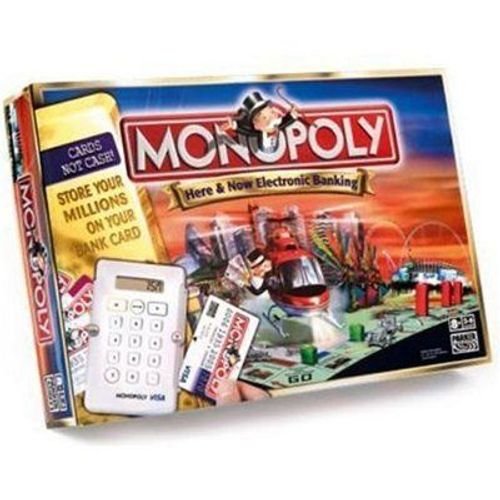
Monopoly: Here & Now Electronic Banking
Monopoly: Here & Now Electronic Banking Rulebook
Table of Contents
Table of Contents
How to Play
Banker
Choose a banker. If more than 5 players are playing, the banker may not take part in the game. The banker is responsible for:
- the electronic banking unit
- the Owner cards
- the houses and hotels
- the auctions
Starting the Game
-
Roll the dice in turn. The player who rolls the highest number starts the game. Play passes to the player on the left.
-
On your turn, roll the dice and move your token clockwise the number of spaces shown. Two or more tokens may occupy the same space.
Depending on the space you land on, you can:
- Buy the property at its original price (if it is unowned). See page 8.
- Ask the banker to hold an auction (if you do not want to buy the property at its original price). See page 8.
- Pay rent (if the property belongs to another player). See page 8.
- Pay taxes.
- Draw a CHANCE or COMMUNITY CHEST card. See page 10.
- Go to jail. See page 11.
-
If you have collected all the properties of one colour, you may build houses or hotels on them.
-
If you run out of money, mortgage or sell property to pay your creditors. If you cannot raise enough money to pay rent, a tax, or a bill, you are declared bankrupt and leave the game.
-
You may not give money to or borrow money from other players. However, when paying, a player may accept your property instead of money.
-
If you roll doubles, move as usual and then roll the dice again. If you roll doubles three times in one turn, go to jail!
-
Play until only one player remains in the game. That player becomes the winner!
Electronic Banking Unit
On the screen of the electronic banking unit only 5 digits fit, so for example 100,000 is displayed as 100K and 1,000,000 as 1M. You must enter numbers exactly as they are printed on the Owner, Chance and Community Chest cards.
Buttons
- M — Million.
- Arrow button — When you pass GO: the banker inserts your card into the left slot of the electronic banking unit and presses this button to add 2M.
- K — Thousand.
- C — Clear. To start a new game, press and hold this button until you hear a signal. The amount on the card returns to its starting value of 15M.
- Decimal point / sound control — To adjust the sound, remove all cards, then press the decimal point button.
Receiving and Paying Money
The diagram shows two cases: Receiving money (a card is inserted into the unit) and Paying money (a card is passed out of the unit).
Batteries
To replace the batteries, see page 11.
Switching On the Electronic Banking Unit
Press any button or insert a card. The starting amount on each card is 15M. The screen first shows the number of the card, and then the balance on it.
Receiving Money
You receive money:
- when passing GO
- when receiving rent
- from CHANCE or COMMUNITY CHEST cards
- from selling houses or hotels
- from mortgaging property
- from a bankrupt player
You receive money from the bank:
- from CHANCE or COMMUNITY CHEST cards
- when passing GO
- from selling houses or hotels
- from mortgaging property
The banker inserts your card into the left slot of the unit. Your balance is displayed. The banker then enters the amount due to you. When the balance has increased, the banker removes the card from the electronic banking unit.
Paying Money
You pay money:
- as rent
- when buying property
- as taxes
- by CHANCE or COMMUNITY CHEST cards
- when buying houses and hotels
- when redeeming a mortgage
- when leaving jail
- when settling with another player
You pay money to the bank:
- by CHANCE or COMMUNITY CHEST cards
- when buying property, houses and hotels
- when paying taxes
- when redeeming a mortgage
- when leaving jail
The banker inserts your card into the right slot of the unit. The banker then enters the amount you must pay. When your balance has decreased, the banker removes the card from the electronic banking unit.
Transactions Between Players
You pay or receive money from another player:
- as rent
- on bankruptcy
- when selling property
The banker inserts the payer's card into the right slot and the recipient's card into the left slot. The payer's balance is displayed. The banker then enters the amount to be paid. The payer's balance decreases. When the recipient's balance has increased, the banker removes both cards from the electronic banking unit.
Ending Use of the Electronic Banking Unit
The electronic banking unit switches itself off after 1 minute without activity. To switch it on again, press any button. All balances are saved in the unit, so you may take a break and continue the game later. All data will be kept!
Tips for the Banker
- Always insert cards into the electronic banking unit in the direction of the arrows on the cards.
- If you do not hear the signal when you insert a card, make sure the card is inserted correctly.
- If you entered the wrong amount, press "C" and enter the correct amount. An error can be corrected only while the card is still inserted in the electronic banking unit.
- The maximum amount of a single operation on the electronic banking unit is 20M, and the minimum is 10K.
Detailed Rules
Buying Property
The game has three kinds of property:
- Properties (Участки)
- Airports
- Utilities
If you stop on an unowned property, you have the first right to buy it. In that case you pay the banker the price shown on the space. In exchange you receive the Owner card. Place it in front of you, face up. If you do not want to buy the property, the banker announces an auction!
You may collect rent from players who stop on your property. If you have collected all the properties of one colour (a monopoly), you may build houses and hotels on them and collect the increased rent!
Auctions
If you decide not to buy the property on which you stopped, the banker announces an auction and awards the property to the player who offers the highest price. Bidding starts at any amount that any player is willing to pay. You may also take part in the auction.
Paying Rent
If you stop on a space that belongs to another player, you must pay rent (if the property is not mortgaged). The owner must ask you for the rent before the next player rolls the dice. The amount of rent is shown on the Owner card and changes depending on the number of buildings on the property.
If you own all the properties of one colour, collect double rent from the unimproved properties of that colour (without houses and hotels). If some of those properties are mortgaged, you may collect double rent from the unmortgaged properties of that colour.
Utilities
Utilities are bought and auctioned in the same way as property. If you stop on a utility owned by another player, pay the owner rent based on the number rolled on the dice that brought you to that space.
- If a player owns one utility, multiply the number on the dice by 4, and then by 10,000. This is the amount of rent.
- If a player owns both utilities, multiply the number on the dice by 10, and then the result by 10,000.
Airports
Airports are bought and auctioned in the same way as property. If you stop on an airport owned by another player, pay that player the amount shown on the Owner card, taking into account the other airports that player owns.
Building Houses
If you own all the properties of one colour, you may buy houses and place them on those properties. The price of a house is shown on the Owner card.
You may buy houses (or hotels) during your turn or between the turns of other players. Build evenly: you may not build a second house on one property until every property in the group has one house. You may buy as many buildings as you like, as long as you have the money! However, you may not build houses if at least one property of the colour group is mortgaged.
Place your houses and hotels on the game board, on the properties you have chosen.
Building Hotels
To buy a hotel you must have 4 houses on each property of one colour group. You exchange the 4 houses on each property for one hotel: return the 4 houses to the bank and pay the banker the price of the hotel shown on the Owner card. Only 1 hotel may be built on a property.
When Buildings Run Out
If no buildings are left, you must wait until other players return their buildings to the bank; then you may buy them.
If houses or hotels are in short supply and more than two players want to buy them, the banker announces a separate auction for each building and gives it to the player who offers the best price.
When Money Runs Out
If you run out of money, you can raise it by:
- selling buildings
- mortgaging property
- selling property, utilities or airports to another player for an agreed price (even if the property is mortgaged)
Selling Property
You may sell unimproved properties, airports and utilities to other players for an agreed price. You may not sell a property if any property of its colour has buildings on it. First you must sell all the buildings on those properties to the bank.
You may sell houses and hotels to the banker for half of their purchase price (as shown on the Owner card). You may sell during your turn or between the turns of other players.
Selling houses. Sell houses evenly, in the same way that you bought them.
Selling hotels. Hotels are sold for half their price, plus half the price of the four houses you exchanged for the hotel. To raise money, you may again exchange hotels for houses: sell the hotel for half its price and receive 4 houses.
Mortgages
How to mortgage property. First sell all the buildings on the property. Then turn the Owner card face down and receive the mortgage amount shown on the back of the card.
The mortgaged property still belongs to you; another player cannot pay off your mortgage and take your property. You may not collect rent from mortgaged property, but you may collect rent from the other unmortgaged property of the same colour.
Paying off a mortgage. You must pay the mortgage amount plus a 10% commission (rounded up to the next 10,000). Then turn the Owner card face up again. You may now collect rent from this property again.
Selling mortgaged property. You may sell mortgaged property to other players for an agreed price. The buyer then either pays off the mortgage immediately, or pays a 10% commission (rounded up to the next 10,000) and leaves the property mortgaged. The mortgage may be paid off later.
If the mortgages on all the properties of one colour have been paid off, the owner may again buy buildings for those properties at full price.
Bankruptcy
If you owe more than you can raise by selling property, you are declared bankrupt and leave the game.
Debt to the bank. Return your Owner cards to the banker, who will sell your property at auction.
Debt to another player. The player who bankrupted you receives all the money from your card, your Owner cards, and all your "Get Out of Jail Free" cards.
Chance and Community Chest
If you stop on one of these spaces, take the top card from the matching deck. Carry out its instruction, then place the card face down on the bottom of the deck. If you received a "Get Out of Jail Free" card, you may keep it for later use or sell it to another player for an agreed price.
If the card tells you to move to another space, move along the arrow. If you pass GO, receive 2M. You do not pass GO if the card sends you to jail, or back.
Free Parking
Free Parking is a free resting place. Here you neither receive nor spend money. You may still collect rent, build buildings, and so on.
Passing GO Twice in One Turn
You may receive 2M twice in one turn. For example, if right after passing GO you stop on a Chance or Community Chest space, and the card says "Proceed to GO", the banker must take out your card and insert it into the electronic banking unit again before pressing the arrow button again.
Jail
How you go to jail. You go to jail if:
- you stop on the space "Go to Jail!" (Отправляйтесь в тюрьму!)
- you take a CHANCE or COMMUNITY CHEST card that says "To jail!"
- you roll doubles three times in a row during your turn
Your turn ends when you go to jail. Move your token to the jail space. In this case you do not receive 2M, wherever you were on the board.
While in jail you may collect rent from unmortgaged property.
How to get out of jail. You may leave jail if:
- you pay a fine of 500K (M500K) during your next turn, before rolling the dice
- you use a "Get Out of Jail Free" card
- you roll doubles on the dice
If you have not rolled doubles by the third roll, pay the banker 500K and move the number of spaces rolled on the dice during that third roll.
On an excursion. If you were not sent to jail, but you stopped on the jail space, you are "On an excursion" (На экскурсии).
Batteries
IMPORTANT. Battery information: battery replacement must be carried out by adults. Keep this information for future reference.
WARNING:
- Like any small items, batteries should be kept out of reach of children. If a battery is swallowed, seek medical advice immediately.
- Always follow the instructions exactly. Use only batteries of the specified type and check that they are inserted with the correct polarity.
- Do not mix old and new batteries, or standard carbon-zinc batteries with alkaline batteries.
- Remove discharged batteries, or batteries that have reached the end of their service life.
- Remove the batteries from the unit if it will not be used for a long time.
- Do not short-circuit the power contacts.
- If this product is likely to cause or receive electrical interference, move it away from other electrical equipment. If necessary, reset the unit (switch it off and on with the power button, or remove and reinstall the batteries).
- Rechargeable batteries: do not use them together with batteries of any other type. Always remove them from the unit before charging. Charging must be done only under adult supervision. DO NOT CHARGE BATTERIES OF ANOTHER TYPE.
Dispose of batteries separately, at a local recycling centre. Do not throw batteries into household waste containers.
Quick Game Rules
If you know MONOPOLY and want a quick game:
- First the banker shuffles the Owner cards and deals 2 to each player. Players immediately pay the banker the price of the property they received. Then play continues as usual.
- To buy a hotel you need to build only three houses (instead of four) on each property of one colour group. You may sell a hotel for half its original price.
- As soon as the second player goes bankrupt, the game ends. Using the electronic banking unit, the banker counts up:
- the money remaining on the players' cards
- the total value of all the players' properties, utilities and transport (airports), at the prices shown on the game board
- the total value of mortgaged property, at half the price shown on the game board
- the value of all houses, at purchase price
- the value of all hotels, at purchase price, including the value of three houses
The richest player wins!
Speed Monopoly
Agree on a time when the game must end. The player who is richest at the moment the game ends wins!