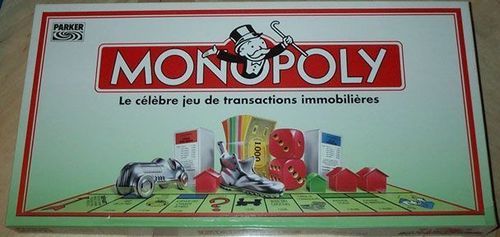
Monopoly: French
Monopoly: French Rulebook
Table of Contents
Table of Contents
- Object of the Game
- Setup
- Playing the Game
- Doubles
- The "GO" Space
- Landing on a Property for Sale
- Owning a Property
- Landing on a Privately Owned Property
- Landing on the "UTILITY" Spaces (Compagnie de Distribution)
- Landing on a "RAILROAD" (Gare)
- Landing on a "CHANCE" or "COMMUNITY CHEST" Space
- Landing on the "IMPOTS" (Taxes) and "TAXE DE LUXE" (Luxury Tax) Spaces
- Landing on FREE PARKING
- Jail
- Houses
- Hotels
- Building Shortage
- Selling Property
- Mortgages
- Bankruptcy
- Final Points
- The Winner
- Short Game Rules
- Timed Game
Object of the Game
To be the last player still in the game, that is, the last player who has not gone bankrupt.
Setup
-
Take the Bank tray and place the Houses, Hotels, Title Deeds and banknotes in their places, sorted by value.
-
The first time you play, detach the rubber feet and place them under the corners of the card holders (the "sabots"). Place the card holders in their designated place on the game board.
-
Detach the Chance and Community Chest cards, shuffle them, and place them face down in their respective decks.
-
Each player chooses a token and places it on the "GO" space.
-
The Banker and the Bank.
Choose one player to be the Banker. If there are more than 5 players, one of the players may decide to act only as the Banker.
The Banker gives each player 150,000 Francs, divided as follows:
- 2 notes of 50,000 Francs
- 2 notes of 1,000 Francs
- 4 notes of 10,000 Francs
- 1 note of 500 Francs
- 1 note of 5,000 Francs
- 5 notes of 100 Francs
- 1 note of 2,000 Francs
The Bank keeps all the remaining money, as well as the Title Deeds, Houses and Hotels, until they are bought by players. The Bank also pays salaries and bonuses, lends money against mortgages, and collects money from taxes, fees, penalties, interest for lifting mortgages, and from the sale of properties. When auctions take place, the Banker acts as the auctioneer.
The Bank can never "go bankrupt", but if it runs out of money, it may issue "IOUs" to the players it cannot pay. To do so, the Banker writes the amount owed on a sheet of paper.
-
Each player then rolls the two dice. The player who gets the highest total starts the game, and the player to his or her left plays next, and so on.
Playing the Game
When it is your turn, roll the 2 dice, then move your token on the board by as many spaces as the total of the dice shows, in the direction indicated by the arrow. The space on which you stop tells you what you must or may do. Two or more tokens may be on the same space at the same time. Depending on the type of space you have landed on, you may do one of the following:
- buy a plot of land or other property,
- pay rent (if the property belongs to another player),
- pay taxes,
- draw a "Chance" or "Community Chest" card,
- go to Jail,
- benefit from Free Parking,
- collect a salary of 20,000 Francs.
When you have finished your turn, it is the turn of the player to your left: pass the dice to them.
Doubles
If you roll doubles with the dice, move normally. Carry out the action of the space you land on, then roll the dice again and move again. You will then carry out a new action. However, if you roll doubles three times in a row, you must go to Jail immediately. Your turn is then over.
The "GO" Space
Each time you pass or stop on the "GO" space, the Bank pays you a salary of 20,000 Francs. It can happen that you receive this 20,000 Franc salary twice during the same circuit of the board, if, for example, you land on a Chance or Community Chest space immediately after the "GO" space and draw a card telling you to go to the "GO" space.
Landing on a Property for Sale
If you stop on a property that belongs to no one (that is, a property for which no player holds the Title Deed), you may decide to buy it. In that case, pay the Bank the price shown on the board. The Bank will then give you the corresponding Title Deed in exchange: place this card face up in front of you. If you decide not to buy this property, the Bank must immediately put it up for auction, and sell it to the highest bidder. The opening bid is the first offer made. All players may take part in the auction, including the player who declined to buy the property.
Owning a Property
Owning a property gives you the right to collect rent from the players who stop on that property. It is an advantage to own the Title Deeds of all the plots of land of the same colour (in other words, to own a monopoly), because you may then build on the plots of land of that group.
Landing on a Privately Owned Property
When you stop on a property that has been bought by another player, you may have to pay rent to the owner, if the owner asks you for this rent before the player following you has rolled the dice. The amount of the rent is shown on the Title Deed, and varies according to the number of Houses built on the property. If a player owns all the plots of land of one colour, the rent for those plots is multiplied by two. On the other hand, if one of the plots in the group is mortgaged, the rent is normal for the plots that are not mortgaged, and there is no rent for the mortgaged plot. When a player has built Houses or Hotels on a plot, the rent increases, as shown on the Title Deed.
Landing on the "UTILITY" Spaces (Compagnie de Distribution)
When you stop on one of these spaces, you may buy it if this utility company belongs to no one. As with properties, pay the Bank the price shown on the board. If the utility company already belongs to one of the players, the owner may then ask you for rent, which depends on the points shown on the dice you have just rolled:
- If this owner owns one utility company, the rent is equal to four times the value of your dice.
- If the owner owns both utility companies, the rent is then ten times the value shown on the dice.
If you stop on one of these spaces after following the instructions of a Chance or Community Chest card, you must then roll the dice to determine the amount of rent to pay.
Landing on a "RAILROAD" (Gare)
If you are the first player to stop on a Railroad space, you may decide to buy it. Otherwise, this Railroad will be put up for auction by the Bank, and even if you declined to buy it, you may take part in the auction. If the Railroad has already been bought, you must pay the owner the amount shown on the Title Deed. The rent varies according to the total number of Railroads owned by that player.
Landing on a "CHANCE" or "COMMUNITY CHEST" Space
When you stop on one of these spaces, you must draw the top card of the indicated pile. These cards may ask you to:
- move your token,
- make a payment (for example, for taxes),
- receive money,
- go to Jail,
- get out of Jail.
You must follow the instructions on the card exactly, then place it face down at the bottom of the pile. If you draw a "GET OUT OF JAIL FREE" card, you may keep it until you need it, or sell it, at a price agreed with the buyer.
Note: if a card asks you to move your token, you may have to pass the "GO" space. In that case, receive 20,000 Francs. You must not pass the "GO" space when you are sent to Jail.
Landing on the "IMPOTS" (Taxes) and "TAXE DE LUXE" (Luxury Tax) Spaces
Pay the Bank the amount shown on these spaces.
Landing on FREE PARKING
When you stop on this space, you receive all the money placed in the centre of the game board. You will leave this space on your next turn.
Jail
You are sent to Jail:
- if you stop on the "GO TO JAIL" space,
- if you draw a Chance or Community Chest card that tells you "GO TO JAIL",
- if you roll doubles three times in a row.
Arriving in Jail ends your turn. You do not pass the "GO" space and you do not receive 20,000 Francs.
You may get out of Jail:
- if you pay a fine of 5,000 Francs, which you place in the centre of the board before rolling the dice, and continue your turn, or
- if you roll doubles with the dice during one of the three turns following your arrival in Jail; move then by the number of spaces shown on the dice, play, then roll the dice again - like any player who has rolled doubles - and play again, or
- if you buy a "GET OUT OF JAIL FREE" card from another player, at a price agreed between you two, or
- if you already hold a "GET OUT OF JAIL FREE" card.
You may not remain in Jail for more than three turns. Immediately after rolling the dice during the third turn, if you have not rolled doubles, you must pay a fine of 5,000 Francs, which you then place in the centre of the board. Then move by the number of spaces shown on the dice and play.
While you are in Jail, you may collect rent, if the corresponding properties are not mortgaged. If you are not "sent" to Jail but you reach this space in the normal course of the game, your stay is considered a "just visiting". You then incur no penalty and you may move normally on your next turn.
Houses
Once you own all the plots of land of a colour group, you may buy Houses to place on these plots, which increases the rent you will charge the other players. The price of a House is shown on the corresponding Title Deed. At any time during your turn, you may buy and build as many Houses as your fortune allows. However, you must build evenly, that is, you may not build more than one House on a plot until you have built a House on every plot of that group. You may then start building a second row of Houses, and so on. In the same way, if you wish to sell Houses, you must reduce the buildings on all the plots of the group evenly.
If you own all the plots of a colour group, and you have built Houses on only one or two of these plots, you continue to collect double rent for the unbuilt plots of that group when a player lands on them. You may not build a House on a plot if, in the same group, one plot is mortgaged.
Hotels
To be able to buy a Hotel, you must own 4 Houses on each plot of the same group. If you wish to build a Hotel, ask the Bank to exchange the 4 Houses on the plot of your choice for a Hotel, pay the price shown for a Hotel on the Title Deed, and place your Hotel on that plot. You may build only one Hotel per plot.
Building Shortage
If the Bank has no more Houses for sale, players who wish to build must wait until a player has returned or sold their Houses. In the same way, when you sell Hotels, you may not replace them with Houses if there are no more available.
Selling Property
You may exchange or sell unbuilt plots of land, Railroads or Utility companies with another player, at a price agreed between you two. However, you may not sell a plot of land to another player if you have a building (Houses or Hotel) on a plot of the same colour. To be able to do so, you must first sell all the buildings of that group back to the Bank. A property, whether mortgaged or not, may only be sold to another player, never to the Bank. You may sell your Houses and Hotels only to the Bank. You may sell them at any time during the game, and for half of their purchase price. For a Hotel, the Bank will pay half the purchase price of that Hotel plus half the purchase price of the 4 Houses that were sold to it for the construction of that Hotel (that is, in the end, half the purchase price of 5 Houses on that plot).
Mortgages
If you need money, you may mortgage a property and receive from the Bank the sum shown on the back of the Title Deed.
Houses and Hotels may not be mortgaged. Before mortgaging a plot of land, you must therefore sell all the buildings on the plots of the same group (the Bank buys them back at half their purchase price). You then turn the Title Deed of the mortgaged property face down. You may no longer collect rent on this property, nor build Houses or Hotels on it. You may lift the mortgage by paying the Bank the sum it lent you, increased by 10% interest.
When you mortgage a plot of land, you remain its owner. Another player may not acquire it by lifting the mortgage with the Bank.
On the other hand, you may sell a mortgaged property to the other players, at a price you have defined between you. The new owner then has the right to lift this mortgage by paying the indicated amount, increased by the 10% interest. If they decide not to lift the mortgage, they must nevertheless pay the interest. If they decide to lift the mortgage later, they will have to pay the 10% interest again.
Bankruptcy
If you owe the Bank or another player more money than you possess, you go bankrupt and must withdraw from the game.
If your creditor is the Bank, you must hand over all your money and your Title Deeds to it. The Banker then puts these properties up for auction, and they will be sold to the highest bidder. You must also return your "GET OUT OF JAIL FREE" cards to the bottom of the corresponding pile.
If your creditor is another player, your Houses and Hotels are sold to the Bank at half their purchase price, and your creditor then receives all the money, all the Title Deeds and the "GET OUT OF JAIL FREE" cards that you possess.
If you hold mortgaged properties, you must also hand them over to your creditor, who must immediately pay the 10% interest and then choose whether or not to lift the mortgage.
Final Points
If you owe more money than you have "in cash", you may pay your creditor partly in cash and partly in properties. In that case, your creditor may accept certain properties (even mortgaged ones) for an amount greater than the one shown on the Title Deed, so as to complete a full group or to prevent an opponent from obtaining that property.
If you are the owner of a property, do not forget to claim the payment of your rent.
Only the Bank may lend money, and then only against a mortgage.
A player may neither borrow money from nor lend money to another player.
The Winner
The last player remaining in the game is the winner.
Short Game Rules
There are three differences in the rules for a short game:
- During SETUP, the Banker shuffles the pile of Title Deeds. The player to the left of the Banker then cuts this pile, and the Banker deals two Title Deeds to each player, including to himself if he is both a player and the Banker. Each player immediately pays the Bank the price of the two properties they have received. The game then proceeds in the usual way.
- In a short game, you must build only three Houses (and not four) on each property of the same group in order to be able to buy a Hotel. The rent collected for a Hotel is identical to that of the standard rules. When a player sells one of their Hotels, the value of that Hotel is half of its purchase price, that is, the same value as in the standard rules minus the value of one House.
- END OF THE GAME. The first player who goes bankrupt withdraws from the game, then the game ends as soon as a second player goes bankrupt. This player hands over to their creditor (whether the Bank or another player) all of their assets, including their Houses, Hotels and properties. Each player still in the game then values all of their assets by counting:
- the money they have in hand,
- the plots of land, Railroads and Utility companies they own, at the price shown on the board,
- their mortgaged properties, at half the price shown on the board,
- their Houses, at their respective purchase prices,
- their Hotels, at their respective purchase prices, including the value of the three Houses previously exchanged.
The richest player is the winner.
Timed Game
This variant of the short game: before starting, the players decide the time at which the game must end. The richest player will be declared the winner. At the start of the game, the Banker shuffles all the Title Deeds and deals two to each player, face down. Each player immediately pays the Bank the price of the two properties they have received.
The game proceeds normally until the agreed time. Then all transactions stop (if one of the players had begun playing, they may finish their turn). Each player then values all of their assets: the richest player is the winner.