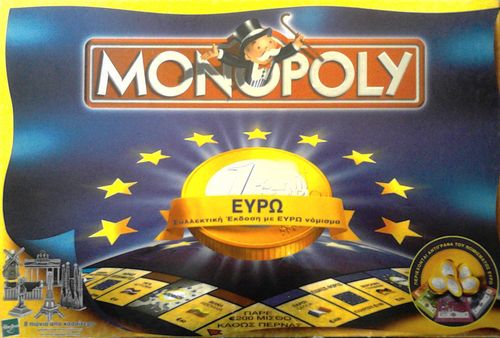
Monopoly: Euro
Monopoly: Euro Rulebook
Table of Contents
Table of Contents
Special Rules for the Euro Version
Followed by the classic rules.
The euro, the single European currency, was introduced in eleven different countries on 1 January 1999. What better way to celebrate the event than to have fun with a game in the colours of Europe?
Read the classic game rules first, on page 5 of this booklet, which is the reference rule. You will then find, on page 2, the various changes proposed in this exclusive version, which notably includes euro banknotes.
The Differences
- The values of the properties are converted into euros, and the presentation of the banknotes is inspired by that of the euro.
- There are 8 pewter tokens, each representing one of the following prestigious monuments: the Palace of Westminster in London, the Eiffel Tower in Paris, the Brandenburg Gate in Berlin, the Leaning Tower of Pisa, a Dutch windmill, the Manneken Pis in Brussels, the Temple of the Sagrada Família in Barcelona, and the Parthenon in Athens.
- Movement around the board is the same, but instead of streets, you buy European capitals.
- The four railroads are replaced by the four most frequently used airports in Europe, and the two utilities are replaced by the European Parliament and the European Court of Justice.
The Game Board
The countries appear in the order in which they joined the European Union. The most expensive properties are the countries that were at the origin of this union. For countries that joined at the same time, we ranked them by the population size of their capital. You will notice that some countries are not yet members, but their position on the board reflects the date on which they applied to join the European Union.
Europe and Its Different Faces
Today, Europeans are increasingly close to one another since the European Union has grown. However, each country wishes to keep its own identity. That is why we offer eight tokens, each reflecting a given country.
The Eight Monuments (Tokens)
The booklet gives a short note on each of the eight monuments represented by the tokens. Each note is reproduced here in order.
The Palace of Westminster – United Kingdom
Since 1550, the Palace of Westminster in London has been the seat of the two chambers, called the House of Lords and the House of Commons. The famous clock tower, adjoining the two chambers, houses the no less famous Big Ben, whose mass reaches 14 tonnes and which chimes every hour.
In April 1951, the Treaty of Paris is signed by six countries: Belgium, France, Germany, Italy, Luxembourg and the Netherlands. This gives birth to the European Coal and Steel Community, the first step towards European union.
The Eiffel Tower – France
Erected in 1889, Gustave Eiffel's tower measures nearly 300 m and is among the monuments known throughout the world. It was built for the Universal Exhibition of Paris and has symbolised France since that date. You can reach the top of the tower by lift or, if you prefer, by climbing the staircase of 1,652 steps!
In 1957, the six founding countries create the European Economic Community (EEC) and the European Atomic Energy Community (EAEC).
The Brandenburg Gate – Germany
Built between 1788 and 1791 by King Frederick William II, the Brandenburg Gate in Berlin has always been a magnificent symbol of division, union and controversy. The goddess Victory, who drives a four-horse chariot, was originally sculpted completely nude but, following public protests, she was covered with a garment.
In January 1973, Denmark, Ireland and the United Kingdom join the EEC.
The Leaning Tower of Pisa – Italy
Begun in 1173, the white marble tower was already leaning before it even reached 10 metres in height. Nevertheless, work continued and the tower was completed in 1350. Defying the laws of gravity, the tower has attracted many visitors, no less famous, such as Galileo for example. The scientist climbed to the top of the tower to carry out an experiment on the speed of falling objects. Today, the tower leans 5 metres and is closed for restoration and foundation work.
In January 1981, Greece becomes the 10th member state of the EEC, and in January 1986 it is the turn of Portugal and Spain.
The Windmills – Netherlands
The first windmill appeared around 1350 and was used to pump water to keep the polders dry. Other models were used to grind grain, saw wood or make paper. Given their growing number on the low-lying landscape of the country, windmills became the undisputed symbols of the Netherlands.
In 1992, further measures were taken towards economic and political unity, leading to the signing of the Maastricht Treaty. This gave birth to the European Union we all know today.
The Manneken Pis – Belgium
In 1619, the city of Brussels asked the sculptor Jérôme Duquesnoy to make a new bronze statue of the Manneken Pis to replace the old one, which had been damaged by the weather. Nobody really knows the origins of the little man, although many legends have been told about him. On great occasions, the Manneken Pis wears a costume; his wardrobe contains at least 600 outfits, from the national costume to that of Saint Nicholas!
On 1 November 1993, the Maastricht Treaty comes into force after ratification by the member states.
The Temple of the Sagrada Família – Spain
Construction of this extraordinary temple in Barcelona began in 1882. The celebrated Catalan architect Gaudí took over the leadership of the project in 1883. Gaudí devoted most of his career to building this temple, but he saw little more than the crypt, as he was knocked down by a tram in 1926. The temple is still not finished today, but work has resumed and Gaudí's work will finally see the light of day.
On 1 January 1995, three new countries, Austria, Finland and Sweden, join the European Union, bringing the number of member states to 15.
The Parthenon – Greece
Begun in 447 BC, this magnificent piece of architecture was erected on the Acropolis hill in Athens for the virgin goddess Athena. The word "Parthenon" actually means "chamber of the virgin". In 1687, during the bombardment of the Acropolis by the Venetians in their battle against the Turks, a gunpowder store in the temple exploded, turning the Parthenon into the most magnificent ruin of classical architecture.
On 1 January 1999, France, Belgium, Germany, Luxembourg, the Netherlands and Italy use the euro as their currency. So do Ireland, Spain, Portugal, Austria and Finland.
Classic Rules
The booklet's reference rules, which the euro version follows except for the changes listed above.
Contents
Game board, property cards, the banker's tray containing the euro banknotes, 2 dice, 8 pewter tokens, 16 Chance cards and 16 Community Chest cards, 32 houses and 12 hotels.
Note: The tokens are made of the highest-quality pewter. As pewter is a very flexible metal, the tokens may be slightly deformed. To restore their original shape, simply bend them back in the opposite direction.
The Game in Brief
Monopoly is the game in which you buy, rent and sell properties in order to increase your wealth, the richest player being the winner. Starting from the GO square, move your token around the board according to your dice roll. When you arrive on a square that does not yet belong to anyone, you may buy it from the bank. If you decide not to buy it, the property will be offered to the other players in an auction and will go to the highest bidder. Players who own properties receive rent from opponents who stop on their land. Building houses and hotels considerably increases the rent you can collect for your properties; so it is advisable to build on as many sites as possible. If you need more money, the bank can lend it to you through mortgages on your properties. You must always follow the instructions given by the Community Chest and Chance cards. Sometimes you will be sent to jail.
Object of the Game
To be the only player who has not gone bankrupt.
Quick Play Rule
Monopoly can also be played quickly. See the paragraph "Rule for a faster game" (p. 11).
Game Preparation
- Put the houses, hotels, property cards and banknotes into the box, sorted by value.
- Separate the Chance and Community Chest cards. Shuffle them and place them face down in the places indicated on the game board.
- Each player chooses a token and places it on GO.
- The banker and the bank. One of the players is elected banker. If there are more than 5 players, the banker may choose to assume only this role.
The banker gives each player 1,500 euros, distributed as follows:
- 2 × 500 euros
- 4 × 100 euros
- 1 × 50 euros
- 1 × 20 euros
- 2 × 10 euros
- 1 × 5 euros
- 5 × 1 euros
The banker also looks after the property cards, houses and hotels until they are bought by players. In addition, the bank pays salaries and bonuses, lends money against mortgaged properties, and collects money from taxes, fines, loans and interest. In the case of an auction, it is the banker who conducts the sale.
The bank never goes bankrupt: it can put into circulation as much money as necessary, in the form of written IOUs on ordinary paper.
- The players roll the two dice. The player who scores the highest goes first, then the turn passes to the player on his left, and so on.
A Game of Monopoly
On your turn, roll the two dice and advance by as many spaces as the number of points shown on the dice. The space where you stop determines what you have to do. Two or more tokens may stop on the same space at the same time. Depending on the space where you stop, you may:
- buy a property,
- pay rent to the owner,
- pay taxes,
- draw a Chance or Community Chest card,
- go to jail,
- rest in Free Parking,
- collect your salary of 200 euros.
Doubles
If you roll a double, carry out the usual actions on the space where you stop, then roll the dice again. If you roll three doubles in a row, go to jail immediately.
Passing "GO"
Each time you pass or stop on GO, you receive 200 euros from the bank. It is possible to collect two salaries during the same turn if, for example, you draw a Chance or Community Chest card just after passing GO, and that card tells you to "Advance to GO".
Buying Properties
If you land on a property that does not belong to another player, you may buy it. If you decide to buy it, pay the price shown on the space to the bank. In exchange, as proof of this acquisition, you receive a property card, which you must keep face up in front of you. If you decide not to buy it, the banker must immediately open an auction, starting at any price set by a player wishing to buy. The property goes to the highest bidder. Even if you refused to buy the property at its initial price, you may take part in the auction.
Being an Owner
Owning a property entitles you to collect rent from every tenant who stops on your land. You may build on any property once you own all the properties of the same colour, that is, as soon as you have the monopoly on it.
Landing on a Property Already Owned
If you land on a property that has been bought by another player, that player may charge you rent. The owner must ask you for the rent before the second player after you has rolled the dice. The amount of rent is shown on the property card and varies according to the number of buildings on the property. If all the properties of the same group (properties of the same colour) belong to the same player, the rent is doubled for each property of that group on which there is no construction. However, an owner who possesses a whole group cannot receive this doubled rent if one of the properties is mortgaged. On properties where houses and hotels have been built, the rent to pay is shown on the corresponding property card. No rent is due on a mortgaged property.
Landing on a Utility
If you land on a utility, you may buy it if it has not yet been bought. As with other properties, pay the amount due to the bank. If it already belongs to another player, that player may ask you to pay rent according to the points obtained on the dice. If the owner has only one of the two utilities, the rent is the total of your dice multiplied by 4. If the owner has both utilities, you must pay 10 times the total of the dice. If you are "sent" to this space by a Chance or Community Chest card, you must roll the dice again to determine the amount to pay.
Landing on a Railroad
If you are the first to land on a railroad, you may buy it. Otherwise, it will be put up for sale by the banker in an auction in which you may take part. If the railroad already belongs to another player, you must pay the amount shown on the property card. This amount varies according to the number of railroads held by that player.
Landing on a Chance or Community Chest Space
Stopping on one of these spaces means you must take the card on top of the corresponding pile. These cards may ask you to:
- move your token,
- pay a certain sum, such as taxes,
- receive money,
- go to jail,
- get out of jail free.
You must follow the instructions on the card and act immediately after putting the card back at the bottom of the pile. If you draw a "Get Out of Jail Free" card, you may keep it until you decide to use it, or sell it to another player.
Note: a card may ask you to move to another space. If you pass GO, you receive 200 euros. You do not pass GO when you are sent to jail.
Landing on "Income Tax" and "Luxury Tax"
If you land on one of these spaces, pay the amount shown to the bank.
Free Parking
If you land on this space, you may rest there until your next turn, or continue your transactions normally (for example, collect rents, build on your properties, and so on).
Jail
You are sent to jail if:
- you land on the "Go to Jail" space,
- you draw a Chance or Community Chest card that tells you to "Go to Jail",
- you roll three doubles in a row.
Your turn ends when you are sent to jail. When this happens, you do not receive a salary, even if you pass GO.
To get out of jail, you must do one of the following:
- pay a fine of 50 euros and play on the next turn,
- buy a "Get Out of Jail Free" card from another player, at a price agreed between you,
- use a "Get Out of Jail Free" card, if you have one,
- wait in jail for three turns, rolling the dice on each turn to try to roll a double. If you roll a double, leave jail and advance using that roll of the dice.
If after the three turns you have not rolled a double, pay 50 euros and move your token according to your dice roll. While you are in jail, you may still collect your rents. If you are not "sent to jail" but simply land on the Jail space, you are a visitor and suffer no penalty.
Houses
Once you own the title deeds of all the properties of one colour, you may buy houses to build on these properties. This increases the rent you charge the tenants. The price of a house is shown on the property card.
You may buy when it is your turn or between the turns of other players. You must build evenly. You may not build a second house on a property until you have built a house on every property of that group, and so on, until each property of the group has four houses. Houses must also be sold evenly. You may buy or sell, at any time, as many buildings as you wish, as long as your finances allow it. No house may be built on a property if one of the properties of the group is mortgaged. If you own all the properties of a group (properties of the same colour) and only one or two of them are "built", you may charge the double "bare site" rent for the property or properties of the group that have no building.
Hotels
You must have four houses on each site of a group before you can buy a hotel. Hotels are bought in the same way as houses. A hotel costs four houses, which are returned to the bank, plus the price shown on the property card. Only one hotel may be built on each property.
Building Shortage
If there are no houses left to sell, you must wait until other players return some to the bank before you can buy any. Likewise, when you sell hotels, you may not replace them with houses if none remain.
If only a limited number of houses or hotels remain, and two or more players wish to buy them, the buildings are sold at auction and awarded to the highest bidder. The auction starts at the lowest price shown on the property card.
Selling Properties
You may sell properties to any other player at a price agreed between you. However, no property may be sold to another player if there are buildings on any property of the same group. If you want to sell a property belonging to a group, you must first sell all the buildings on the sites of that group to the bank. Houses must be sold evenly, in the same way they were bought (see "Houses" above). Houses and hotels may not be sold to other players. They must be sold to the bank for half their value, as shown on the property card, and they may be sold at any time. For hotels, the bank pays half the price of the hotel, plus half the price of the four houses that were given to the bank when the hotel was bought. All hotels of the same group must be sold at the same time.
If you only need a little cash, hotels may be exchanged with the bank for houses in order to recover money. To do this, exchange your hotel for four houses and receive half the value of the hotel in cash. A mortgaged property may not be sold to the bank, only to other players.
Mortgages
If you have no money left and must pay a debt, you may mortgage a property. To do this, first sell all the buildings on that property to the bank. To mortgage a property, turn its property card face down and receive the value of the mortgage from the bank; this value is shown on the back of the card. When you want to lift the mortgage, you must pay this value plus 10% interest. While you have mortgaged a property, you still hold it. No player may acquire it without your agreement, even by paying the mortgage to the bank. You may not collect rent on a mortgaged property, but you continue to collect rent on the other properties of the same group. You may nevertheless choose to sell a mortgaged property to another player at a price agreed between you. The buyer may then decide to lift the mortgage immediately by paying the value of the mortgage plus 10% interest. When no property of a group remains mortgaged, the owner may start building on those properties again.
Bankruptcy
If you owe more money to the bank or to a player than you can raise, you are declared bankrupt and eliminated.
If your debt is to the bank, the bank takes your money and property cards. The banker then sells the property cards one by one at auction; each property goes to the highest bidder. You must put "Get Out of Jail Free" cards back at the bottom of their respective piles. If you are made bankrupt by another player, your houses and hotels are sold to the bank at half their original value, and that player takes your money, your property cards and your "Get Out of Jail Free" cards. If you have mortgaged properties, the player who takes them must immediately pay 10% interest on each mortgage, and then choose either to keep the mortgages on those properties or to settle them at once.
Notes on Play
If you owe a rent greater than what you can pay in cash, you may settle part of your debt in cash and another part in properties without buildings. The creditor may then accept one or more properties (including mortgaged ones) at a value higher than their real value, in order to complete a whole group, or to prevent another player from gaining control of that property.
If you own properties, it is up to you to check that the other players pay you the rents owed to you.
Only the bank may lend money to a player, and only by means of mortgages.
No player may lend money to, or borrow money from, another player.
The Winner
The last player remaining in the game is the winner.
Rule for a Faster Game
-
During the setup of the game, the banker shuffles the property cards. The player to the left of the banker then cuts the cards, and the banker deals two property cards to each player (including the banker, if he takes part in the game). Players immediately pay the price shown on the two properties they have just received. The game then begins according to the rules of a normal game.
-
In this "short game", you need to build only three houses (instead of four) on each property before you can buy a hotel.
The rent collected for a hotel remains the same as in the standard rule. If you wish to sell a hotel back, its value is reduced by half compared with the purchase price, plus half the value of each of the three houses.
- End of the game. The first player to go bankrupt withdraws from the game, and the game ends when a second player goes bankrupt. The bankrupt player transfers all of their assets to their creditor (the bank or a player).
Each remaining player then values their wealth according to:
- the sum of the banknotes they hold,
- their properties, utilities and railroads, at the price shown on the game board,
- their mortgaged properties, valued at half the value shown on the game board,
- their houses, valued at the purchase price,
- their hotels, valued at the purchase price, which includes the value of the 3 houses given in exchange.
The winner is the richest player.
Timed Game
Before starting the game, agree on a time limit for the end of the game. The richest player at the agreed time is the winner. At the start of the game, the property cards are shuffled and cut, and the banker gives two cards to each player. Players immediately pay the bank the price of these properties, and the game continues normally.