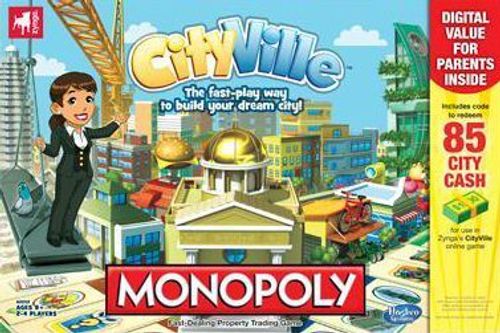
Monopoly: CityVille
Monopoly: CityVille Rulebook
Table of Contents
Table of Contents
- How to Win
- Setup
- Buildings
- Before You Play
- I Am in Jail
- Trading Properties with My Neighbours
- Visit to the Bank: Paying a Tax or Fine to the Bank
- Earning Money: Needing Money to Buy Goods or to Pay Another Player
- Your Turn: Roll the Dice and Move Forward
- Decorations and Buildings on a Property You Have Just Bought
- Decorations
- I Owe Money but I Have None
How to Win
The first player to own 4 skyscrapers wins.
Setup
Each player receives three bills of each colour.
Determine which player starts, and begin building the city of your dreams! Each player chooses a token and places it on the Start space.
Buildings
The game includes three types of buildings: residential buildings, commercial buildings and official buildings. They all have the same purchase price, pay the same rent, and may be mixed. The difference: Visitor cards only affect commercial buildings and official buildings. Gains or penalties can therefore be greater for commercial and official buildings.
To buy a skyscraper, you must already own the three other types of buildings. Buying a skyscraper costs more than other buildings, but remember: to win you must own four skyscrapers!
The four building types are shown on the leaflet as: Residential (red), Commercial (blue), Official Buildings (yellow), and Skyscraper (grey).
Where to Build?
Buildings are built in the centre of the board. Arrows of the colour of the properties indicate where you should place your buildings.
Buildings stack on top of one another. The skyscraper can only be placed last, on top of the three buildings.
Before You Play
Don't roll the dice too quickly! Before rolling the dice, you may carry out the actions below:
Building a building if I don't own all the properties of a colour group?
Yes, but you may only build on a property that you own. Buy a building from the Bank and build it on your property. It will remain part of your property for the rest of the game. To learn more about the different types of buildings, see page 2.
Tip: if you own the Bridge or the Dam, each property costs $25 less to buy.
Tip: the cost of buildings and skyscrapers is shown on the Expansion Titles of each property.
I own all the properties of one colour group
Build as much as you like, on whichever properties you wish. You may combine different types of construction and stack buildings in the order you choose. You may even build unevenly between the different properties, so there may be more buildings on one property and fewer on another property of the same colour.
Building skyscrapers
You must own all the properties of one colour group and have three buildings on the property where you decide to build a skyscraper.
Tip: if you own both the Bridge AND the Dam, each skyscraper costs $100 less.
I Am in Jail
If you start your turn in jail, you may pay a fine of $50 to the Bank so that you are only Simply Visiting, and wait until your next turn to roll the dice normally. See the paragraph "Visit to the Bank" explaining what happens when you pay a fine or fees to the Bank.
Trading Properties with My Neighbours
In order to build skyscrapers, you must own all the properties of one colour group.
To gather all the properties of one colour, you must negotiate with the other players. You may (and should) negotiate with the other players during the turns of the other players, but you may only exchange properties with your neighbours at the start of your own turn. If several people are involved in a trade, one of them must be the player who is about to play.
You may exchange properties with each other, for money, or for a combination of both. Buildings and decorations built remain on the property during the exchange. See the paragraph "Decorations" for more information.
Visit to the Bank: Paying a Tax or Fine to the Bank
A visit to the Bank is required if you must pay a fine or a tax because of a special space, a Visitor card, or to get out of jail. You may take advantage of this visit to buy a property that does not belong to any player, at the price shown on the board. This lets you form colour groups more easily and therefore build skyscrapers more quickly.
Earning Money: Needing Money to Buy Goods or to Pay Another Player
You may sell up to two properties that you own to the Bank for $50 less than their original value, whatever buildings or decorations are on those properties. The buildings and decorations present on the property remain on the property. The next player who buys the property recovers the decorations and the buildings. You may only sell two properties during your turn, so if you have already sold two properties at the start of your turn and still do not have enough money at the end of your turn, you have lost!
Your Turn: Roll the Dice and Move Forward
I am in jail. I do not want to pay to get out.
Roll the dice. If you roll a double, you get out of jail and move your token forward by the number of spaces indicated by the dice. If you do not roll a double, your turn is over. You have three turns to try to roll a double and get out of jail. If on your third try you still do not roll a double, you must pay $50 to the Bank, roll the dice and move forward as many spaces as indicated by the dice. See the paragraph "Visit to the Bank" for what happens when you pay a fine.
I am ready to play!
Roll the dice. Move clockwise, by the number of spaces indicated by the dice, and carry out the actions indicated on the space where you land. If you roll a double, carry out the action of the space where you land and roll again. If you roll a double three times in a row, go straight to jail.
I pass or stop on the Start space.
Receive $200 from the Bank.
I stop on a property belonging to no one.
Great! You may then buy this property if you wish. Pay the Bank the amount shown on the game board and you will receive the Expansion Title in exchange. If you need money to buy a property, see the paragraph "Earning Money".
I stop on a property belonging to another player.
If you are the owner of the property, you have nothing to do. If this property is a bridge or a dam owned by a neighbour, you have nothing to do either. These spaces do not generate rent. For all other properties, pay your neighbour the rent shown on the Expansion Title. The amount of rent depends on the decorations, buildings or skyscrapers present on the property. If you need money to pay your neighbour, see the paragraph "Earning Money".
I stop on a ZAC Pack or Cityville Bank space.
Pay the Bank the amount shown on the space. See the paragraph "Visit to the Bank" for what happens when you pay a tax to the Bank.
Decorations and Buildings on a Property You Have Just Bought
You are lucky! Another player had to sell their property to the Bank. If the property has several buildings and/or decorations, you benefit from them for free when you buy the property at its original price as shown on the game board.
I stop on the Visitor space.
Draw the card from the top of the pile and follow the instructions. Then put the card back underneath the pile, unless the card tells you to keep it. If you must pay an amount to the Bank, see the paragraph "Visit to the Bank".
I stop on the Mystery Gift space.
Mystery Gift spaces are fun. They offer decorations that increase the value of properties. Draw two cards from the top of the pile: give the first to the player of your choice and keep the second for yourself. To learn how to use these cards, see the paragraph "What are decorations?"
Decorations
"Decorations" are elements of the Mystery Gift cards, which increase the value of a property. If you receive one, choose the decoration you prefer and place it on one of your properties. If you obtain a Mystery Gift card and you have no properties, keep it until you have one. The rent you collect for a property with a decoration increases by the amount shown on the Mystery Gift card. Decorations remain on the property, even if the property is exchanged with another player or sold to the Bank. A property may carry several decorations on the same plot.
I Owe Money but I Have None
Go to the paragraph "Earning Money". If you owe more money than you can raise (you have already gained the maximum money possible this turn, or the money you could earn would not be enough), you are declared bankrupt and lose the game. If you owe money to another player, give that player all your remaining money and properties. That player then owns your properties. If you owe money to the Bank, give all your money and all your properties to the Bank. The other players may then buy the properties from the Bank and benefit from the decorations and buildings present on the properties.