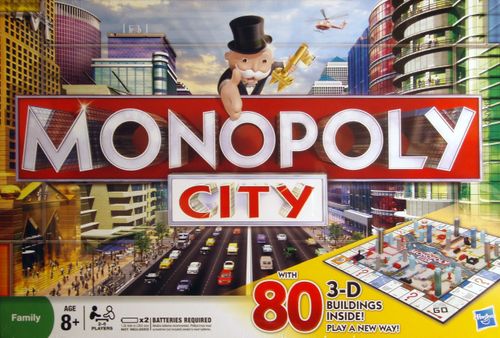
Monopoly City
Monopoly City Rulebook
Table of Contents
Table of Contents
- New Rules (The Most Important)
- How to Win
- Contents of the Game
- Setup
- How to Play
- The Spaces of the Board
- Auctions
- Building
- The Buildings
- Stadiums, Skyscrapers and the Monopoly Tower
- Building Permits
- Bonus and Nuisance Buildings
- Collecting Rent
- Deals, Mortgages and Bankruptcy
- Free Parking and Jail
- End of Game
New Rules (The Most Important)
You move around the board by buying the districts of the city and by constructing buildings. Each district is represented in the centre of the board. If you land on a district that nobody owns yet, you may buy it, or ask the banker to put it up for auction.
The basic rules:
- You may build when it is your turn.
- Construct residential and/or industrial buildings on your districts to increase the amount of your rent.
- Residential buildings cost less to buy, but if another player decides to build a nuisance building (such as a wastewater treatment plant or a landfill) on your district, your residential buildings are no longer worth anything at all. Industrial buildings cost more to buy but remain a safer investment.
- To protect your districts, build schools, water towers and other bonus buildings (see the Bonus and Nuisance Buildings chapter).
Additional rules:
- If you buy two districts of the same colour group, you may build a stadium on them, which increases your rents.
- If you buy all the districts of one colour group, you may build a skyscraper, which doubles the rents of all the districts in that group.
- If you buy all the districts of two different colour groups, you may build the Monopoly Tower, which doubles the rents of all your districts.
You are now ready to enter the world of Monopoly City!
How to Win
The winner is the player who is the richest at the end of the game, by buying districts and constructing buildings to collect the largest possible rents. See the End of Game section for how to calculate your wealth.
Contents of the Game
The box contains: 1 game board, 6 tokens, 80 buildings, 22 property cards, 25 Chance cards, 6 rules reminder cards, 1 rent exemption card, 2 dice, 1 bundle of MONOPOLY money and 1 multi-function electronic unit.
Each player starts the game with:
- 6 x M5M bills
- 6 x M1M bills
- 2 x M500k bills
- 2 x M200k bills
- 2 x M100k bills
- 1 x M50k bill
- 5 x M10k bills
Put the remaining money in the compartments of the box provided for this purpose.
The components pictured in the booklet are: residential buildings (1, 2 and 3 building pieces), industrial buildings (1, 2 and 3 building pieces), stations, stadiums, skyscrapers, the Monopoly Tower, bonus buildings and nuisance buildings.
Setup
Do NOT place anything in the centre of the board, as that is the location of your future buildings!
- Place the game board in the middle of the players, on a flat surface.
- Remove the rent exemption card from the Chance deck and place it on the FREE PARKING space.
- Give each player a rules reminder card.
- Shuffle the Chance cards and make a face-down pile beside the game board.
- Each player chooses a token and places it on the GO space.
- Elect one player as the banker.
The Electronic Unit
- ENCHÈRES (AUCTION) button: If a player lands on a district that nobody owns yet and decides to auction it, the banker presses this button to start the auction. See page 8.
- ON/OFF button: Turns the unit on and off, located underneath.
- CONSTRUCTION button: Press this button when you want to build on one of your districts. The electronic unit then gives you your building permit for 1, 2 or 3 buildings, or to build a station. See page 8.
The Banker
The banker manages the money, the property cards, the buildings and the auctions. Before you start playing:
- Group the property cards of the same colour and arrange them in the compartments of the box provided for this purpose.
- Group the buildings of the same colour and place them beside the game board.
How to Play
-
Define the length of the game first:
- You can play until only one player remains who has not gone bankrupt (this takes about 2 hours, depending on the number of players),
OR
- you can set a duration (1 hour, for example). The electronic unit tells you each hour played.
-
Switch on the electronic unit using the ON/OFF button underneath it.
-
The players each roll the two dice. The player with the highest total goes first, and play continues clockwise. Tip: to avoid knocking over all the buildings on the board during the game, roll the dice in the compartment of the game box.
-
When it is your turn, follow these three steps:
- A. Roll the dice and move forward as many spaces as the dice indicate.
- B. Look at what the space you land on indicates.
- C. Build buildings if you wish. You may build on any of your districts when it is your turn (see page 8).
-
If you roll a double, play it, then roll again and repeat steps B and C (you may build again after each roll of the dice).
Your turn is then over. The player to your left rolls the dice next.
Time Limit
- As the time limit approaches, the electronic unit starts beeping more often. To continue playing, switch the unit OFF and then back ON (ON position). A new hour will then begin.
- At the end of the game, each player adds up their wealth (see page 16). The richest player wins the game!
The Spaces of the Board
A district that nobody owns:
- You may buy it at the price shown on the board space. Pay the amount demanded to the banker,
OR
- ask the bank to auction this district (if you do not wish to buy it at the price shown, you MUST put it up for auction).
A district owned by another player: You must pay them the rent. The amount of rent depends on the number of buildings constructed on that district (see page 13).
A district that you already own: You cannot do anything, unless there is a station on it. If there is indeed a station, you may move to any other district with another station on it, and may thus buy it or put it up for auction (if that district belongs to nobody). If that district belongs to another player, you must pay them rent.
AUCTIONS: You may ask the bank to open an auction for any district that nobody owns (see page 8).
INDUSTRIAL TAX: If you own an industrial building, you must pay the amount shown on the board space. If you do not own any, you have nothing to pay.
BUILDING PERMIT: You may construct a nuisance building OR a bonus building (see page 11).
FREE PARKING: If you stop on this space, take the rent exemption card (see page 15).
CHANCE: Take the Chance card from the top of the pile and follow its instructions.
JAIL: Go directly to jail without collecting any money if you pass the GO space (see page 15).
Auctions
- The banker must press the AUCTION button on the electronic unit to start the auction. You have 50 seconds to complete the transactions.
- The bidding starts at the amount set by the player who decided to put this district up for auction, with a minimum of M10k.
- Each player may make a bid higher than the current one at any time, including the player who started the auction.
- When the electronic unit beeps and the red light starts flashing faster, you have 5 seconds left to complete the auction!
- The player who made the highest bid when the light goes out wins the district and pays the banker for it.
Building
- Press the CONSTRUCTION button on the electronic unit.
- The number that appears is the maximum number of buildings you may construct this turn. For example, if the number 3 appears, you may construct up to 3 buildings. If the unit displays the station logo, you have permission to construct a station only (see page 9).
- You may construct residential buildings, industrial buildings or a mixture of both (see page 9). You must buy them from the bank at the price shown on the property card(s).
You may construct on ANY district that you own. You may also construct on several districts in the same turn. You may press the CONSTRUCTION button only once in the same turn.
The Buildings
To increase the value of your rents, build up to 8 buildings per district. You may construct residential buildings, industrial buildings or a mixture of the two. To find out how many buildings (1, 2, 3 or a station) you are allowed to construct, press the CONSTRUCTION button on the unit.
Residential Buildings (Grey)
- Residential buildings cost less to buy than industrial buildings.
- If another player constructs a nuisance building on one of your districts, all residential buildings that may be there lose their value and no longer count in the calculation of the rent amount (see the chapter on nuisance buildings).
Industrial Buildings (Blue)
- Industrial buildings cost more to buy than residential buildings.
- However, industrial buildings are a safer investment: if another player decides to construct a nuisance building on your district, the industrial buildings on that district are still counted when calculating the rent to be collected.
Stations
When, after pressing the CONSTRUCTION button on the electronic unit, the station logo appears, you may construct a station on the district of your choice free of charge!
- Place the station token on the district space, and not in the middle of the board as with the other buildings.
- Stations let you make moves that take you past the GO space more often, so you collect your salary sooner! Stations also let you travel to a part of the board where you wish to buy, and avoid a district where rents are high.
- When you stop on a space with a station, you may move to ANY other space that also has a station.
- To use this rule, you must land on a space with a station during your turn. If you start your turn on such a space, you must play normally.
- If you move onto a district with a station owned by another player, you must pay them rent before leaving that space.
Tip: If you have no more room to construct on one of your districts, you may exchange a token worth 1 building plus a token worth 2 buildings for a tower worth 3 buildings.
Stadiums, Skyscrapers and the Monopoly Tower
Stadiums
- Stadiums come in addition to the 8 buildings allowed per district.
- Once you own 2 districts of the same colour group, you may build a stadium on one of these 2 districts during your turn.
- You receive M1M per stadium you own each time you pass the GO space (in addition to your salary)!
- COST: M2M
- Building a stadium on your district lets you increase your income. There are only 2 stadiums in the game, so hurry before the others buy them!
- You may build 1 stadium per colour group.
- Stadiums do not increase the value of your rents.
Skyscrapers and the Monopoly Tower
- Skyscrapers and the Monopoly Tower come in addition to the 8 buildings allowed per district.
- Once you own ALL the districts of one colour group, you may build a skyscraper on any of the districts of that group.
- Building a skyscraper on your district doubles the rent value of all the districts of the colour group. The purchase value of a skyscraper is shown at the bottom of each property card.
- You may build 1 skyscraper per colour group.
- A skyscraper immediately doubles the rent values of the colour group (see the chapter on collecting rent, page 13).
- Once you own ALL the districts of two colour groups, you may build the Monopoly Tower on any of the districts of those 2 groups.
- COST: M7M
- This action doubles the rent of ALL your districts!
Building Permits
Residential and industrial buildings, nuisance buildings and bonus buildings are free and come in addition to the 8 buildings allowed per district.
If you stop on a BUILDING PERMIT space, you must:
- construct a bonus building on one of your districts,
OR
- construct a nuisance building on one of another player's districts (so that their residential buildings lose their value),
OR
- construct a bonus building or a nuisance building on a district that nobody owns yet (if you plan to buy that district, or if you know another player intends to take it).
IMPORTANT: PLACING A BONUS BUILDING ON A DISTRICT PREVENTS ANOTHER PLAYER FROM CONSTRUCTING NUISANCE BUILDINGS ON IT!
Example: if you have built a school on one of your districts, the other players cannot build a power station there, and vice versa.
Bonus and Nuisance Buildings
Bonus Buildings
Protect your districts! Place bonus buildings on your districts to prevent the other players from constructing nuisance buildings on them.
The bonus buildings pictured are: school, park, wind farm and water tower.
Nuisance Buildings
The nuisance buildings pictured are: power station (3 buildings), wastewater treatment plant (3 buildings), prison (4 buildings) and landfill (2 buildings).
- If another player constructs a nuisance building on one of your districts, all residential buildings that may be there lose their value and no longer count in the calculation of the rent amount. However, leave these buildings on the board.
- You may have the nuisance buildings on your districts removed by paying the bank M500k per building (only when it is your turn).
Example: To remove a prison (worth 4 buildings) from one of your districts, pay M2M (4 x M500k) and return the prison building to the bank. You can then count your residential buildings again in the calculation of your rents.
Collecting Rent
When a player stops on a district that belongs to you, here is how to calculate the rent to demand from them:
- You have no buildings: the rent is that of the bare land.
- You own residential and/or industrial buildings: count the number of buildings (note that some pieces count for several buildings) that you have on your district, and demand the corresponding rent shown on the property card.
- You have nuisance buildings on your district: count only the industrial buildings in the calculation.
- You own a skyscraper on one of the districts of that colour group, OR a Monopoly Tower on one of your districts: the amount of your rent is doubled. (If you own both, you cannot double your rent twice!)
If the player you are demanding rent from cannot pay, they must mortgage one of their districts or offer you a deal that will bring you money.
Example of rent calculation: You own the Docks district, the Plein Ouest district and the Station district. A player stops on the Docks space.
You have built on this district:
- 2 residential buildings, which do not count in the rent calculation because another player has placed a nuisance building (a power station) that makes them lose all their value. Value = M0.
- 4 industrial buildings. Value = M3.5M.
- 1 skyscraper on the Station district, which is a district of the same colour group as the Docks, doubles the amount of the rent. 2 x M3.5M = M7M.
TOTAL RENT TO COLLECT: M7M
Deals, Mortgages and Bankruptcy
Deals: You may make agreements with the other players to earn money or to recover the districts you covet!
- When you exchange or sell a district during a deal, you also exchange or sell the buildings that are on it.
- When you wish to propose a deal to another player, press the AUCTION button on the electronic unit. You must reach an agreement with the player to whom you proposed the deal before the time allowed runs out!
Mortgages: If you cannot pay a rent or a tax demanded of you, you may mortgage one or more of your districts to raise money.
Lifting a mortgage: You may lift a mortgage by paying the value of the mortgage to the bank, that is the amount the bank paid you earlier.
Mortgaging a district: The value of the mortgage corresponds to the value of the rent at the moment of mortgaging. When you wish to mortgage a district, turn its property card face down, and the banker must give you the value of the mortgage in banknotes. All the buildings remain on that district.
Once the mortgage is lifted, you may turn the card face up in front of you again, in order to collect your rents and construct buildings once more.
You cannot collect any rent for a mortgaged district.
Bankruptcy: If you owe a debt to the bank or to another player and you have no means of paying, you are declared bankrupt and you are eliminated.
- Debt to another player: that player receives your banknotes, your property cards and all "Get Out of Jail" cards in your possession.
- Debt to the bank: return your property cards to the bank, which will immediately and individually put them up for auction. Finally, you must put the "Get Out of Jail" cards back at the bottom of the Chance deck, and the rent exemption card on the FREE PARKING space.
Free Parking and Jail
Free Parking
If you stop on this space, you may rest until your next turn or continue your transactions normally (for example collecting rents, constructing buildings). At least one space where you will not lose any money!
The rent exemption card
The rent exemption card allows you not to pay a rent demanded by another player!
- When you stop on the FREE PARKING space, take the rent exemption card.
- Use this card when a player demands rent from you.
- Once used, place this card beside the FREE PARKING space.
- If another player lands on the FREE PARKING space before you have used this card, too bad! You have missed your chance, and you must give it to the next player!
Jail
While you are in jail, you may collect your rents and construct buildings, provided of course that your properties are not mortgaged.
You will be sent to jail if:
- you stop on the "Go to jail" space,
- you draw a Chance card that tells you to go to jail,
- you roll three doubles in a row on the dice.
Your turn stops when you are sent to jail. Move to the JAIL space and do not collect a salary when you pass the GO space on the way there.
To get out of jail, you must do one of the following:
- Pay a fine of M500k and play the next turn.
- Use a "Get Out of Jail" card, if you have one.
- Roll the dice and roll a double, when it is your turn.
If you have not rolled a double after three turns, pay the banker M500k, then move your token according to your last roll of the dice.
End of Game
The electronic unit will tell you when the game ends (after one hour). Each player then calculates their wealth:
- By counting their banknotes.
- By calculating the value of their districts. The value of a district is equal to the value of the rent that another player would pay on landing on that space (see page 13).
- By adding up their banknotes with the total value of their districts.
- The richest player wins the game!
The booklet's final page also contains safety notices on the use of batteries in the electronic unit; these are not gameplay and are not transcribed here.