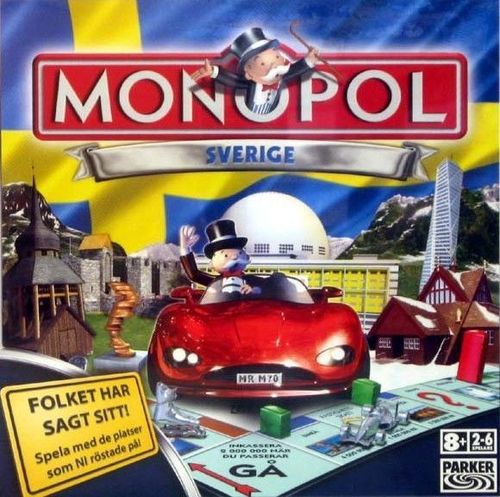
Monopol: Sverige
Monopol: Sverige Rulebook
Table of Contents
Table of Contents
Contents of the Game
- 1 game board
- 6 tokens
- 2 dice
- 32 green houses
- 12 red hotels
- 16 Chance cards
- 16 Community Chest cards
- 28 title deed cards
Banknotes: 10 notes of kr 10,000; 40 notes of kr 2,000; 25 notes of kr 1,000; 20 notes of kr 500; 60 notes of kr 200; 60 notes of kr 50.
Number of Players
Up to 7 people can take part: 6 players and a banker (for the banker's duties, see "Banker" and "Bank").
Course of the Game
The game board is laid out on a table of suitable size, and the cards are placed face down on their spaces on the board. Each player receives one token. Everything else is handled by the bank. One of the players is chosen as the banker. (See below under "Bank" and "Banker".)
Each player receives kr 30,000 in the following denominations: one note of 10,000, six of 2,000, four of 1,000, three of 500, ten of 200 and ten of 50. All remaining money goes to the bank.
If seven people are playing, one player must wait until all the others have received their starting capital, and then makes do with the denominations in which the bank can conveniently pay out their kr 30,000. To save time, all players may receive their starting capital in larger notes, which the bank changes when needed.
All players roll both dice once each, starting with the banker. The player who rolls the highest total begins the game. They place their token on "GÅ" (Go), roll the dice, and move their token in the direction of the arrow as many spaces as the dice show. Then the nearest player to the left rolls. A token stays where it is until its owner's next turn, and the player continues from the space it has reached. One or more tokens may be on the same space at the same time.
Depending on the space the token lands on, the player may be entitled to buy building plots or other properties, or be forced to pay rent (if another player owns the property), pay tax, draw a card, go to jail, and so on.
During the game, players pass around the board several times.
If a player rolls doubles (the same number on both dice), they move the full total as usual and follow the instructions on the space where they land. They then roll again and proceed in the same way from the new space. If a player rolls doubles three times in a row, they do not move their token on the third roll, and must go to jail immediately. (See "Jail".)
Salary
Each time a player lands on or passes "GÅ" (Go) in the direction of the arrow, they receive a salary of kr 4,000 from the bank.
Unowned Property
If a player lands on unowned property (that is, a plot for which no other player holds a title deed), whether directly by rolling the dice or by following the instructions on a drawn card, they may buy that plot from the bank at its fixed price. If they decide to buy, they pay the bank and receive from it the corresponding title deed card, which they place in front of them face up.
If the player prefers not to buy the plot, the bank must immediately offer the property at auction and sell it to the highest bidder. The buyer pays in cash and receives the title deed from the bank. All players may bid at the auction, including the player who initially did not want to buy the plot. Bids may start at any amount.
Owned Property
If a player lands on another player's property, whether directly by rolling the dice or by following the instructions on a drawn card, they must pay rent to the owner in the amount stated on the owner's title deed.
Note: If the property is built on, the rent is higher than if it is unbuilt.
Note: If the property is mortgaged, the owner receives no rent for it. A mortgaged property is marked by turning its title deed card upside down.
Note: If the property owner forgets to demand the rent before the next player has rolled, they receive no rent.
Advantages for Property Owners
It is advantageous to hold the title deeds to all plots within a complete colour group (for example Centrum and Norrmalmstorg, or Folkungagatan, Götgatan and Ringvägen), because in that case the owner may demand double rent for unbuilt plots within the group. (See "Title Deeds".)
If a player owns a complete colour group, they may build houses on its plots.
It is advantageous to own houses or hotels, because the rents for built-up plots are considerably higher than for unbuilt ones.
Chance and Community Chest Spaces
If a player lands on such a space, they take the top card from the corresponding pile and follow its instructions, and then put the card back face down at the bottom of the pile. Only the card "Get Out of Jail Free" is kept until it is used; only after that is it put back at the bottom of the pile. This card may be sold to another player for a price the two agree on.
Tax Spaces
If a player lands on a tax space, they pay the tax to the bank.
Banker
A good auctioneer should be chosen as banker. If the banker, as is usually the case, also takes part in the game, they must keep their own money and the bank's money carefully separate. When more than five players take part, the banker sometimes acts only as the bank and auctioneer.
Bank
For convenience, it is suitable for the banker to keep the bank's assets on a small table beside them, and they may use the game box as a cash box. Apart from money, the bank holds all title deeds, and all houses and hotels until they have been sold to a player.
The bank pays out salaries and commissions, sells plots to the players and hands out the corresponding title deeds, holds auctions, sells houses and hotels, and, on request, lends money against mortgages up to half the value of the plot. The bank is obliged to buy back houses and hotels at half price at any time on request.
Players pay the bank for purchase prices, taxes, fines, levies, loans and interest.
Jail
A player goes to jail: 1) if they land on a space marked "Gå i fängelse" (Go to Jail); 2) if they draw a card marked "Gå i fängelse" (Go to Jail); 3) if they roll doubles three times in a row.
Note: If a player is sent to jail, they cannot collect their salary in the same turn, because from the space where they are they must go directly to jail.
Visiting jail: If during the game a player passes or lands on the jail space without any of the three conditions above applying, they are merely "visiting" the jail and move their token on as normal.
A player is freed from jail: 1) if they roll doubles on either of the first three rolls after going to jail. In that case they immediately move their token on according to the dice; 2) if they buy a "Get Out of Jail Free" card from another player for a price they agree on (or if they already hold such a card, which they drew earlier from the pile); 3) if they pay kr 1,000 in fines BEFORE making their first or second roll after going to jail; 4) a player may not remain in jail for more than three rolls after going there. Immediately after the third roll they must pay kr 1,000 in fines, unless they roll doubles. In that case they are freed and move as normal according to the dice (but without an extra roll).
A player may buy and build houses, sell or buy property, and collect rent even while they are in jail.
Houses
Houses may be bought only from the bank, and may be built only on plots in a complete colour group that the player owns.
Example: If a player has become the owner of Folkungagatan, Götgatan and Ringvägen, that is, a complete colour group, they may at any time buy one or more houses from the bank and build them there. If they buy only one house, they may place it on any of these plots. The next house they buy must be built on an unbuilt plot, either within this colour group or within any other colour group the buyer owns. The price of each house is stated on the buyer's title deed for the plot. For the unbuilt plots of their complete colour group, the owner may demand double rent from other players who land there.
A player may buy and build as many houses at any time as they consider necessary or can afford, but they must build evenly. That is, they may not build more than one house on each plot in a colour group until all the plots have at least one house. Then they may begin a second row of houses, and so on, up to a maximum of four houses on each plot. However, for example, a player may not build three houses on one plot if they have only one house on another plot in the same group.
Hotels
A player must have four houses on each plot of a complete colour group before they may build a hotel. Once they have this, they may buy a hotel from the bank and build it on any plot within the colour group. As payment, they hand over to the bank the four houses on that plot and the cash amount stated for a hotel on the title deed. (Building a hotel is extremely advantageous because of the very high rents that can be collected. Only one hotel may be built on each plot.)
Stagnation in Construction
If the bank has no house for sale, the would-be builder must wait until another player returns or sells a house to the bank.
If only a limited number of houses and hotels are available, and two or more players wish to buy more than the bank has for sale, the available houses or hotels must be sold at auction to the highest bidder.
Sale of Properties etc.
Unbuilt plots, railway stations and utilities may be sold to any player as a private transaction, at whatever price the owner can get. However, no plot may be sold to another buyer while there are buildings on any other plot of the same colour group. All such buildings must be sold back to the bank before the owner may sell any plot of that colour group.
Houses and hotels that were once bought may be sold back only to the bank, but this may be done at any time, and the bank must pay half the original price. For hotels bought back, the bank pays half the cash price of the hotel plus half the cash price of the four houses that were given as part payment for the hotel (that is, 5 times half the house value).
Mortgages
Mortgage loans may be granted only by the bank. The mortgage value is stated on each title deed. The interest rate is 10% and is paid when the loan is received. The amount is rounded to the nearest 50 kronor. If a mortgaged plot is sold, the new owner may redeem the loan immediately if they wish, but must pay 10% interest. If they do not redeem the loan, they still pay 10% interest; if they redeem it later, they pay 10% interest on top of the capital debt as well.
(Note: The rules on interest may, especially for beginners, be omitted entirely!)
Houses and hotels may not be mortgaged. All buildings on a plot must be sold back to the bank before the plot can be mortgaged. The bank pays half the purchase price (see above).
If a player wants to build on a mortgaged plot, they must redeem the mortgage plus 10% interest, and buy a new house from the bank at the full price.
Bankruptcy
A player who is bankrupt, that is, who owes more than they can pay, must hand over everything they own to their creditors and leave the game. In this case, houses and hotels that they own are returned to the bank, which pays half their price, and this money is handed to the creditor.
If a bankrupt player hands a mortgaged plot to their creditor, the new owner must immediately pay the bank 10% interest on the loan. At the same time, they may, if they wish, redeem the mortgage by paying the capital debt (regarding the omission of the interest, see above).
If a player is not able to raise enough money to pay their taxes and levies, even by selling their houses and mortgaging their plots, the bank takes over all their assets and sells everything by auction to the highest bidder, except the buildings. The player leaves the game.
The last remaining player has won.
Miscellaneous
If a player owes more in rent than they can pay in cash, they may pay partly in cash and partly in plots. In this case it sometimes happens that the creditor accepts certain plots at a considerably higher price than the assessed value, namely if they are located such that the creditor needs them as building plots, or if the creditor wants to prevent another player from gaining control of them.
Property owners must be careful to collect their rents on time! Do not help other players!
The bank lends money only against mortgages. Players may not lend each other money or property.
Short game: At the start of the game, the banker may shuffle the deck and give each player two or more title deeds, at their assessed price. This puts rent money into circulation faster and speeds up the game.