Monochrome Chess
Monochrome Chess Rulebook
Table of Contents
Table of Contents
Setup
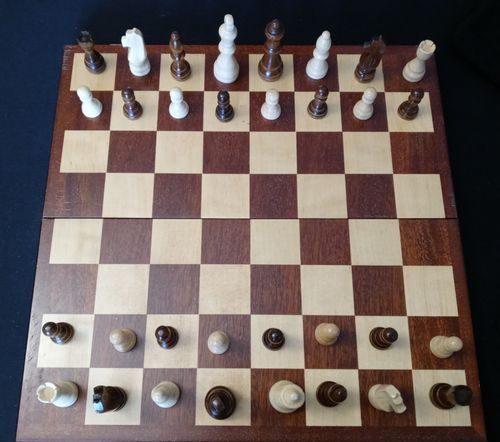
To play Monochrome Chess, you will need 2 identical Chess sets. Set up as you would for Normal Chess, except use the same color on both sides of the board. If you're using white, for example, put the black pieces away - you won't need them.
If you have a folding Chess board, set it up so that the fold line runs parallel to the rows of Chessmen. This will make the Centerline (a theoretical boundary used in Monochrome Chess) more noticeable.
The usual rules for setting up the board, of the white square corner being positioned on the right side and the Queens going on their own color, are discarded. Just make sure that the two Queens face each other, i.e. one goes on her color, the other one does not.
Playing The Game
To decide who goes first, hold your hands out to your opponent, with one hand empty and the other concealing a single pawn. Tell your opponent to choose the hand containing the pawn - if they guess correctly, they go first. Otherwise, you do. Then play Chess as usual, with the following exceptions:
- The Centerline divides your pieces from those of your opponent. Any piece positioned on your side of the Centerline belongs to you - only you may move it. The upshot of this is that anytime you move a piece across the Centerline, it suddenly becomes your opponent's piece.
- You may only capture pieces belonging to your opponent, i.e. pieces on the other side of the Centerline.
- All pieces move as they normally do except for Pawns, which can move in either direction. Nothing special happens to Pawns that advance to the 8th square. Pawns may move 2 spaces towards the center line anytime they are in one of the Pawns' normal starting squares. As in Normal Chess, pawns may only move forward if the path is unobstructed, and they may only capture diagonally.
- No limitations are imposed on Castling, except that no pieces may obstruct the path between King and Rook. In other words, the rule that neither piece have been moved prior to a Castle and the rule that prohibits Castling across Check are discarded.
- The Kings may be captured, just like any other piece. There is no requirement to announce that a King is threatened, i.e. you never have to say "check."
- The game can ends as soon as one player runs out of pieces, i.e. as soon as one side of the Centerline is devoid of pieces. Note that a player with only one piece remaining can force the end of the game by moving it across the Centerline.
- A player may not "reject" the move of their opponent. If a player moves a piece across the Centerline, the opponent cannot simply move it back to its original square. Example: If John moves a Queen from square A (on his side of the board) to square B (on Lisa's side of the board), Lisa may not immediately move the queen back to square A. She may move it to a different square, C, on John's side, but she can't simply "reject" John's move. Note however that the Queen may be moved back to square B in future plays - the "No Rejections" rule only applies to a pair of sequential moves.
- If both players agree that the game has reached a stalemate and no more pieces will ever be taken no matter how long they play, then the game ends. The winner is determined via the normal scoring system.
Scoring
Each player gets points for the pieces they capture. Player with the highest score wins. Scores are assigned as follows:
- King - 10 points
- Queen - 8 points
- Rook - 5 points
- Bishop - 4 points
- Knight - 3 points
- Pawn - 1 points