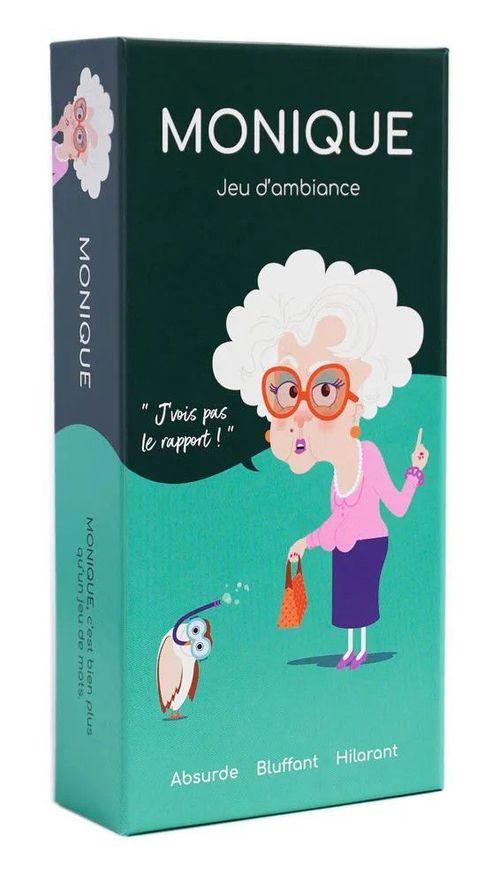
Monique
Monique Rulebook
Table of Contents
Table of Contents
Game Components
The game contains 300 cards, consisting of:
- 264 "word" cards:
- 218 "simple word" cards, each showing a single word.
- 26 "gap" cards, each showing a single letter followed by "...".
- 20 "censored word" cards. These are recognisable because they are red. Note: they are not for players under 16.
- 36 "Monique" cards, of which 9 are censored (not for players under 16).
Setup
How many cards does each player receive?
- 2 to 4 players: 5 cards each.
- 5 players or more: 4 cards each.
The remaining cards form the draw pile.
Gameplay
Who starts? Work it out among yourselves! Players take turns in clockwise order. The first player lays down one of their cards of their choice and reads it aloud.
On your turn, you have 4 options:
- Play a face-up word card
- Play a face-down word card
- Draw a card
- Play a Monique card
1. Play a face-up word card
Lay a face-up word card on top of the previous one. Your word must have a connection with the previous word. If the association of the 2 words is accepted unanimously by the other players (roughly, if nobody says anything), your turn is over, and it is the turn of the player to your left.
However, if one of the players thinks that your word has no connection with the previous one, they may say "J'vois pas le rapport" ("I don't see the connection"). We will call this player the accuser and you the accused. They then ask for an explanation of the connection between your word and the previous one. The group listens to your explanation. Then the other players vote (thumb in the air, hand raised, ...) to judge whether your explanation convinced them or not. Caution: the accuser and the accused do not have a vote.
If the explanation is accepted by the majority (a majority means MORE than half), the accuser draws 1 card. If it is not accepted, you (the accused) draw 2 cards.
Note: to avoid upsetting Monique, avoid challenging obvious associations.
2. Play a face-down word card
You may play a face-down word card. This card may or may not have a connection with the previous word. A player may then say "tu bluffes" ("you're bluffing"). You must then turn your card face up and justify yourself. If the explanation is accepted by the majority, you win your bluff and the accuser draws 1 card. Otherwise, you draw 3 cards. Yes, bluffing is risky!
However, if none of the players dares to say "tu bluffes", your turn is over. It is the turn of the player to your left, who continues from the last face-up word card.
Note: it is forbidden to play more than 3 face-down cards in a row.
3. Draw a card
If none of the cards in your hand is suitable and you are afraid of bluffing, draw a card. You may play it immediately or pass your turn.
4. Play a Monique card
You may play a Monique card (see the explanations below) if you have one in your hand.
The Monique Cards
On your turn, you may play a Monique card in place of a word card. Each Monique card has its own specific features and rules, which are described on each card. The next player continues from the last face-up word card.
Note: the individual rules of each Monique card are printed on the card itself. They are not described in this leaflet.
The Censored Cards
When the children and the mother-in-law have gone to bed, bring out the censored cards (red cards)!
Humour in All This?
During their justification, if the accused manages to make the accuser laugh, the justification is won! The accuser therefore draws 1 card. If you are playing with party jokers who put all their bets on humour at the expense of logic, or if it is getting late, a piece of advice: grit your teeth.
End of the Game
The first player who has no cards left is the great winner. It is possible to end the game by playing a Monique card. The other players may continue the game, start another round, or drink a toast!
Examples
"I don't get it, what's this vote business?"
Example: Benoit, player 1, plays the card "cheese". Marion then plays the card "telescope". Jean-Pascal, player 3, is perplexed and may legitimately exclaim: "Good grief, Marion! I've racked my brain, and I can't see the connection!"
Marion then replies: "I like looking at the moon with my telescope, its craters make me think of the holes in a Gruyère cheese..." The group is doubtful (and it's easy to see why). The players vote against it by pointing a thumb down, as in gladiator fights. In short, it doesn't pass! Marion draws 2 cards. Serves you right! And moreover, the Gruyère doesn't even have holes.
"What's the point of playing a face-down card?"
Example: The last face-up word revealed was "chicken". Martine would gladly get rid of her "legislation" card (not very fun), but she is afraid that people won't see the connection, and above all, it is a bit too late to launch into a serious explanation referring to article L.214 of the rural code, the law on animal protection... So she prefers to play her card face-down. Valentin sensed Martine's hesitation in her manner, so he launches a "you're bluffing, Martine!"
Martine turns her card over. Valentin rubs his hands together. Martine justifies herself: "Have you ever watched a session of the National Assembly? It sounds like a real hen-house!" Valentin did not expect this (it must be said that Martine's explanations are usually quite painful). Like a turkey, he lets out a gobble. Martine wins the bluff, and Valentin draws 1 card.