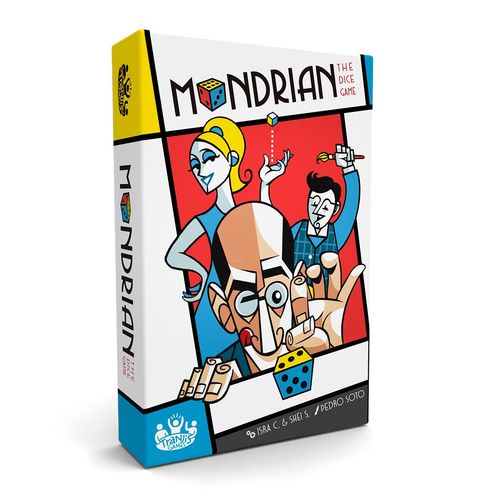
Mondrian: The Dice Game
Mondrian: The Dice Game Rulebook
Table of Contents
Table of Contents
Game Components
- 36 Canvas Cards
- 12 Blank Canvas Cards
- 20 Dice
- 4 Painter's Kits (brush and palette)
- 1 First Player Token
Set Up
Sit around the game board and clear the table so you have plenty of space.
Each player receives 3 blank canvas cards (with values, 1, 2 and 3), a painter's kit, and 5 dice of the same color.
Shuffle the canvas cards and make a grid on the table with the numbers facing up to make the game board. The size of the grid will depend on the number of players.
- 2 players: 5x5
- 3 players: 6x5
- 4 players: 6x6
The first player token goes to whoever made a drawing most recently.
Game Objective
In the game, players roll dice on the board to acquire canvas cards. After four rounds, you will use the cards in your hand to make your masterpiece.
The player whose composition is worth the most points will be the winner.
How to Play Mondrian
Players begin the first round with two dice. A die is added at the beginning of each round until all five dice are used on the fourth and final round.
At the beginning of each round, all players select their actions by placing each available die on an action icon on their palette (limit one die per icon).
Choose your actions wisely because they will determine how you will roll the dice on the board.
Each player chooses the order in which their actions are taken.
Example: On the first round, the red player has placed one die on the Left Hand Roll icon and the other on the Vertical Drop. On the next round, she will be able to use three dice and choose any three actions. On the third round she will use 4 dice, and 5 on the fourth and final one.
Left Hand Roll
Roll the die from outside the board using your left hand.
Right Hand Roll
Roll the die from outside the board using your right hand.
Blind Roll
Close your eyes and cover them with one hand, roll with the other. No cheating!
Vertical Drop
Place your brush on the board to determine the height of the drop. Remove the brush and let the die drop.
The Flick
Place the brush horizontally on the edge of the board to determine the distance. Place the die on the table on the opposite end of the brush, remove the brush and flick it, but not too hard!
Brush Stroke Round
Once everyone places their dice on the palettes, the brush stroke round begins!
The player with the first player token will roll one of his dice in the manner chosen:
- If the die lands inside the board, it will remain there until the end of the round, even if it's in an empty block.
- If the die falls outside the board, you will be able to repeat your roll, but only once per die!
- If the die hits another die, the roll is final and can't be repeated.
After the first player rolls their first die, the player to their left will roll next. Play continues clockwise until all available dice have been rolled.
Obtaining Canvas Cards
Starting with the first player, each player will collect the cards that have one of their dice on it:
If the number on the die is equal to or higher than the value of the card, remove the die and put the card in your hand, leaving an empty block on the board.
If the number on the die is lower than the value of the card, you may play one of the cards in your hand to supplement said die in order to match or pass the value of the canvas card. Remove the die, place the canvas card in your hand, leaving the card played in its place on the board.
If a player has several dice on the same card, the numbers on the dice may be added to determine whether they can take the card.
If there are multiple dice on a card belonging to different players, the die with the highest value will take preference. In the event of a tie, the player who rolled first wins.
If a die is touching more than one card, the player will be able to choose among them (as long as they have preference on the card, see the rule above).
Once all the players have resolved their rolls, the first player token is passed to the left and a new brush stroke round begins.
After four rounds of play (in which all 5 dice will be available), it's time for the exhibition round!
After each round, you may adjust the board if any cards have moved out of place, respecting empty blocks.
Choose your strategy to win: go after cards of highest value, or aim for color excellence.
Exhibition Round
You've been painting for a while now, it's time to see who made the best Mondrian-style composition!
First, determine what the final canvas size will be. To do so, count the cards in your hand (don't forget the cards you started with!) to see who has the fewest. The size of the canvas will be the even number closest to the number of cards in that player's hands rounded down.
Example: A player has the fewest number of cards: 7. Thus, all players will be able to make a canvas with 6 cards.
Each player will determine which cards they want to play to make their square composition face down in front of them. The rest of the cards not used will be discarded. Once all players are done creating their masterpieces, flip them up and score them.
Base Score
Add the numbers of the cards in your composition; this will be the base score.
Example: Base Score: 1+6+2+4+3+1 = 17 points. Blocks: 4 reds, 3 blues, 2 yellows, 1 black.
Excellence Score
The player who used the most number of blocks of a particular color, is considered to have achieved excellence in that color and will add the following to their base score:
- Blue Excellence: 8 points
- Yellow Excellence: 10 points
- Red Excellence: 12 points
- Black Excellence: 14 points
Once all the base scores and excellence scores have been determined and added, the player with the highest score wins the game!
If there's a tie, the players will count their white canvas cards and whoever achieves excellence in white will be declared the winner.
If there's still a tie, both players have equal artistic talent! How about another game?