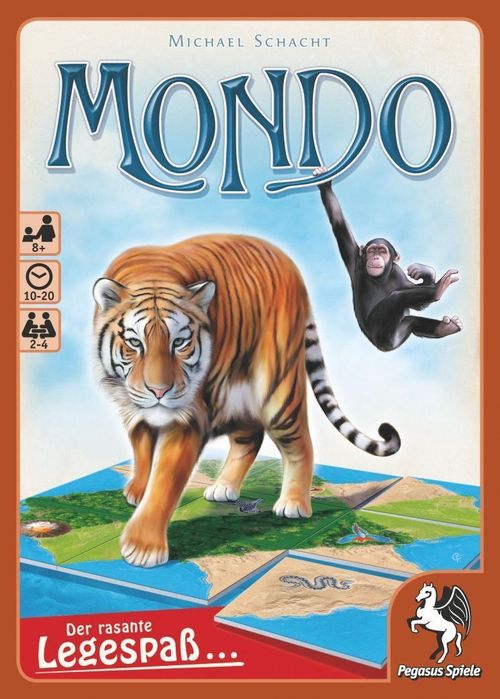
Mondo: Der rasante Legespaß
Mondo: Der rasante Legespaß Rulebook
Table of Contents
Table of Contents
Contents
- 48 Landscape Tiles (two-sided), shown in the printed rules with their Forest, Desert and Plains types on the front side and their clouds on the back side
The tile illustrations are not reproduced here.
You will also need a pen, some paper and a timer (an egg timer or smartphone app will do). If you don't have a timer at hand, you can play without one using the variant at the end of these rules.
Game Concept
Every player fashions his own small island full of exotic animals and a variety of landscapes. While doing so, it's important to keep a sharp eye on the time and the other players, because everything happens simultaneously until the timer runs out. After three turns, the player who has collected the most points wins the game.
Game Play
A game runs for 3 turns. In each turn you will create an island of Landscape Tiles (only referred to as tiles from now on) in front of you in a 3 by 3 grid surrounded by water. At the end of each turn you take score.
Set-Up
At the beginning of each turn, place all tiles unsorted as a loose pile with either side up in the middle of the table, easily reachable by all players.
Set the timer to 4 minutes. Advanced players can try a timer with 3 minutes. Place the timer so that each player can see the remaining time.
One player counts down "Ready, set, GO!" During this countdown players should scramble the pile of tiles in the middle of the play area. At "GO!" all the players cease shuffling and can start grabbing the tiles.
Placing Tiles
Now, you all look simultaneously for the tiles you want to place in front of you. The first tile can be placed on any space of the imaginary 3 by 3 grid in front of you but each subsequent tile must border at least one edge of one or more previously laid tiles.
The orientation of the tiles may be chosen freely. (Animals may face sideways or upside down.) You should arrange the tiles in such a way that their borders match up with their neighboring tiles as much as possible: Plains touching Plains, Forest touching Forest etc. Nevertheless, it is allowed to place the tiles so that their edges do not match up. But 2 edges that do not match up count as 1 misconnection.
Further Rules
- Each player may use only one hand for looking for and placing tiles.
- You may shift the tiles in their pile, but may not dig in them.
- Turning around tiles is permitted, because the front and back sides are always different. You may choose freely which side to place in your 3 × 3 grid. But be aware: the backside (with the clouds) will rarely be useful to you.
- You may have no more than 1 tile in your hand at any time.
- You may place the tile in your hand either in your grid or back in the middle.
- You may not remove, rotate or move tiles that have been placed in your grid.
- You may not place tiles on top of each other.
- Your island has to consist of tiles in a 3 × 3 grid. You may not place tiles outside of this grid.
- All outwards facing tile borders have to show their water side.
- All inwards facing tile borders may not show their water side.
Example 1: This island has been placed correctly: A 3 × 3 grid where all outward borders show water and inward borders show no water.
Example 2: This island violates a rule: The top-middle tile has an inward tile border showing water (A).
(Diagrams for Examples 1 and 2 are not reproduced here.)
Jumping Out
You can jump out of the current turn at any time, as long as the timer hasn't run out. This is only permitted if you have completely filled your 3 × 3 grid. Announce your jumping out by saying "Done!". Thereafter you may not intervene in the gameplay.
End of the Turn
A turn ends as soon as all players have jumped out or the timer runs out.
If the timer runs out, you must end all actions. You may not take or place anything. If you still have a tile in hand when the timer runs out, put it back on the pile. Now, you take score.
Scoring
First, make sure that each player is fulfilling the following 2 criteria:
- All outwards facing tile borders have to show their water side.
- All inwards facing tile borders may not show their water side.
If a player does not fulfill both criteria he scores 0 points for this turn and does not participate during this scoring any longer.
Example 3: The player who has built the island in Example 2 (see other page) would score 0 points because one of his tiles has an inward tile border showing water. He will not participate further during this scoring.
See how many points each player participating in the scoring has accumulated:
- Every animal always counts as 1 plus point.
- Every enclosed and misconnection-free landscape counts 2 plus points. Exception: Water landscapes score no points. (Hint: It's easiest to count all the landscapes of a given kind at the same time, e.g.: all deserts, all plains etc.)
- The player with the most volcanoes receives 1 minus point for each of his volcanoes. All players tying for most, each receive these minus points. (Note: Count only those players who still participate in the scoring.)
- Each empty space in the 3 × 3 grid counts as 1 minus point. For every misconnection you also receive 1 minus point. Empty spaces do not cause misconnections and therefore count no more than 1 minus points.
- The player who jumped out of the current round first additionally receives 4 plus points.
Note: The clouds on the tiles' backside have no relevance. They are just pretty.
Write down the points of every player on some paper. If someone scored more minus points than plus points write down 0 points instead.
Example 4:
Kathrin receives 2 points for 2 animals. She also has 11 misconnection-free enclosed landscapes: 4 Forests, 4 Plains and 3 Deserts. This yields her 22 points. She also has the most volcanoes - 3. For that she receives 3 minus points. She has no empty spaces nor any misconnections. She jumped out first so she receives an additional 4 plus points. Kathrin receives a total of 25 points this turn.
Peter has 4 animals gaining him 4 plus points. He receives an additional 10 points for 5 misconnection-free enclosed landscapes: 2 Forests, 2 Plains and 1 Desert. He receives no minus point for his volcanoes, because he doesn't have the most. 1 empty space and 2 misconnections, however, cause 3 minus points. So for this turn, Peter scored a total of 11 points.
| Scoring example | Kathrin | Peter |
|---|---|---|
| Animals | +2 | +4 |
| Landscapes | +22 | +10 |
| Volcanoes | -3 | 0 |
| Empty Spaces / Misconnections | 0 | -3 |
| Jumped Out 1st | +4 | 0 |
| Sum | +25 | +11 |
Next Turn
Place all tiles back onto the pile in the middle and shuffle them. Set the timer again and start the next turn.
Ending the Game
After 3 turns, add up all points scored for each player. The player with the most points wins the game. Tied for most players share the win.
Game Without the Timer
Once a player has finished his 3 × 3 grid and jumped out, all other players may only place 1 more tile. Then this turn ends and you take score.
Alternate Playstyle for 2 Players
In a game with 2 players you can also try building islands in a 4 × 4 grid. You still have to make sure that there is only water facing outwards and no water facing inwards.
Example 5: This is what a correct island in a 4 × 4 grid looks like. All outwards facing borders show water and no inwards facing borders show water.
(The diagram for Example 5 is not reproduced here.)