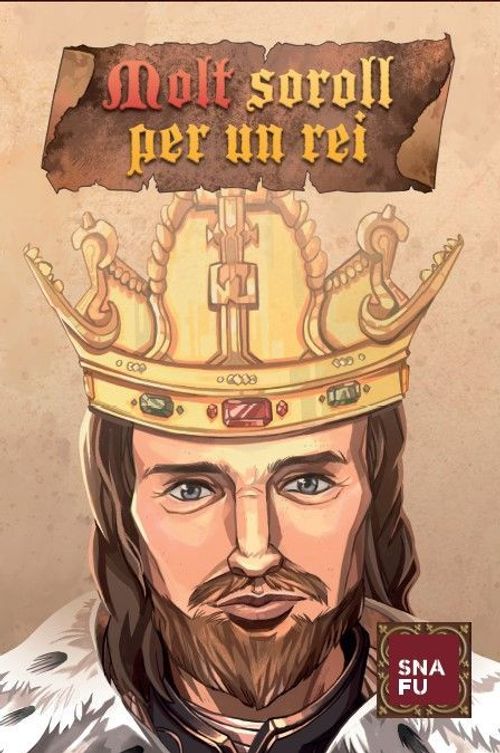
Molt soroll per un rei
Molt soroll per un rei Rulebook
Table of Contents
Table of Contents
Components
- 1 map
- 21 counters
- 38 cards
- This rule booklet
- 1 six-sided die
The Map
The map shows the western Mediterranean region. There are boxes at different locations on the map, all connected by lines. These lines converge at Barcelona and are called Fronts. These Fronts are labeled: "Noblesa catalana" (Catalan Nobility), "Noblesa aragonesa" (Aragonese Nobility), "Andalusins" (Andalusis), "Nàpols" (Naples), "França–Felip l'Ardit" (France - Philip the Bold) and "França–Beaumarchais" (France - Eustache de Beaumarchais), and they are identified on the map by their respective Coats of Arms.
These Fronts are an abstract representation of the threats and pressures faced by King Peter, not a geographical representation of any specific military campaign. The boxes of each Front have a city name just for geographical interest. Note also that the coast of Provence has been compressed to allow space for the Italian peninsula.
The boxes are the places where the counters representing enemy forces are placed. They are numbered in ascending order from their starting point towards Barcelona (0 to 3 or 4, the box just before Barcelona). The Fronts "França–Beaumarchais" and "Noblesa aragonesa" share the last three boxes: Saragossa, Lleida, and Igualada.
Some boxes have an anchor symbol. These are sea boxes in which fleets can be used and in which Barbary pirates can act.
Some boxes have a fortification outline. This indicates that an enemy force must besiege the box before conquering it.
The map also includes some spaces, tracks and tables to show various elements of the game:
- A "Jaume de Mallorca" track, with four boxes, showing the allegiance of James of Mallorca.
- A "Fidelitat de la noblesa" track, with four boxes, showing the allegiance of the Catalan and Aragonese nobility.
- A "Papat" track, with five boxes, showing the stance of the Papacy.
- A space for placing Almogàvers counters, with boxes labeled "Disponibles" (Available) and "Reagrupament" (Regrouping).
- A space for placing Fleet counters, with boxes labeled "Disponibles" (Available) and "Reagrupament" (Regrouping).
- A space for placing "Amenaces eliminades" (eliminated threats): counters that are not in play anymore.
The Cards
Cards are the key to the game. They determine the events that take place, which enemies advance, and how many actions the player can perform.
The deck is divided into two parts: "A" cards and "B" cards, as shown in the lower right corner. At the beginning of play, you'll use only "A" cards. "B" cards will be added when the event "Vespres Sicilianes" (Sicilian Vespers) occurs. There are also two special cards: "Excomunió i croada" (Excommunication and Crusade) and "Mort a Vilafranca" (Death in Vilafranca). These two cards show the letter "E" in their lower right corner.
Each card provides all the information needed to activate the corresponding actions and can include the following items:
- Available Actions: How many actions the player has and if some actions have some kind of die roll modifier.
- Special Actions: If present, an action to be performed at the end of turn.
- Reinforcements: If present, shows that enemies are reinforced.
- Event: If present, shows which historical event happens and how it is implemented.
- Movement: Which Fronts advance or, in some cases, fall back.
- Deck: The group of cards – A, B, or E – that the card belongs to.
Card diagram labels: Available Actions; Die Roll Modifiers; Reinforcements; Illustration; Historical Comment; Event; Movement; Special Actions; Deck.
The Counters
The counters are divided into enemy forces, modifier tokens and markers.
Enemy forces
They represent the various forces and actors that King Peter faced during his reign. Some of them are classical armies, like Charles of Anjou's in Naples or Philip the Bold's in France. Others are an abstract representation of pressure groups, like the Nobility. There is a counter for each Front.
A typical enemy force counter can include:
- Name and Coat of Arms or identifying symbol.
- Combat value: The value that the player must exceed in a die roll for moving back an enemy force (see "8.1 Conducting Offensives").
- Siege value: The value that the player must exceed on a die roll to keep the force from succeeding in the siege of a fortified box (see "6. Siege Resolution").
- An asterisk: Only found on the "Noblesa Catalana" and "Noblesa Aragonesa" counters as a reminder that their values are modified by the current position of the "Fidelitat de la noblesa" track.
All enemy force counters have two sides: the front showing a full force and higher combat and siege values, and the back showing a reduced force and lower combat and siege values.
Modifier Tokens
Modifier tokens abstractly represent resources available to the player during gameplay. They all have the same structure:
- Name, and in some cases, a symbol or Coat of Arms.
- Modifying Value, which is added to a die roll during offensives.
Modifier tokens available to the player, and their effects, are:
- 4 Fleet counters: 1 Estol Reial, 1 Roger de Llúria, 1 Conrad Llança and 1 Berenguer Mallol. When used (see "8.1. Conducting Offensives") they give a +1 die roll modifier in an offensive, but only if it is performed in a sea box (with anchor symbol).
- 3 Almogavar counters: 2 generic and 1 Galceran de Cartellà. When used (see "8.1. Conducting Offensives") they give a +1 die roll modifier in an offensive.
When one of these counters enters play by means of an event, it is always placed in the respective "Disponibles" (Available) box, ready to use.
Markers
Markers are used to keep track of various elements of the game:
- Stance of James of Mallorca: Used in the "Jaume de Mallorca" track to show his current level of allegiance to the King.
- Stance of the Nobility: Used in the "Fidelitat de la noblesa" track to show their current level of allegiance to the King.
- Relationship with the Pope: Used in the "Papat" track to show the quality of relationship between King Peter and the Pope.
- Berenguer Oller's Riot: Placed beside Barcelona when the event "Revolta de Berenguer Oller" occurs. While in play, the player has a -1 die roll modifier in all offensives.
- Barbary pirates: Placed on its active side in its box when the event "Pirates Berberescos" occurs. While active, the player has a -1 die roll modifier in all offensives in sea boxes.
- 3 siege markers: Used when an enemy force lays siege to a fortified box. The marker's backside shows a destroyed rampart and is used when an enemy force has succeeded in a siege.
"James of Mallorca", "Relationship with the Pope" and "Stance of the Nobility" markers are moved one box to the right (when an event shows "+1") or one or two boxes to the left (when an event shows "-1" or "-2"). No action can move any of these markers beyond the first or last box of their tracks.
The Die
A six-sided die is used to determine the success or failure of almost all actions. As a general rule, low values are bad for the player while high values favor the player.
Setup
Prepare to play by following these steps:
- Unfold the map on a table.
- Place the enemy forces "Andalusis", "Catalan Nobility" and "Aragonese Nobility" at full force in the initial boxes (showing the Coat of Arms) of their corresponding Fronts.
- Place a generic Almogavar counter in the "Disponibles" (Available) box of the Almogavar space.
- Place:
- The "Stance of James of Mallorca" marker in the box "Neutral Pro-Felip" of the "Jaume de Mallorca" track.
- The "Stance of the Nobility" marker in the box "+1/0" of the "Fidelitat de la noblesa" track.
- The "Relationship with the Pope" marker in the box "3" of the "Papat" track.
- All other counters, including the enemy forces of Naples and France, are not active at the beginning of the game. Place them off the map; they will enter play when specific cards are drawn.
- Place the "E" card "Excomunió i croada!" (Excommunication and Crusade) next to the map.
- Separate the "A" cards from the deck, shuffle them, and place them face down besides the map. "B" cards and the "E" card "Mort a Vilafranca" (Death in Vilafranca) will enter play when the "Sicilian Vespers" occur.
How to Play
The game consists of numerous turns in which a card is drawn and played. There is no set number of turns. The game ends when the King dies and his heir, Alphonse, accedes to the throne (the player wins) or when an enemy force successfully lays siege to Barcelona (the player loses).
Each turn has the following phases, which must be performed in the order stated:
- New card. Draw the topmost card of the deck and place it face up in the "Esdeveniment actiu" (Active Event) space of the map. This will be the active card during the turn.
- Reinforcements. If the card shows a small blue banner in its upper right corner, enemies can receive reinforcements.
- Event. Implement the event, if shown.
- Siege Resolution. Resolve any ongoing sieges.
- Movement. Move enemy forces as indicated on the card.
- Actions. Spend your available actions as indicated on the card.
- Lay Siege. Place siege markers if needed.
- Special Actions. Perform any special action as indicated on the card.
- Relationship with the Pope. Check the "Papacy" track. If the marker is at zero, place the "Excomunió i croada!" (Excommunication and Crusade) card in the "Active Event" space. This will be the active card for the next turn.
Each of these phases is explained in detail in the following sections.
New Card, Reinforcements and Event
Draw the topmost card of the deck and place it face up in the "Esdeveniment actiu" (Active Event) space of the map. This will be the active card during the current turn. If the card shows a small blue banner in its upper right corner, enemies can receive reinforcements: For each enemy force at reduced force, and for the Barbary pirates if in play and on its inactive side, roll a die. If the result is 1, 2 or 3, the force is flipped back to full force (or to the active side for the pirates).
Then, if the card shows an event, implement it according to the card's instructions.
When an event states "Activa el front..." (Activate the Front…), you must add the corresponding enemy force to the first box of its Front.
Siege Resolution
During this phase, if there is an enemy force with a siege marker, you must check whether the force succeeds in the siege and conquers the besieged city. Roll a die:
- If the die roll is equal to or lower than the siege value of the enemy force, the siege succeeds and the city falls. Flip the siege marker to show the destroyed ramparts, and leave it on the fallen city or beside it. From now on, this box is considered to not have any fortification.
- If the die roll is higher than the siege value of the enemy force, the defenders hold and the siege goes on.
ATTENTION! If a siege against Barcelona succeeds during the Siege Resolution phase, the game ends immediately and the player loses. See section 12.1 to assess the level of this defeat.
Movement
Each card indicates which enemy forces move in the current turn. This is indicated by the Coat of Arms at the bottom of the card. In general, enemy forces always move one box towards Barcelona (i.e., to the next higher-valued box).
Example: In this case, the "Aragonese Nobility" and "Andalusi" forces advance.
If a Coat of Arms is highlighted with a red outline, that Front moves backward one box. Some events will also cause one or more Fronts to move backward.
ATTENTION! If an enemy force must advance to Barcelona and the city is already occupied by another force, the enemy does not advance and remains in place. If two or more forces must advance to Barcelona, the leftmost Coat of Arms has preference.
ATTENTION! The French force of Beaumarchais and the "Aragonese Nobility" share some boxes. Only one force can be placed in any one box. If a force must advance or go back to a box already occupied by the other one, they swap places or return to Egea or Terol (if advancing to Saragossa).
ATTENTION! If an enemy force has a "Setge!" (Siege) marker, it does not advance, even though the card says so. The enemy must first succeed at the siege.
ATTENTION! If a card instructs the advance of a non-active Front, this movement is ignored.
From Palermo to Barcelona
If the force of "Charles of Anjou" must advance from Palermo to Barcelona, you can intercept this movement if you have a fleet in the "Disponibles" (Available) or "Reagrupament" (Regrouping) box. Remove your fleet from play and keep Charles' force in Palermo.
This "advance" of Charles of Anjou to Barcelona is somewhat symbolic and abstract, representing not only Charles' total control of Sicily but also a military defeat of Peter in this theater that removes his fighting power on all other Fronts and (who knows?) perhaps the establishment of Philip of France as King of Aragon and Valencia and count of Barcelona… causing the end of the House of Barcelona 200 years earlier!
Rosselló and James of Mallorca
The Kingdom of Mallorca has a marker to show its attitude in the conflict. If the marker is in the box "Visca lo rei en Pere!", when the French force is in Perpinyà, Panissars, Girona or besieging Barcelona, it will always be on its reduced side and will not be able to receive reinforcements.
The allegiance of James also modifies the offensives conducted in Perpinyà or Panissars with a +1 or -1.
See section 8.6 to know how to influence the stance of James of Mallorca.
Actions
Each card specifies the number of actions a player has during the current turn to improve their situation. This number is the figure on the red seal.
The available actions can be spent on:
- Conducting offensives (see 8.1)
- Regrouping Almogavars (see 8.2)
- Regrouping fleets (see 8.3)
- Influencing the Nobility (see 8.4)
- Influencing the Papacy (see 8.5)
- Influencing James of Mallorca (see 8.6)
Actions are spent one after another, so you can decide your next action after seeing the result of the previous one. You'll be able to distribute the actions as you see fit. You can repeat the same action as many times as you want (provided you have available actions remaining).
In this game, the most important element of decision-making for the player is the distribution of actions available.
Some cards show die roll modifiers for specific actions. The die roll modifiers are shown below the red seal and can apply to the following actions:
- A Coat of Arms indicates a die roll modifier for conducting offensives on that specific Front.
- Two crossed swords indicate a die roll modifier for conducting offensives on any Front.
- A Parchment with Coats of Arms means a die roll modifier for the corresponding influence (Nobility, Papacy, or James).
- "No" indicates that no actions are permitted in that Front or area of influence.
Conducting Offensives
With offensives, the player seeks to push back enemy forces and maybe weaken them as well.
Offensives
To conduct an offensive, first designate a Front and a force to be attacked. Then roll a die and apply all possible modifiers:
- If the modified die roll is equal to or lower than the combat value of the enemy force, the attack has failed and there is no effect. The enemy forces remain in place.
- If the modified die roll is higher than the combat value of the enemy force, the attack has been successful, and the enemy force moves back one box (if possible). Moreover:
- If the die roll is a natural 6, the enemy force is flipped to its reduced side. If the force is already reduced, there is no additional effect.
Use of Modifier Tokens
In any offensive, the player can use at most one Almogavar token and, in sea boxes, also one Fleet token from their respective "Disponibles" (Available) boxes. Each one of these tokens gives a +1 to the offensive die roll.
Once used, the tokens are placed in the "Reagrupament" (Regrouping) box. Tokens in "Reagrupament" (Regrouping) cannot be used. First, you must regroup them using an action, thus placing them in the "Disponibles" (Available) box (see also 8.2 and 8.3).
Support of James of Mallorca
The attitude of James of Mallorca toward his brother King Peter has the following consequences for the offensives launched on the French Front by Philip the Bold:
- "Visca lo rei en Pere!" (Long live King Peter!): In the offensives conducted against Perpinyà or Panissars, you have a +1 die roll modifier. The French force will not receive reinforcements and it will always be on its reduced side when in Perpinyà, Panissars, Girona, or besieging Barcelona.
- "Neutral Pro Pere" and "Neutral Pro Felip": No effect.
- "Aliat de Felip" (Allied of Philip): In offensives conducted against Perpinyà or Panissars, you have a -1 die roll modifier.
Berenguer Oller's Riot
When the event "Berenguer Oller's Riot" appears, its marker is placed beside Barcelona and is considered an enemy force with a combat value equal to 3. While the riot is active, all your offensives have a -1 die roll modifier – except offensives against the riot itself.
You can try to crush the riot with a standard offensive, without modifiers. In an offensive against Berenguer Oller you cannot use Almogavars or Fleets. The riot does not besiege anything (it is a riot inside the city), but if a Front advances to Barcelona and the riot is active, the siege resolution is considered an automatic success and the player loses.
If you crush the riot, place the "Berenguer Oller" marker in the "Amenaces eliminades" (Eliminated threats) box.
ATTENTION! If the riot occurs while Barcelona is besieged, the player loses immediately, without playing the rest of the turn.
It is not easy to crush the riot. However, while the riot continues, you'll always have the -1 modifier in all your offensives. You'll need to decide whether to forget about external enemies and focus on the riot, or the other way around.
Barbary Pirates
When the event "Barbary Pirates" appears, its marker is placed in the corresponding box and is considered an enemy force with a combat value equal to 2. While "Barbary Pirates" is active, all your offensives in sea boxes have a -1 die roll modifier (except offensives against the pirates themselves).
You can try to get rid of the pirates with a standard offensive, without modifiers. In order to do so, you must spend an available Fleet and place it in the "Reagrupament" (Regrouping) box.
If you succeed, flip the Barbary Pirates marker to its inactive side. It can be flipped again to its active side when a reinforcement banner appears in a card (with a die roll of 1, 2, 3, just like any standard enemy force).
First Box of the Front
An enemy force can never be moved back beyond the first box on the Front.
Front Elimination
Some cards have a special action listed: "Possible inactivació" (Possible Inactivation) of a certain Front. In these cases, you have the opportunity to remove the enemy force on a Front from play. Roll a die. If the result is higher than the value of the box in which the enemy force is currently situated, the force is eliminated and placed in the "Amenaces eliminades" (Eliminated threats) box. The corresponding Front remains inactive during the rest of the game.
Regrouping Almogavars
You can spend one action in order to move an Almogavar token from "Reagrupament" (Regrouping) to "Disponibles" (Available). In this way, you can use the token again for your offensives, even in a later offensive during the same turn. Regrouping is always automatic, no die roll is needed.
Regrouping Fleets
You can spend one action in order to move a Fleet token from "Reagrupament" (Regrouping) to "Disponibles" (Available). In this way, you can use the token again for your offensives, even in a later offensive during the same turn. Regrouping is always automatic, no die roll is needed.
The game action of Regrouping a fleet represents the task of returning to port and repairing and supplying the ships.
Influence the Nobility
You can spend one action in order to try to influence the Nobility. For each action spent, roll a die and add possible modifiers as directed by the active card.
- With a die roll of 1, 2, 3 there is no effect.
- With a die roll of 4, 5, 6 move the marker one box to the right.
The box in which the marker is situated shows the combat and siege values to add to those of the "Catalan Nobility" and of the "Aragonese Nobility". For example, in this situation:
Example: The combat value of the "Catalan Nobility" is 3 and its siege value is 2 if at full force, and 2 and 1 if at reduced force.
Influence the Pope
You can spend one action in order to try to influence the Pope. For each action spent, roll a die and add possible modifiers as directed by the active card.
- With a die roll of 1, 2, 3, 4 there is no effect.
- With a die roll of 5, 6 move the marker one box to the right.
Some events also move the "Relationship with the Pope" marker, usually towards 0. Once 0 is reached, the excommunication of Peter and the Crusade against the Crown is triggered (see "11. Relationship with the Pope"). At this point, trying to influence the Pope is hopeless; ignore any future Papal references on the cards.
There is a good chance that the Crusade will be launched. Spending actions to improve relations with the Pope can cause the declaration of the Crusade to be delayed by a few turns. It's up to you to decide whether it's worth it or not.
Influence James of Mallorca
You can spend one action in order to try to influence James of Mallorca. For each action spent, roll a die and add possible modifiers as directed by the active card.
- With a die roll of 1, 2, 3, 4 there is no effect.
- With a die roll of 5, 6 move the marker one box to the right.
Some events also move the marker, usually towards an alliance with Philip of France.
It's not easy to keep James from supporting French King Philip. Again, it will be up to you to decide whether it is worth the effort or not.
Laying Sieges
Once you've completed all of your actions, place a "Setge!" (Siege) marker on any enemy forces located in a fortified box.
Special Actions
Some cards show a special action that must be performed after the movement, actions, and siege phases. These special actions are shown at the bottom of the card.
If present, follow the instructions.
The Sicilian Vespers
The card "Vespres Sicilianes" (Sicilian Vespers) is an important and special event: The "B" deck must be added to the still unplayed cards (even if it is the first card of the game). Follow this procedure:
- Shuffle all the unplayed "A" cards, then shuffle them with all the "B" cards.
- From this newly shuffled deck, draw 5 cards face down and shuffle them with the "Mort a Vilafranca" (Death in Vilafranca) card.
- Place this group of six cards face down on the table. On top of them, place all the remaining cards of the deck that was shuffled in step 1. As a result, you know that the king's death will appear during the last six cards.
Relationship with the Pope
As the last phase of the turn, check the position of the "Relationship with the Pope" marker in the "Papacy" track. If the marker is in the "0" box, the Pope excommunicates King Peter and proclaims a Crusade against the Crown of Aragon, with Philip the Bold of France as its leader.
In that case, place the "Excomunió i croada!" (Excommunication and Crusade) card in the "Esdeveniment actiu" (Active Event) box. This will be the active card for the next turn – do not draw a new card from the deck.
The "Relationship with the Pope" marker can be removed from the game, as it will no longer be used. Ignore any references on the cards to the relationship with the Pope.
Winning and Losing
If an enemy force succeeds in its siege of Barcelona, you lose the game immediately. In order to assess your defeat, see 12.1.
However, if after the siege resolution phase of the "Mort a Vilafranca" (Death in Vilafranca) card Barcelona has not fallen to any enemy force, you win! King Peter has died in Vilafranca del Penedès and during his reign he has kept all threats at bay. Nonetheless, you can still assess the situation in which you left the kingdom to his heir, Alphonse. See 12.2.
Assessment of the Defeat
To assess your defeat, determine your "Defeat Points" as follows:
- 2 points for each unplayed card.
- 2 points for each enemy force in the "4" box of its Front.
- 1 point for each enemy force in the "3" box of its Front.
- 2 points if the Berenguer Oller's Riot is active.
- 2 points if the Barbary pirates are active.
- –1 point for each counter in the "Amenaces eliminades" (Eliminated threats) box.
- –5 points if the Crusade has not been proclaimed.
Add all these values together and assess the magnitude of your tragedy as follows:
- 51 - 99 points: Peter the Tiny
- 21 - 50 points: Peter the Small
- 00 - 20 points: Peter the Unlucky
Assessment of the Victory
To assess your victory, determine your "Victory Points" as follows:
- For each enemy force, as many points as the value of the box in which it is located.
- –5 points if an enemy force besieges Barcelona.
- 10 points for each counter in the "Eliminated threats" box.
- 10 points if the Barbary pirates are in play but inactive.
- 5 points if the Crusade has not been proclaimed.
- –2 points if the Berenguer Oller's Riot is active.
- –2 points if the Barbary pirates are active.
Add all these values and assess the magnitude of your tragedy according to these levels:
- 30 - 45 points: Petrus Magnus, eternal glory.
- 0 - 29 points: Peter the Great, local fame.
- Any negative score: Much ado about a king…
Note on the source: the printed levels read "0 - 29 puntu: points" (a typo for "points"); transcribed here as "0 - 29 points". The Defeat and Victory point lists are otherwise transcribed as printed.