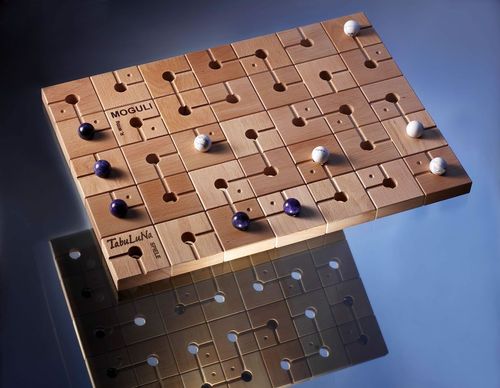
Moguli
Moguli Rulebook
Table of Contents
Table of Contents
Components
- 35 tiles
- 35 doors
- 10 pawns (5 per player)
- 1 rulebook
Before the first game, carefully detach the tiles from their cardboard sheet. Then remove the circular holes in the centre of each tile and place a door in each one so that it protrudes above the top of the tile. During the game the doors are used to rotate the tiles. The tiles must lie flat on the table, underside down.
Setup
- The players sit facing each other and decide who will play first.
- Shuffle the 35 tiles and place them at random between the two players, forming a rectangle 5 tiles wide (facing the players) and 7 tiles long (between the players). This is the playing surface.
- Each player places their 5 pawns on the doors of the 5 tiles along their own side of the playing surface. This is their starting row. There may be only one tile on each door.
Course of the Game
The game is played over a number of turns, with the players taking turns one after the other.
On their turn, a player may perform two actions:
- A. Rotate a tile of their choice
- B. Move one of their pawns
A player may perform the two actions in any order, but may not perform the same action twice.
During the game, each player must make sure that at least two of the doors in their starting row are free. This means that on each player's first two turns, they must move one of their pawns that is on their starting row.
On the other hand, a player has no such obligation regarding their opponent's starting row. A player may therefore bring one of their pawns onto a free door of the opposing starting row, provided they follow the movement rules, even if this means that there are no longer two free doors in that row.
In that case, the opponent must then, on their next turn, move a pawn from their own starting row, if they can, to free a door. So if there are fewer than two free doors in their own starting row, a player must always, if they can, move one of their pawns from that row in order to free a door. Likewise, a player may never bring one of their pawns onto their own starting row if, as a result of that move, there would be fewer than two free doors on their starting row.
The Paths
Each tile has two paths (a double white line) on its top face and two paths on its underside. The paths run from the door to one of the sides of the tile. There are two kinds of tile:
- Tiles with a white triangle: The paths on the top face (surface) and the underside (underground) of the tile are identical, and therefore connect two sides of the tile.
- Tiles without a white triangle: The paths on the top and underside are reversed. The two paths shown underneath the tile therefore connect the two sides that are not connected on the top.
[The rulebook shows an illustration of tiles with and without a white triangle, with their top and underside faces.]
A. Rotate a Tile
Before or after moving one of their pawns, a player may rotate a tile. To do so, they lift the tile by holding it by its door, turn it through 90, 180 or 170°, and set it back down in the same place. A player may rotate any tile, including a tile carrying one of their own pawns or an opposing pawn. A player who rotates a tile with a pawn on it must take care not to make the pawn fall, or to put it back in place afterwards.
Translator's note: the French text prints "170°". This is presumably a typo for 270°, which would make the three rotations 90°, 180° and 270°. The source does not confirm this, so the text is transcribed as printed.
Exception: A player may not rotate again a tile that their opponent has just rotated.
A player may rotate a tile even if they cannot move a pawn.
Note: Rotating tiles in this way lets a player prepare a path for their own pawns, or break a path that is useful to the opponent.
B. Move a Pawn
A pawn move always takes place in three steps:
- First movement on the surface
- Underground movement
- Second movement on the surface
1. First Movement on the Surface
The player moves their pawn as far as they wish along the paths on the top face of the tiles, going from door to door. The arrival and departure doors must therefore be joined by an unbroken path on the top face of the tiles.
All doors passed through must be free, that is, no pawn may be on them. It is forbidden to pass across the surface through a door where another pawn stands, whatever its owner.
[Diagram: example of a first surface movement, with the paths marked by green arrows.]
On the surface, the player may move the light-coloured tile only in the direction of the arrow. They may not move it in the other direction, because the door is occupied.
The first surface movement ends when the player uses a free door to pass under the playing surface. The pawn must then make an underground movement, of at least one tile, to another door before returning to the surface.
Note: The first surface movement is not compulsory, and the player may choose to pass immediately beneath the playing surface, at the door where the pawn is, and begin the underground movement straight away.
2. Underground Movement
This movement follows the underground paths, under the same rules as surface movement, with the following changes:
- Pawns block movement on the surface, but not underground. A player may therefore move a pawn under the playing surface, passing through a tile occupied by a pawn, whoever owns it. The pawn is simply considered to pass beneath it.
- During an underground movement, the player must pass their pawn under at least one tile occupied by a pawn, whoever owns it.
Note: An underground movement requires at least three tiles: the tile where the pawn goes underground, the occupied tile under which it passes, and the tile where it comes back up to the surface.
Note: A player may in no case move a pawn if they cannot make it pass under at least one other pawn during its underground movement.
The underground movement ends when the player uses a free door to come back up to the surface.
[Diagram: example of a complete pawn move. The pawn moves on the surface from A to B, goes underground passing beneath tile C, then comes up at D and E.]
The player moves their pawn on the surface from A to B, where they use the door to go underground. They then move beneath the playing surface, passing under the occupied tile C, then to D and E, where they must come back up to the surface, since it is no longer possible to move further underground.
The player cannot move their pawn directly from A to D and E, because they must go underground and pass beneath at least one other pawn.
Bonus Action
If, during its underground movement, a player passes their pawn under at least one opposing pawn, they are entitled to an additional "rotate a tile" action at the end of their turn.
Note: If the player rotated a tile before their movement, they may rotate that same tile again, or another. If a player has, during their turn, rotated two different tiles, their opponent may not rotate either of them on their next turn.
3. Second Movement on the Surface
The second surface movement follows the same rules as the first.
Note: Like the first, the second surface movement is optional, and the player may decide to stop the pawn's movement on the door they used to come back up to the surface.
Impossible to Move a Pawn
A player may find themselves unable to move a pawn. There are two situations in which this can happen. Either the player has no legal move available for any of their pawns, or they must move one of the pawns in their starting row because there are fewer than two free doors on that row, and they have no legal move available for a pawn in their starting row. In both cases, the player does not move a pawn. This means in particular that they may not use the fact that their starting-row pawns are blocked to move another pawn. In such a situation, the player may only rotate a tile, preparing a later move.
End of the Game
The game ends when a player brings their fourth pawn onto one of the doors of the opposing starting row. If it was the first player who did this, their opponent is still entitled to play one last time. If this also allows the opponent to bring their fourth pawn onto the opposing starting row, the game is a draw. Otherwise, the player who has brought all four of their pawns onto the opposing starting row is the winner.
The game also ends if, for three consecutive turns, no player has been able to move a pawn. In this case, the winner is the player who has brought the most pawns onto the opposing starting row.
Variants
The two variants that follow may be played separately or combined.
New Starting Row
After the playing surface has been set up, the first player may change their starting row by exchanging all of its tiles with those of one of the three central rows. The order and orientation of the tiles must not be changed during this exchange. The second player may then do the same, exchanging their starting row with one of the three central rows, again without changing the order or orientation of the tiles.
Of course, neither player is obliged to make this change, and each may be content with their row. If the first player has not changed their starting row, they may not do so after the second player has changed theirs.
The Cylinder
In this variant, play as if the playing surface were a cylinder seven tiles long. The playing surface is set up as in the basic game. During the game, the tiles at the left and right ends of the same row are considered adjacent, so a pawn may move directly from one to the other if their paths connect.
Note: It is a cylinder and not a tyre, so the tiles of the starting and finishing rows are therefore not adjacent.