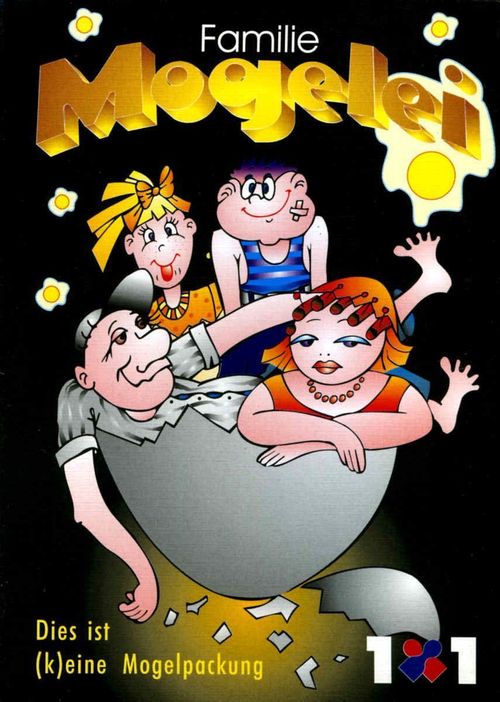
Mogelei
Mogelei Rulebook
Table of Contents
Table of Contents
Number of Players
3 to 8 players, ages 10 and up.
Components
Each of the four members of the Mogelei family has 24 cards, numbered 1 to 24, in their own colour:
- Father Mogelei: BLACK (SCHWARZ)
- Mother Mogelei: RED (ROT)
- Daughter Mogelei: YELLOW (GELB)
- Son Mogelei: BLUE (BLAU)
12 reward cards for "the fattest egg" (das dickste Ei).
Object of the Game
Reward cards bring plus points; fried eggs (Spiegeleier) bring minus points. The player with the best score wins.
Setup
Sort out the reward cards and place them as a face-up stack in the middle of the table. All family members (colours) are always in play. Which card values are used depends on the number of players:
| Number of players | Card values used |
|---|---|
| 3 | 1-9 |
| 4 | 1-12 |
| 5 | 1-15 |
| 6 | 1-18 |
| 7 | 1-21 |
| 8 | 1-24 |
The remaining cards stay in the box and are not used. You also need paper and a pencil to record the scores.
One player is chosen as the dealer (Kartengeber). In the next game, the player to the dealer's left becomes the new dealer, so the role passes clockwise from game to game. The dealer shuffles the cards and deals them face down to every player (including themselves). Each player receives 12 cards, which they take into their hand and sort by colour.
Tip: Do not let the other players see your cards!
Playing the Game
A game consists of several rounds. Unlike in other card games, a round is not necessarily over when every player has played a card. Instead, a round can consist of several passes (Durchgänge). The player to the left of the dealer is the first caller (Ausrufer). The game ends when no player has any cards left in hand.
Beginning a Round
The caller may call any colour they like, including a colour they do not have in hand.
For example, the caller says "BLACK" (SCHWARZ). All players, including the caller, then play one card face down in front of themselves, following these laying rules:
- A player who has the called colour in hand must play a card of that colour face down.
- A player who does not have the called colour in hand plays any other card face down.
Reveal or Not?
After all players have played a card, each player decides whether to reveal their card or leave it face down. The caller begins, and the other players follow clockwise.
- A player who could not play the called colour (because they did not have it) must leave their card face down. They do not reveal which card they played.
- A player who did play the called colour has a choice:
- They may reveal the card.
- Or they may leave it face down and bluff. (They act as if they did not have the called colour.)
Once every player has decided whether to reveal their card or not, it is determined who is next to move ("who is on turn"):
- If no card was revealed in the last pass, the caller is on turn again.
- If one or more cards were revealed in the last pass, the player who revealed the highest value in the last pass is on turn.
(By "the last pass" the rules always mean the cards lying on top!)
The player who is on turn now has a choice:
-
They say "I'll continue!" ("Ich mache weiter!") The round continues and the next pass begins. The player must again call the colour that was called at the start of this round. Then every player plays one card face down according to the known laying rules. Each card is placed on top of the card(s) already played, but in such a way that the card(s) underneath remain visible. Then it is again time to ask: "Reveal or not?"
-
They say "I'll end it!" ("Ich mache Schluß!") This ends the round. It is determined whether any player has laid "the fattest egg" (see below). Then the player who ended the round collects all cards played in this round, forms them into a stack, and places it beside themselves on the table. The player who received the cards begins the next round (see "Beginning a Round").
-
They say "You're bluffing!" ("Du bluffst!") This accuses one player who did not reveal their card of having played the called colour. The accused player must then reveal their most recently played card.
- If the accused player really did play the called colour, they receive all cards played in this round.
- If, however, they did not bluff and played a different colour, the player who made the accusation receives the cards played in this round.
Before either of the two players receives the cards, it is determined who laid "the fattest egg."
The player who received the played cards begins the next round (see "Beginning a Round").
"The Fattest Egg" (Das dickste Ei)
All players who still have their card lying face down from the last pass reveal it. Of these players, whoever played the highest card of the called colour in the last pass has laid "the fattest egg." That player receives a reward card from the stack in the middle of the table and places it beside themselves.
IMPORTANT: If several passes were played in a round, "the fattest egg," an accusation ("You're bluffing!"), and the question "Reveal or not?" always refer only to the cards played in the last pass.
End of the Game
The game ends when the last card has been played. The final round is also evaluated in the same way: it is determined who must collect the cards and who laid "the fattest egg." Then the scores are tallied.
Each reward card scores 3 plus points. Each fried egg (Spiegelei) scores 1 minus point (only the fried eggs on the edge of a card are counted).
The score is recorded, and a new game begins. After 5 games, the player with the best total score is the winner.
Example of Play
[The printed example uses five players: Anton, Berta, Claus, Doris and Emil. The printed diagrams show the played cards for each step as described below.]
Beginning of the round
Pass 1: Player A is the caller. They may call any colour, even one they do not have. Player A calls the colour BLACK ("SCHWARZ"). All players play one card face down. Whoever has BLACK must play a BLACK card; whoever does not have BLACK plays any other colour.
[Diagram: five face-down cards, labelled A to E.]
Now it is time for "Reveal or not?", in the order A, B, C, D, E. Whoever played BLACK may reveal their card or keep it face down (bluffing). Whoever did not play BLACK must keep their card face down.
[Diagram: the cards of A, B, C and D are shown with values 10, 5, 4 and 11; E's card remains face down.]
Player D is now on turn, because D revealed the highest card in BLACK (BLACK 11). Player D could say "I'll end it," could accuse player E, or could say "I'll continue." Player D decides to "continue." Player D must now call the starting colour again: "BLACK!"
Pass 2: All players again play one card face down each, so that the card underneath remains visible. Whoever has BLACK must play BLACK. Whoever does not have BLACK plays another colour.
Now it is time for "Reveal or not?", in the order D, E, A, B, C. Whoever played BLACK may reveal or bluff. Whoever did not play BLACK must keep the card face down.
[Diagram: the stacks show A 10 (over a face-down card), B 5 over 2, C 4, D 11 over 1; E's stack remains face down.]
Player B is now on turn, because in the last pass B played the highest BLACK card (BLACK 2). Player B could say "I'll end it," "I'll continue," or accuse A, C or E. Player B decides not to "continue," because the chance of catching someone bluffing becomes smaller with each further pass. Player B wants to accuse someone who may have bluffed. Player B considers:
- "Player A has such an honest face. A must not have bluffed..."
- "Player C thought for a long time when asked 'Reveal or not?'"
- "Player E surely does not dare to bluff, right?"
Player B decides and says to player C: "You're bluffing!" Player C must now reveal their card: it is YELLOW 12. So player C did not bluff after all... bad luck, the accusation was wrong.
Player B receives all the cards from the round (10 cards). Player B places them face down beside themselves, but first the fattest egg must be determined among the cards still lying face down.
Players A and E now turn their cards over, and it turns out that both were bluffing:
[Diagram: A shows 9 over 1; E shows 8.]
Player A played BLACK 9, and player E played BLACK 8. (By the way, player E had already bluffed in the first pass.)
Who bluffed best? Because player A had the highest (face-down) card of BLACK in the last pass, player A receives a reward card from the middle of the table and places it beside themselves.
Had player B accused player A, player A would have received all the cards from the round. Had player B accused player E, player E would have received the cards from the round.
The player who received the cards (player B) begins the next round and becomes the caller.
Tips
When should a player (the caller) say "I'll continue!"? (Every player must have at least one card in hand.) If the player expects that, in the next pass, another player will reveal the highest card of the called colour.
When should a player (the caller) say "I'll end it!"? If the player cannot say "You're bluffing!" to any other player, because every player has already revealed their most recently played card, and the player expects that they will not catch any opponent bluffing in a further pass. This is the case when all cards of one colour have already been played.
When should a player (the caller) say "You're bluffing!"? (At least one card of the other players must have remained face down.) If the player wants neither to continue nor to end the round, but instead wants to expose one of the other players for "bluffing."
Which colour should you play when you do not have the called colour in hand? You could play a colour of which you have only one card or only a few cards.
Which card value should you play when you have the called colour and must play it? When a colour is called for the first time in a round, you can play a high card value. The lower values are saved for later passes. BUT: Whoever wants to lay "the fattest egg" must do the exact opposite and hope that they are not accused.
Who is on turn if all players kept their card face down at the question "Reveal or not?" The caller is on turn.
Can a player also accuse themselves of having bluffed? NO, of course not!