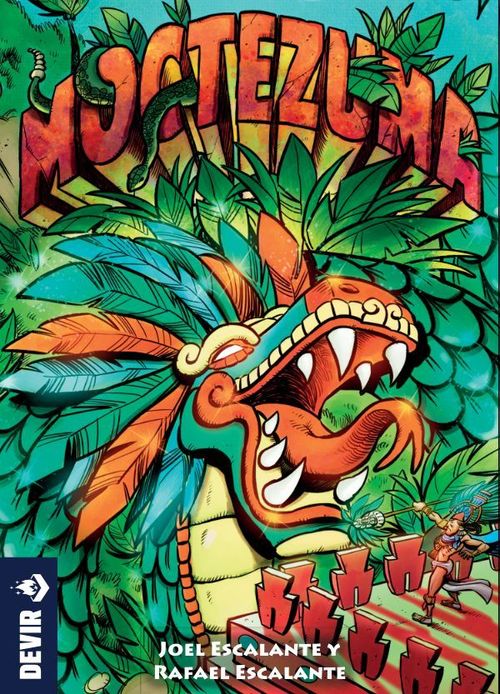
Moctezuma
Moctezuma Rulebook
Table of Contents
Table of Contents
Components
110 cards:
- 58 Mexica cards:
- 24 Warrior cards
- 6 Eagle Warrior cards
- 1 Moctezuma card
- 27 Priest cards
- 14 god cards:
- 4 Quetzalcoatl cards
- 1 Quetzalcoatl power card
- 9 Mexica god cards
- 34 Conquistador cards:
- 33 Conquistador cards
- 1 Cortes card
- 4 Fortress cards
5 cardboard invocation markers.
3 god headers: main god, secondary god and additional god (according to the rule for the god Coyolxauhqui).
1 Quetzalcoatl header.
Card Descriptions
The cards are the main component of this game. As you will see, most of them show a series of abilities and their own rules at the bottom, which must be taken into account when playing.
The Mexica Warriors
The brave defenders of the land are willing to do anything to repel the invader.
- Unit icon (Eagle Warrior)
- Unit icon (Warrior)
- Unit name
- Unit ability
- Resistance of this unit
Example cards shown: Devoto (Warrior) — "This warrior can be sacrificed to Quetzalcoatl as a priest, adding an additional invocation marker." Papalotl (Warrior, resistance 3) — "If at the end of the conquistadors' attack phase this warrior has received at least 1 damage, it must be sent to Mictlan."
The Conquistadors
The sophisticated invading troops have arrived in Tenochtitlan with all kinds of clerics and fierce warriors, aiming to snatch the ancestral lands from the Mexica people.
- Unit icon (Conquistador)
- Unit name
- Troop ability
Example cards shown: Refuerzo Doble (Double Reinforcement) — "Add the top two cards of the Conquistador Reserve to the end of the siege line." Sargento (Sergeant) — its troop ability is shown by an attack icon with the number 2.
The Gods
The gods always watch over their chosen people. They represent the resilience of the city of Tenochtitlan and have their own powers that affect the rules and the development of the battle.
Each god has two types of effect, indicated in the card's ability:
- INFLUENCE: this effect is constant throughout the game, but ends when the god is destroyed (loses all its fortress).
- SACRIFICE: this effect is triggered each time a priest is sacrificed.
Labels on the example card (Xiuhtecuhtli): unit icon (gods), name of the god, effects of the god.
Example god abilities shown in the rulebook:
- Quetzalcoatl (power card). INFLUENCE: If Moctezuma is on the battlefield, damage from warriors and priests cannot be redirected to the gods. SACRIFICE: Add 1 invocation marker to the following Quetzalcoatl card.
- Tlaloc (main god). INFLUENCE: At the start of the Siege phase, add an additional conquistador card face up to the end of the siege line if the players do not send a warrior from the battlefield or from their hand to Mictlan (in that case, the players then draw 1 card from the Mexica deck). SACRIFICE: Add up to 2 fortress points to a god (the fortress value of a god cannot exceed its initial value).
- Xiuhtecuhtli. INFLUENCE: When a Mexica ability is used that recovers cards from Mictlan or returns any card to a deck, subtract 1 fortress point from a god. SACRIFICE: Send a Simple or Double Reinforcement card from the siege line to the Conquistador Reserve.
Fortress Cards
The fortress associated with each god represents the people, buildings and temples of Tenochtitlan. Fortress cards indicate how many attacks each god can receive before falling and losing its influence in the battle.
Fortress cards are slid under the god cards and under the Quetzalcoatl power card, so that the first visible number shows the god's current fortress points.
Each time a god loses or gains fortress, the fortress card must be moved so that the first visible number below the god card shows the new fortress value. A god can never have more fortress points than its initial value, which is indicated on its header as a reminder.
Example: after suffering several attacks, the main god (Tlaloc) has 4 fortress points at that moment.
Quetzalcoatl Invocation Markers
Quetzalcoatl is key to the players defeating the invader and winning the game. The invocation value of each card indicates the number of sacrifices the Mexica priests must perform to invoke each of the four parts of Quetzalcoatl.
Each time a sacrifice to Quetzalcoatl is made, an invocation marker is placed on the Quetzalcoatl card in play. When the markers reach the number shown on all of the cards, Quetzalcoatl is considered invoked and the players win the game.
Example: the players have already obtained three of the four parts of Quetzalcoatl and are one invocation marker away from obtaining the last.
Icons
The cards carry the following icons, which identify each unit and complement their card abilities.
- Resistance. Indicates how much damage this unit can withstand before being sent to Mictlan.
- Damage. The number inside this icon indicates how much damage this unit's attacks inflict. Next to it appears one of the following icons, which shows what type of unit the attack affects:
- Damage to a Mexica warrior
- Damage to a Mexica priest
- Damage to a god
Setup
The different types of card are laid out on the table following the steps below.
-
Separate the cards into their different decks according to their back. For now, the Eagle Warrior cards are left in the box; the game will indicate if they are needed (only when the god Huitzilopochtli comes into play).
-
Prepare the Conquistador deck. For the first game we advise leaving in the box the conquistador cards that bear the special icon. Shuffle the conquistador deck and place it face down at one end of the play area. Next to it, reserve a space for the conquistador discard pile, called the Conquistador Reserve.
Note (printed box): once you have played a few more games, if you want a more unpredictable deck, compose your conquistador deck as follows: leave the Hernan Cortes card on the table, shuffle the rest of the conquistador cards (including those with the special icon), and discard 7 cards at random without looking, returning them to the box. Finally, shuffle the Cortes card into the resulting deck.
-
Prepare the conquistadors' siege line. The layout varies according to the number of players, as shown in the following table. Take the number of cards indicated for the siege line and place them face down in a row next to the conquistador deck. Then turn over as many cards as indicated in the table and leave them face up, starting with the ones furthest from the deck.
| Number of players | Cards for siege line | Cards face up |
|---|---|---|
| 1 | 2 | 1 |
| 2 | 2 | 1 |
| 3 | 3 | 2 |
| 4 | 4 | 2 |
| 5 | 5 | 3 |
- Leave a space in the centre of the table between the conquistador cards and the temple cards: this is the battlefield.
- The god Quetzalcoatl always takes part in Moctezuma games. Place the Quetzalcoatl power card on the table and shuffle the 4 Quetzalcoatl cards, placing them face down (with the invocation value visible) next to the power card. This forms the Quetzalcoatl deck. Place the Quetzalcoatl invocation markers near its deck.
- Draw two more god cards at random and, without looking at them, place them in a row to the left of the Quetzalcoatl power card. The god furthest from Quetzalcoatl will be the main god, and the nearest will be the secondary god. Return the remaining god cards to the box, as they will not be used in this game.
- Place the corresponding headers above the god cards. Slide a fortress card under the main god so that it protrudes, showing the value indicated in the difficulty table below. Do the same with the secondary god and with the Quetzalcoatl power card. In the first game we advise playing on the easy difficulty, as shown in the example.
| Difficulty | Main god | Secondary god | Quetzalcoatl |
|---|---|---|---|
| Easy | 9 | 6 | 5 |
| Normal | 8 | 5 | 4 |
| Hard | 7 | 4 | 3 |
| Critical | 6 | 3 | 2 |
-
Shuffle the Mexica deck (without the Eagle Warriors) and deal three cards face down to each player, forming their hands of cards. If playing solo, the player will have a hand of 4 cards.
Only at this moment may players send to Mictlan any cards in their hand that they do not want, and draw new cards until their hand is complete. The rest of the deck is set aside on the table. Reserve a space next to it for the Mexica discard pile, called Mictlan.
Setup example (page 8): a game prepared for 4 players on the easy difficulty. The example shows the conquistador reserve, the siege line (Refuerzo Simple and Cura in the last two places), the battlefield, the main god, the secondary god and the Quetzalcoatl power card with its four Quetzalcoatl cards and invocation markers.
Playing the Game
The Mexica, controlled by the players, must coordinate to defend Tenochtitlan. To do so they must invoke Quetzalcoatl before the conquistadors assault the city.
The game is played in rounds, each made up of a sequence of phases. Once all phases have been resolved in order, the round ends and the next one begins. Rounds are played until a victory or defeat condition is met.
The phases of each round are:
- Mexica defence (this phase is skipped in the first round of the game)
- Planning
- Conquistador attacks
- Siege
- Reflection
1. Mexica Defence
Players may use the Mexica warriors and priests that are on the battlefield at that moment. The players decide which of the abilities of the troops present they wish to use. If there are priests in play, or warriors that allow themselves to be sacrificed, then apart from their own abilities, the players may also decide whether it is worthwhile to sacrifice some of them to claim the powers of the gods. Both abilities and sacrifices may be resolved in the order the players agree.
Troop abilities. Most Mexica cards have a detailed ability at the bottom. To activate that ability, players must remove from the battlefield the Mexica card they want to activate. Mexica cards removed this way are placed face up in the Mictlan area.
Sacrifices. Priests on the battlefield, apart from using their troop abilities, can be sacrificed to activate the powers of the gods and to invoke Quetzalcoatl. Sacrificed priests do NOT go to Mictlan; they are removed from the game and are out of the game permanently. Players decide to which of the gods present each sacrifice is dedicated: to the main god, to the secondary god or to Quetzalcoatl.
Each sacrifice to Quetzalcoatl places an invocation marker on the visible Quetzalcoatl card on the table. When the number of markers equals the invocation value shown on that card, all the invocation markers on that card are returned, and the card is moved face up to the battlefield to show that this part of the invocation is complete (it can no longer receive invocation markers). As soon as the four cards that make up Quetzalcoatl have been completely invoked, the players win the game.
2. Planning
Players simultaneously take a card from their hand and add it to the battlefield.
Before doing so, they may talk among themselves to plan which cards will be played. Players may comment on anything they consider appropriate about the content of their cards and their reasons for playing one or another; however, it is not permitted to show the cards to the other players.
After they have added their cards to the battlefield, in whatever order they wish, each player draws a card from the Mexica deck. Once the Mexica deck has run out of cards, the players can no longer draw cards.
When playing solo, the player may place 2 cards per turn on the battlefield and draw 2 cards from the Mexica deck.
3. Conquistador Attacks
The players resolve, one at a time, the attacks and abilities of the cards in the siege line, starting with the one furthest from the conquistador deck. Cards that are face down are turned face up when it is their turn to be resolved, and then resolved.
Damage to warriors and priests. Each card inflicts as many damage points on a Mexica card of that type as indicated by the number on its icon.
Examples: this troop inflicts 2 damage to warriors; this troop inflicts 1 damage to a priest.
Resistance. Generally each warrior and priest has a resistance of 1. Therefore, when a warrior or priest receives 1 damage, it is sent to Mictlan immediately. Units with a resistance greater than 1 can absorb more damage points than the others, and can receive attacks from different conquistador cards before being sent to Mictlan.
If an attack has no Mexica of the target type indicated by its damage icon on the battlefield, the damage is applied to the main god instead. If the main god has fallen, the secondary god is targeted, and finally Quetzalcoatl if it is the only god left in play.
Order of damage. If a card's attack causes more than 1 damage, the players assign the damage one point at a time, in the order they wish, and to the possible targets they wish. No more damage may be assigned to a unit than its resistance value indicated on its card.
Redirecting damage. Each damage point directed at a warrior or priest on the battlefield may be redirected to the gods, at the players' choice. In this way one fortress point is removed from the main god, or failing that from the secondary god or from Quetzalcoatl (if it is the only one left in play).
Damage to gods. When damage is inflicted on gods, it is always directed at the main god. If the main god has fallen, the secondary god is targeted, and finally Quetzalcoatl (if it is the only god left in play).
Example: this troop inflicts 2 damage to a god.
Destruction of a god. The moment a god has no fortress points left, its card is immediately removed from the game and its powers cease to have effect. If Quetzalcoatl is destroyed, the players lose the game.
Once all attacks have been resolved, the conquistador cards are removed from the siege line and placed face up on the Conquistador Reserve pile, one at a time, starting with the one furthest from the conquistador deck.
4. Siege
A new siege line is generated, formed as during the setup phase according to the number of players, with the furthest cards face up and the rest face down.
5. Reflection
In this phase the players may activate the troop abilities of the cards they have on the battlefield, sending them to Mictlan as appropriate. However, no sacrifices to the gods may be made in this phase, nor may abilities that involve sacrifices of any kind be activated.
End of the Game
As soon as any of the conditions for victory or defeat occurs, the game ends immediately.
Victory conditions. The players win the game if they manage to invoke the four Quetzalcoatl cards on the battlefield.
Defeat conditions. The players lose the game if any of the following circumstances occur:
- Moctezuma is in Mictlan at the end of a round.
- Quetzalcoatl is destroyed.
- There are no cards left in the conquistador deck to complete the siege line. The siege has ended and the conquistadors launch the final assault, ending Mexica resistance.