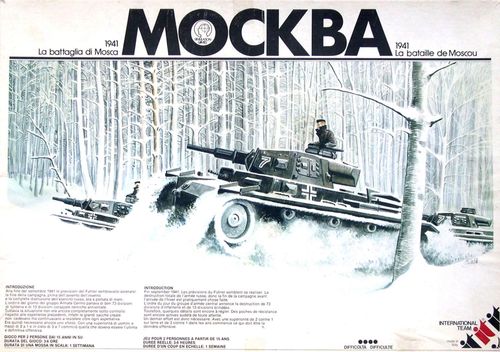
MOCKBA: La battaglia di Mosca 1941
MOCKBA: La battaglia di Mosca 1941 Rulebook
Table of Contents
Table of Contents
- Game preparation
- The game turn
- The game board
- The game pawns
- The calendar
- Allocation of German air force points
- Determining the Supply status
- First Phase of movement
- First Combat Phase
- Combat Results
- Exploitation phase
- Control Supply Situation
- Retreat
- Advance after combat
- The influence of the terrain on the Combat
- Follow-up Combat Phase
- Soviet reinforcements and rebuilding
- Victory Conditions
- Optional rules
- Terrain table
- Calendar table
- Notes on the source
Game preparation
The two halves are matched together.
The Soviet player takes a seat on the east side, the German player on the west side.
The Soviet player places all units of the armies shown on the card on the board. Those of the armies on the front line at a maximum of 6 hexes from the front line to the east and at least 3 units against the front line. The units of the three reserve armies (31, 32 and 49) on the hex with the relevant army designation or on an adjacent hex.
The German player now places all his units on the map within the indicated army borders (imaginary line to the west of the map).
Both players must take the stacking limit into account:
- German player: 3 divisions and 1 regiment.
- Soviet player: 4 divisions.
- 2 brigades count as 1 division.
See also the Order of Battle table.
Order of Battle table
The source prints an Order of Battle table for each side, grouped by "Mossa coup" (the first column) and army designation. The unit icons in the column headers are not reproduced here; each column is identified by its printed Combat Factor (CF) - Movement Factor (MF) value.
German (Tedeschi / Allemands)
| Mossa coup | Armata / Armee | 4-3 | 5-6 | 7-6 | 3-4 | 3-2 | 2-6 | 3-6 | 1-4 |
|---|---|---|---|---|---|---|---|---|---|
| 1 | 9 | 13 | 1 | ||||||
| 1 | 3P | 4 | 2 | 3 | |||||
| 1 | 4 |
Soviet (Russi / Russes)
Columns: 1-2 | 1-3 | 2-4 | 2-4 (armored) | 2-3 (cavalry) | 2-3 (infantry) | 2-3 (militia)
| Mossa coup | Armata / Armee | 1-2 | 1-3 | 2-4 | 2-4 (armored) | 2-3 (cavalry) | 2-3 (infantry) | 2-3 (militia) |
|---|---|---|---|---|---|---|---|---|
| 1 | 3 | 6 | 1 | 1 | 1 | |||
| 1 | 13 | 7 | 1 | 1 | 1 | |||
| 1 | 16 | 7 | 1 |
The game turn
Mockba has 10 game turns. Each game turn consists of two player turns: a German player turn followed by a Soviet player turn.
The player turns consist of the following steps:
German player turn:
- German Air Force Allocation
- Determine Supply status of German units
- First Phase of Movement
- First Combat Phase
- Follow-up Combat phase
- Exploitation Phase
- Control Supply situation German units
Soviet player turn:
Ditto steps 1-7. During step 1, the Soviet player receives any reinforcements (see calendar) and may deploy them.
Only the first game turn looks slightly different for the German player: after step 4), units of the 2nd Panzer Army continue their turn with steps 3) and 4) again, after which the normal steps 5) and 6) for all units of the other armies are executed.
If units are added to the 2nd Panzer Army (GD regiment or the SS cavalry brigade), the rules for units of the 2nd Panzer Army also apply to these units.
The game board
The map shows 11 major cities, the capture of which by the German player determines who wins the game. Furthermore, the Soviet fortifications are indicated in dark blue. The rivers and lakes in light blue. In black the Minsk-Moscow highway and the railway lines, as well as the initial front line and the position markings of the initial army formations. Shaded hexagons represent rugged terrain (forests and/or hills).
All full hexes and half hexes on the east and west edges of the board are playable.
The game pawns
Pawns represent divisions, brigades and regiments from the historical campaign. The Germans are gray, the Soviets brown. All pawns have a lighter colored back, on which the reduced value is indicated or which indicates that they are buried.
The following information is indicated on the units:
- the type (armor, mechanized infantry, infantry and cavalry);
- the size (division, brigade and regiment);
- the combat factor (CF);
- the movement factor (MF);
- the army designation to which the unit belongs.
Soviet line infantry with a CF of 1 have the symbol on the back that they are dug in. They are always immediately eliminated during a reduction.
Furthermore, there are explosion markers that can be used to indicate blown bridges, interrupted railway lines or units without Supply. Inverted explosion markers can be used to indicate that units have participated in a Follow-up attack and may therefore no longer be moved during the exploitation phase.
The calendar
The calendar lists the details for each game turn. Each calendar turn corresponds to 1 week in history.
Per turn it is stated:
- costs in extra movement points to cross rivers;
- air support points each turn;
- entry of Soviet reserve armies;
- cities that must have been conquered by the German player that turn;
- reduction in movement points for the German player per MF type: a unit with an MF of 2 is not reduced;
- reduction of combat factors for the German player per unit type.
Allocation of German air force points
Players may use air force points as ground support.
The German player may decide to cancel Soviet air force points. This costs him 2 air force points for every Soviet air force point.
The German player may also use his air force to reduce Soviet rail movements: for each air force point deployed, the Soviet player can move 2 fewer units by rail (in total, he may move a maximum of 12 units by rail per turn).
Finally, the German player may also use his air force to resupply units that are Out-of-Supply for that turn. This costs him 2 air force points per division and 1 point for a reduced division or a smaller unit.
Determining the Supply status
Before players move their units, they check whether they can be supplied with Supply.
To get Supply, a route must be able to be drawn from the unit to a Supply source.
A Supply route must be free of enemy units or their ZOCs, but may be passed over friendly units in enemy ZOCs.
A ZOC (Zone of Control) is all hexagons adjacent to a unit. For the Germans, Supply comes from the hexagons on the western edge of the map, for the Soviets, Supply comes via hexagons on the eastern edge and northern edge (east of the railway line) of the map.
The Soviets may also obtain Supply via unbroken/unoccupied railway lines, which leave the map on the north, east and south sides.
The Soviets are also allowed to supply 1 unit on the west side of Lake Seliger through this lake.
In any case, a Soviet supply route from the farthest point of a continuous railway or board edge hexagon to a unit may never be longer than 20 hexes.
If German units enter a Soviet railway line, it will be interrupted. Over an interrupted railway hex, the Soviets cannot move railways or draw supplies. Indicate a broken railway hexagon by placing an explosion pawn on it. If a Soviet unit remains on an interrupted railway hexagon for an entire movement phase, it is repaired again.
If units cannot be supplied with Supply, they are marked with an unsupplied (OOS) marker or explosion pawn.
First Phase of movement
A player may move all his pawns during this phase within the limits of the MF and the restrictions indicated on the calendar.
A unit can move at least 1 hex (even if it has insufficient MF).
Entrenchment: Soviet Infantry with a strength of 1 CF may also dig in instead of moving. To do this, the unit is turned over and given a CF of 2 (MF=0). Of course, they may also do this in the second movement phase/exploitation phase.
The influence of terrain on unit movement
Open terrain costs 1 MF for all units.
Movement via the main road costs 0.5 MF.
Entering rough terrain costs mechanized units and armored units 2 MF.
Lakes are impassable.
Depending on the weather conditions, crossing rivers costs 1 or 2 extra points (see calendar).
The influence of enemy units on unit movement
Units may never be moved onto/over enemy units. Each unit has a ZOC (Zone of Control) over the adjacent hexes.
Exception: German units have no ZOC against a Soviet fortification hex if they are in front of it.
A ground unit must immediately end its movement if it enters an enemy ZOC.
Only Armored units (Panzer 7-6, Tank 2-4) may move from enemy ZOC to ZOC. However, this costs 1 MF extra.
German unarmored units may also be moved to an adjacent hex in a ZOC in the first movement phase when they start in an enemy ZOC, after which they end their movement.
Rail Movement
Travel by rail (Soviet only): unlimited.
Soviet rail movement may never take place over interrupted railway hexes, German units or their ZOCs. The 12 Soviet units that may be moved by rail apply to both movement turns together.
First Combat Phase
Combats take place between enemy units in adjacent hexes. A combat is optional. The attacker determines the order of battles to be carried out.
Adjacent units do not need to be attacked.
A battle is defined as an attack by units of one or more hexes against all enemy units in a hex.
A unit may never make more than one attack during a Phase.
A unit can suffer multiple attacks if it is withdrawn from friendly units and then attacked. The previously withdrawn units do not add their strength to the attacked units, but they do suffer their fate.
The attacker first counts all his CFs, possibly reduced by terrain. Then the defender does the same.
During an attack, the attacker indicates whether air support will be provided (maximum 1 air force factor per attacking unit).
The defender may then allocate any air support (maximum 1 air force factor per attacked hex).
The ratio between modified combat factors of attacker and defender is determined and rounded in favor of the defender. Any column shifts in favor of the Soviets if these fortifications are defended will only be applied once the final ratios have been determined (i.e. never greater than 7:1).
The final ratio can never be greater than 7:1 or less than 1:3. An attack may not be performed if the ratio is less than 1:3.
The attacker rolls a die and the combat result can be read based on ratios and the roll.
Combat Results
AE/DE: all attacking or defending pawns are eliminated.
AR/DR: all attacking or defending pawns are reduced. Already reduced pawns or Soviet Infantry (1 CF) are destroyed upon reduction. [Source text: "Already reduced pawns or become Soviet Infantry (1 CF)destroyed upon reduction." Wording restored.]
A1/A2: The attacker must withdraw all his pawns 1 or 2 hexes. If possible, a retreat should take place towards a player's Supply sources.
D1/D2: Same for the defender.
D3: Same, but 3 hexes and the attacker decides where the defender is withdrawn. If possible, in the direction of a player's Supply sources. [Source text: "...the attacker decides where to go defender is withdrawn. If possible in the directiona player's Supply sources." Wording restored.]
EX: All defending units are eliminated. The attacker loses as many CFs as defender owned, modified to terrain.
They are not allowed to participate in the exploitation phase.
The German player has no follow-up Combat Phase (and exploitation phase) in the 5th, 6th, 8th, 9th and 10th game turns.
Combat Results Table
| Die | 1/3 | 1/2 | 1/1 | 2/1 | 3/1 | 4/1 | 5/1 | 6/1 | 7/1 |
|---|---|---|---|---|---|---|---|---|---|
| 1 | AE | AE | AR | A1 | EX | D1 | D2 | D3 | DR |
| 2 | AE | AR | A2 | EX | D1 | D2 | D3 | DR | DE |
| 3 | AR |
Exploitation phase
All units that did not participate in the previous phase may be moved again.
German non-armored units may no longer be moved from ZOC to ZOC at their start.
German units are restricted in their movement during their 3rd, 4th and 7th exploitation phases.
Control Supply Situation
At the end of a player's turn.
If unsupplied units marked with an OOS or explosion marker can no longer draw Supply, they will be reduced.
Reduced units of Soviet 1-CF infantry are destroyed.
All units will now have their unsupplied or explosion markers removed.
Retreat
Non-armored units may only withdraw over friendly units in enemy ZOCs.
Only Armored units may withdraw through enemy ZOCs.
Instead of retreating, a player may also reduce all his units. One cannot withdraw some units and reduce others. It's one or the other.
After a retreat, the stacking limit must be respected.
Advance after combat
Only if the attacked hex is vacant can the attacker occupy this hex with attacking units. This move may always be performed, even if it concerns movement from an enemy ZOC to another.
In fortifications, the vacant hex may only be occupied if the defender is eliminated.
The influence of the terrain on the Combat
Units attacking across a river are halved.
Armor units attacking rough terrain are halved.
CF halved: rounded up (3 CF / 2 = 2 CF).
Non-entrenched infantry units that defend cities are doubled in combat power.
If Soviet units defend fortifications against a German attack that goes completely against the fortifications, they receive a Shift of 2 columns to the left on the CRT. If an attack is made from both the front and the side, only 1 Shift to the left is obtained. The defender has no advantage against attacks from the side or behind.
Due to terrain (and weather) conditions, an attacking unit can never be less powerful than 1 CF.
Follow-up Combat Phase
All units adjacent to the defender's units may attack them again.
Soviet reinforcements and rebuilding
Soviet reinforcements that have an Army designation must enter the map via a railway line or hex on the map edge.
Soviet militia infantry (1-2s and associated armored units) or rebuilt units (turn 3) must be deployed on friendly cities.
No more than 2 armored units may be rebuilt.
When deploying reinforcements, the stacking limit applies. Reinforcements may also enter the game later than indicated.
Victory Conditions
The calendar shows the 10 cities that the German player must conquer before or on the indicated turn in order to earn points. He receives 1 point for each city captured in time.
For Moscow 8 points.
So a total of 17 points can be earned.
The German player loses 1 point for every city that he does not capture in time or that is recaptured by the Soviets.
Final score:
- 1-4: Soviet victory;
- 6-17 points: German victory.
[The source gives no result for a final score of 5. It is transcribed as printed.]
Optional rules
Optional (1): Soviet dug-in infantry does not possess ZOC.
Optional (2): During turns 1 through 7, units have none ZOC to the other side of a river.
Optional (3): A number of bridges appear in the game. The Soviet player may attempt a bridge instead of an attack to blow if located at a distance of 5 hexes from the bridge there is a German unit. This works with one die: it becomes 5 or 6, and only a 6 if the side of the bridge there is also a German unit. [Source text is garbled by typesetting; this reading is the most consistent reconstruction of the printed words, and the bridge rule should be checked against the original Dutch edition if it matters for play.]
Optional (4): If the defender loses a unit during a Follow-up Combat Phase and gained advantage of the terrain, the attacker must reduce one of his attacking units.
Optional (5): In the later version of EURO-GAMES there is the rebuilding of 11 divisions instead of units!
Optional (6): On turn 4 the Soviet player receives 1 para unit. He may drop this in a turn if his air force is not completely suppressed by that of the German. During the dropping operation, the para-unit is Supplied. During the dropping, the Soviet player rolls a die: on a roll of 4 to 6, the unit is reduced after landing. The unit may not be moved during the first phase of movement.
Optional (7): One of the German motorized divisions of the 4th Panzer Army was the "Das Reich" division. This unit had 1 extra regiment and is therefore a 6-6.
Terrain table
| Terrain | Movement | Combat |
|---|---|---|
| Clear | 1 MF | |
| River | +1 MF; Turns 4, 5: +2 MF | AF x 1/2 |
| Rough | Inf-Cav: 1 MF; Pz-Tk-Mec: 2 MF | Pz-Tk AF x 1/2 |
| City | Inf DF x 2 | |
| Fortification | Ratio -2 (-1 from the side) | |
| Road | 0.5 MF |
Calendar table
The calendar is printed as a table. "GER" is the German player, "RUS" the Soviet player. Air Points are the air force points each side receives that turn. "GER MF Reduction" gives the movement-point reduction for the German player in the first movement phase and in the exploitation phase, per MF value (6, 4, 3). "GER CF Reduction" gives the combat-factor reduction for German Panzer units and for other German units. A dash means no entry in the source.
| Turn | River | Air Points GER | Air Points RUS | RUS Reinforcement | GER Goals | 1st Mvt Phase MF 6 | 1st Mvt Phase MF 4 | 1st Mvt Phase MF 3 | Exploitation MF 6 | Exploitation MF 4 | Exploitation MF 3 | GER CF Reduction Panzer | GER CF Reduction Other |
|---|---|---|---|---|---|---|---|---|---|---|---|---|---|
| 1 | +1 | 10 | 3 | ||||||||||
| 2 | +1 |
(In the source, "No" in the exploitation columns is printed once across the three MF columns for that turn.)
Notes on the source
- The source document is a third-party English translation of the Dutch-language rules, formatted into three columns. It is not the publisher's own English edition.
- The source contains typesetting errors (overlapping or merged words). Where the intended wording is clear, it has been restored and marked in brackets. Where it is not, the printed text is kept as is and flagged.
- Where the source is silent (for example, the result for a final score of 5), nothing has been added.