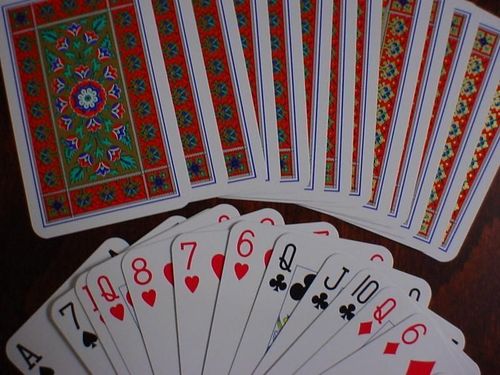
Mizerka
Mizerka Rulebook
Table of Contents
Table of Contents
Setup
Mizerka is a three-player game using a standard 52-card pack. The cards in each suit rank as usual, from ace (high) down to two (low). The game is played clockwise.
Any player may deal first, and the turn to deal passes clockwise after each deal.
Contracts
In each deal the player to the dealer's left chooses among six possible contracts:
- clubs
- hearts
- spades
- diamonds
- no trumps
- mizerka
Each player must choose each contract once. After 18 deals, when everyone has played every contract, the game ends.
In the first four contracts (clubs, hearts, spades, diamonds) the aim is to win tricks, with the named suit as trumps. In "no trumps" the aim is to win tricks, but without a trump suit. In mizerka there are also no trumps, but the aim is to avoid winning tricks.
Dealing
The dealer deals the cards one at a time into four piles: a hand for each of the three players and a talon.
After six cards have been dealt to each player, the deal pauses. The player to the dealer's left must select the contract on the basis of his or her first six cards. After the contract has been announced, the deal is completed, so that each player has a hand of 13 cards and there is a face-down talon of 13 cards.
Exchanging Cards
The player to the dealer's left may now discard any number of unwanted cards and replace them by drawing cards from the top of the talon. Having drawn replacement cards, the player is not allowed to discard any further cards.
The player to the dealer's right may then discard any number of cards, up to the number of unused cards remaining in the talon, and replenish in the same manner.
Finally, if there are any cards left in the talon (which is unusual), the dealer may do the same.
No player is obliged to discard any cards at all. You may play with your original hand if you wish to.
Play
The player to the dealer's left leads to the first trick.
Players must follow suit if possible. A player who has no card of the suit led may play any card. There is no obligation to trump or to overtake.
The trick is won by the highest trump played, if any, or otherwise by the highest card of the suit led. The winner of a trick leads to the next.
Quotas and Scoring
Each player has a quota of tricks to make, and scores according to the number of tricks they win more or less than their quota.
The quotas and scores are as follows:
| Player | Trumps or no trumps: Quota | Trumps or no trumps: Score | Mizerka: Quota | Mizerka: Score |
|---|---|---|---|---|
| Left of dealer | 7 tricks | Each trick above quota scores +1. Each trick below quota scores -1. | 1 trick | Each trick above quota scores -1. Each trick below quota scores +1. |
| Right of dealer | 5 tricks | (not stated in source) | 5 tricks | (not stated in source) |
| Dealer | 1 trick | (not stated in source) | 7 tricks | (not stated in source) |
Editor's note: the source gives a quota for each player in both contract types, but states the per-trick scoring only for the player to the dealer's left. The scoring for the player to the dealer's right and for the dealer is not printed in the source and is left blank here rather than guessed.
Scoresheet
The scoresheet has a left-hand section headed "NT" and "Miz", in which an "X" is marked to show the contracts that each player has chosen. The cumulative scores of the players are kept in the area to the right.
The scoresheet is laid out with one row per player (Player A, Player B, Player C).
Example
Suppose that in the first deal player A chooses hearts as trumps and wins 5 tricks, while B and C each win 4 tricks. Then A loses 2 points, B loses 1 point, and C wins 3 points.
In the second deal, player B plays a mizerka and wins 2 tricks. C wins 6 tricks and A wins 5. So B and C each lose a point, and A wins 2 points.
The scoresheet would then look like this. The source prints it as a flat line of text, reproduced here as printed:
NT Miz Player A X -2 0 Player B X -1 -2 Player C +3 +2
Editor's note: the source's text rendering of this example does not preserve the column alignment, so only the values are given here.
The scores always add up to zero. The score after all 18 deals have been played indicates how much each player has won or lost.