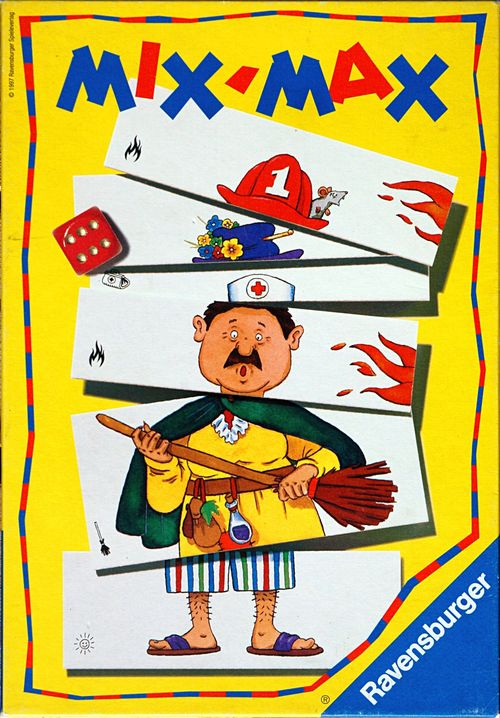
Mix-Max
Mix-Max Rulebook
Table of Contents
Contents
- 1 die
- 15 animal cards (cut into 4 pieces each)
- Rule set
Round # 1
Roll for fantastic animals: All animal card pieces have a die symbol on the backside (1 for all heads, 2 for all necks, 3 for all bellies and 4 for all legs). The card pieces are sorted by the number symbol on their back. Then, each pack is shuffled separately and placed as a face-down stack on the table. The dice symbol is up and the stacks are placed next to each other in ascending order.
Game play: The youngest player begins. The die is rolled in turn order. Depending on the outcome of the roll, it is possible to get one or more cards, or even none. When a 1, 2, 3 or 4 is rolled, the player takes the topmost card from the matching stack. When the stack with this number is already depleted, the player gets no card and may also not roll again.
When a 5 is rolled the player gets nothing and passes the die to the next player.
When a 6 is rolled, the player may take the topmost card from each stack. In this way he gets 4 cards. If one or more stacks are depleted, he gets one or more less cards. Players do not roll again after a 6.
Each player collects his gained cards in front of him. When there are no more cards in the middle of the table, players attempt to create as many fantastic animals as possible. One condition: Each animal must have a head, neck, belly and legs.
Scoring: For each complete fantastic animal the player gets 1 point. Separate pieces or incomplete animals don't score anything.
At this point it would be very funny to name your best fantastic animal and start telling a little story with it, or explain where it lives and what it eats and what it does etc.
Round # 2
Robbers at the Zoo: piece by piece the correct animals are put together out of the fantastic animals.
Preparation: Each player keeps the cards he gained from the first round and sorts them with the help of the symbols. Cards from the same animal are placed together, with matching heads, necks, bellies and legs. If in this way, a player gets to collect all 4 parts of the same animal, he can put it aside for end of game scoring.
Game play: In front of each player are now incomplete animals and separate cards. The missing cards must again be collected with the roll of the die, but this time, players can steal the resulting cards from another player.
Important: It is only allowed to steal from another player, if the player owns at least one card from the corresponding animal. This also accounts for the roll of a 6.
Example: when you roll a 1, you may choose a missing head for one of your existing animals, when you roll a 2 you may choose a missing neck, when you roll a 3 a missing belly and with a 4 the missing legs to one of your animals.
Again, a roll of the 5 five gets you nothing.
If you roll a 6 you may steal all missing cards for one animal of which you have at least one card already, so you may steal a maximum of 3 cards.
If you roll a number of which you already have all the parts (Example: a 1, when you already have heads for each of your animals) then you may not steal anything and pass the die to the next player.
Scoring: The game ends when all animals are put together correctly again. For each complete animal the player scores 1 point. The clown animal is a special case. Since there are two clowns hidden under costumes, the player gets 2 points for it. Then, the points of both rounds are added up and the player with the most points wins.