Mitsudomoe
Mitsudomoe Rulebook
Table of Contents
Table of Contents
Goal
Get all 3 of your balls to your goal spaces opposite your starting corner, or be the last player remaining in the game.
Equipment
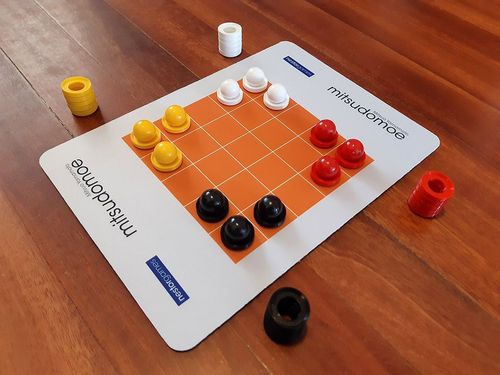
1 gameboard depicting a 5 × 5 grid, 12 balls (3 each in black, white, red, and yellow), 32 rings (8 each in black, white, red, and yellow), carrying case.
Setup
Each player selects a colour. Take the 3 balls and 8 rings of your colour. Then place one of your rings on each of the 3 starting spaces that are in a corner of the board, according to the image below. Atop each of your starting rings, place a ball of your colour. The player wearing the largest garment matching their player colour goes first. Play goes clockwise.
The 2-player, 3-player and 4-player setup diagrams are images in the printed rulebook and are not reproduced here; the placement they show is described by the text above.
General Rules
- Once a component is in play, it never leaves the board.¹
- A ball can only sit directly on a ring of the same colour.
- Adjacent means "orthogonally or diagonally adjacent".
- Once a ball reaches one of its goal spaces, it never leaves that space.
How to Play
Your turn consists of two steps:
- Place or move one of your rings.
- Move one of your balls.
If you are unable to perform either of those steps, you are out of the game; if more than one player remains in the game, remove all of your balls (not the rings). Remove your rings as they get exposed during the game.
1. Place or Move One of Your Rings
Either place a new ring from your supply, or move an exposed ring of yours on the board (it must have neither a ring nor a ball atop it). The destination space can be any space that does not have a ball in it; however, the space can have any number of anyone's rings already there. Place your ring on top (of the stack or empty space).
2. Move One of Your Balls
Move one of your balls that has not yet reached one of your goal spaces, either by moving it to an adjacent space that has your ring on top (but no ball), or by vaulting over anyone's adjacent ball.
Vaulting Over an Adjacent Ball
Your ball can vault over any number of balls in a straight line, and it does not matter to which players those balls belong (all yours, all opponents', yours and opponents'). The first space after that line of balls must have a ring of your colour on top, because that is where your ball must land, and a ball can only sit directly on a ring of the same colour. If you do not have the topmost ring in that first ball-less space, you cannot vault in that direction (if you want to vault to that space, be sure to place a ring there in the ring step of your turn).
Finally, relocate each ball over which you vaulted that belongs to an opponent. As always, a ball can only sit directly on a ring of the same colour. If you must relocate several balls, you can choose the order in which you do this.
Example: The white ball vaults over two adjacent balls, landing on a white ring. Then the White player moves only the black ball jumped over to different black ring.
If there are no valid destinations for a ball you must relocate, you cannot perform the vault that would relocate it.
Your ball cannot vault over an opponent's ball that has reached a valid goal space, because once a ball reaches one of its goal spaces, it never leaves that space, and vaulting over opponents' balls requires relocating them.
Game End
If, at the end of your turn, all of the balls of your colour are on the home spaces of the opposite corner of the board, you win the game.
If, at the end of your turn, you have not won, and your three home spaces are filled with balls of any colours, you are out of the game.² If more than one player remains in the game, remove all of your balls (not the rings). Remove your rings as they get exposed during the game.
¹ With the exception of pieces of eliminated players.
² Rule added by Néstor, to prevent passive play.