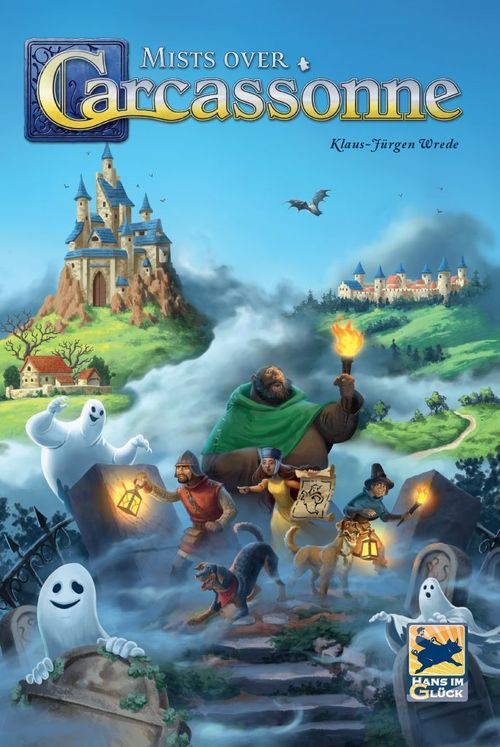
Mists over Carcassonne
Mists over Carcassonne Rulebook
Table of Contents
Table of Contents
Game Components and Setup
First, let's look at the land tiles. The 60 land tiles picture roads, cities, castles, and cemeteries.
Additionally, most of the land tiles show mist. In the mist, you will always find one or more ghosts, that you must pacify during the game. We will explain more about ghosts later.
Tile types: a tile with a city; a tile with a castle, road, and mist; a tile with a cemetery and city.
First, place the new starting tile, as shown, in the middle of the table. For Level 1, return all 5 cemeteries and all 5 castles to the box. Shuffle the remaining land tiles and place them in a face-down supply on the table, so that everyone can reach them. (The starting tile counts as 4 regular-sized tiles.)
Note: Setup for the other levels is a bit different, see the Level sections below.
Take the scoring track and place it near the edge of the table.
Place the level summary next to the scoring track. This will show you which tiles you need (or not), and how many points you need to reach each level. For Level 1, that's 50 points. Thus, place the goal tile onto space 0/50 of the scoring track.
Return the 2 hounds to the game box.
Now, let's look at your playing pieces, which we call meeple (i.e. 'my people'). These represent your followers. They are a bit different from the meeple in the base game and are called guard meeple. But for these rules we'll just refer to them as meeple. There are a total of 30, 5 in each color: Red, Green, Blue, Yellow, Black and Pink.
Give each player (including yourself) 5 meeple in their chosen color. These form each player's supply. Then, place 1 meeple in an unchosen color onto space 0/50 of the scoring track. This is your scoring meeple. Return the rest of the meeple to the box.
Changes for 2 player- and solo game: Give each player 6 meeple in 2 different colors (3 per color). For the solo game, you take 12 meeple in 4 colors (3 per color). Then put 1 meeple in an unchosen color onto space 0/50 of the scoring track.
Finally, place 15 ghosts as a general supply next to the scoreboard. Place 3 of the ghosts on the ghost symbols shown on the starting tile.
Object of the Game
Players take turns, adding a new land tile to the board each time. This creates an ever-enlarging game board onto which you place your meeple to score points. During the game, ghosts will keep appearing – your job is to pacify them. Together, you must reach the goal tile, i.e. score a pre-determined number of points. But watch out: If there are too many ghosts on the board, or you can't draw land tiles any more, you lose the game. All players play together against the game. Show each other your tiles and decide as a team where to place them. In later levels especially, you will need to cooperate well!
Gameplay
Play in clockwise direction. Whoever is reading these rules is the start player. Each turn, you must execute a set of actions in a specific order. We will explain as if you are doing everything; you can then explain it to your fellow players. Any details about the following actions will be explained later in the rules, when they become relevant.
- Place a new land tile — You must draw exactly 1 new land tile from the face-down supply and place it next to at least 1 existing tile.
- Place ghosts and meeple — If mist is shown on the just placed tile, then you must worry about ghosts (see "Placing Ghosts" below). You may then place exactly 1 meeple from your supply on the just-placed tile.
- Score points — Finally, you must complete all scoring triggered by the placing of your tile.
Roads
1. Place land tile
The tile you just drew shows 3 roads coming out of a village. You place it next to an existing land tile. You must make sure that one of the new roads connects to an existing one. (Example: you placed this tile — the road matches the road and the field matches the field. Well done!)
2. Place a meeple
After placing the land tile, you may place a meeple onto one of the tile's roads. However, that is only allowed if the road is still unoccupied. (Example: you placed a meeple onto the tile you just placed. Since the road was unoccupied, this was legal.)
It is then the next player's turn. They draw a land tile and add it to the board. The right-hand road coming into the village is already occupied. Your fellow player therefore cannot place a meeple onto it. They decide to place their meeple onto the other road on the just-placed tile instead. (The right hand road is already occupied. Blue, therefore, decides to place their meeple onto the other road.)
Change in 2 player- and solo game: Each turn, you may place a meeple in any of your colors.
3. Score points
Whenever a road is finished at both ends, it counts as complete and is scored (e.g. when a road ends in a village, city, or loops back onto itself). So when a road is completed on both ends, scoring is triggered. In this example, your fellow player placed the tile that finished the road with your meeple on it. Each tile the finished road is on is worth 1 point. Since this road is 3 tiles long, it is worth 3 points.
Now the scoring track comes into play. It tells you what score you need to reach with your remaining tiles. Each time you score, you get closer to the goal.
Since your fellow player triggered the scoring, you move the scoring meeple 3 spaces forward on the scoring track. Finally, retrieve your meeple from the completed road, returning it to your supply. (Take the meeple that just scored you 3 points and return it to your supply. The blue meeple stays on the board, since it wasn't involved with the scoring – it's on a different region. That road isn't finished yet, so you haven't scored it yet.)
You now understand the most important parts of the game. That wasn't hard at all, right? Let's now look at the other types of regions:
Cities
1. Place land tile
Draw a tile to add to the board. If your tile shows a city, you may add it to an existing, incomplete, city. Remember that the sides of the tiles must match.
2. Place a meeple
Next, check if the city already has a meeple in it. If not, you can place one of yours (add it to the city on the tile you just placed). (Example: you placed the tile such that this incomplete city is now 1 tile larger. The city is unoccupied, so you may add one of your meeple to it.)
3. Score points
Let's fast forward a bit and assume that you drew this tile on your next turn. Since the edges match, you can add it to the city with your meeple in it. Once a city is completely surrounded by city walls, it is complete. That is the case here. Since you have a meeple in this city, you now score it.
Each tile the finished city is on is worth 2 points. Additionally, each shield in the city is worth 2 extra points. After scoring points, return the meeple from the city to your supply. (In the example, you score 8 points! As with any other scoring, move the scoring meeple that many spaces forward.)
Mist and the Ghosts
1a. Place land tile
As usual, draw a tile to add to the board. This tile shows mist in addition to the road. Mist always covers a field or a road, never a city. As usual, you must place the tile such that road matches road and field matches field. When doing so, you do not need to worry about the mist. In other words, you can place a misty road next to a clear road, or the other way around. The same counts for misty fields. (Example: you draw this tile with mist on it. You decide as a team where to place it. You decide to place it next to the rightmost tile, lengthening the road and ignoring the mist.)
1b. Check mist
Now, check to see if a mist bank has been finished. Mist counts as finished when it is surrounded on all sides (i.e. there is no way to make it larger – this works in the same way as with a city). It can never be finished as soon as one side is next to a field or road without mist.
If you finished a mist bank, remove all ghosts from the associated mist, returning them to the general supply. We'll explain how the ghosts got there in the first place now. (Example: you place this tile, finishing the mist bank. You remove all 3 ghosts from the mist.)
2a. Place ghosts
If the mist bank is not finished, place as many ghosts on the tile you just placed as there are ghost symbols on it.
If you expanded at least one mist bank (i.e. matched at least one side of the tile you just placed with mist already on the board), then you place one fewer ghost on the tile. If the tile only shows a single ghost, then you don't need to place any ghosts. (Example: first you place a tile showing 2 ghost symbols and place 2 ghosts on it. On a later turn, you place a tile expanding the mist. Since there is only 1 ghost symbol on it, you don't need to place any ghosts. Well done!)
Ghost Supply — Important: If, at any time, there are fewer ghosts left in the supply than you need to place on a tile, you immediately lose the game (see Game End, below).
2b. Place a meeple
You can place your meeple like usual onto a road or city (or, in later levels, onto a castle – more on that below). You may place your meeple on a road, even if it is covered by mist. However, you cannot place a meeple on a field (with or without mist).
3. Scoring: Points or remove ghosts
While you can finish mist banks, they never trigger scoring (as described above, you remove ghosts instead). However, placing the tile can also trigger scoring in the usual manner.
When placing a tile triggers scoring – regardless of whether there was mist on the tile or not – you always have 2 options:
- Either score the points as usual.
- Or remove up to 3 ghosts from exactly 1 tile of your choice, returning them to the supply.
(Example: you finish the road. Instead of scoring 4 points, you choose to remove the 3 ghosts from the topmost tile instead.)
Special case: When a single tile triggers scoring more than once, the active player decides what happens for each scoring separately.
Remember: The starting tile counts as 4 tiles.
Joint Scoring
You can help each other by connecting your regions. However, that can only be done indirectly, and takes some teamwork. If you manage it, then you can score significantly more points for your roads and cities. We will use roads as an example of how this works.
The tile that you just drew, could be placed so that it finishes the existing road. However, the road is already occupied by one of your teammate's meeple. So you would not be allowed to add a meeple of your own. Instead, you decide to place the tile such that the roads are not (yet) directly connected.
On one of your next turns, you draw this tile and add it to the two unfinished roads, joining (and finishing) them. There are now 2 meeple on the road. Since the road is finished, it triggers scoring. Each of you scores 4 points, i.e. 8 points total. Return the meeple to your personal supplies.
You only get additional points if meeple of different colors are involved in one scoring. Then, you get again as many points for each other color involved. Of course, this also applies to cities. However, it does not matter if there are several meeple of the same color in the scored area.
Game End
In Mists over Carcassonne, you either win or lose as a team. There is no final scoring. The end of the game can be triggered in various ways:
VICTORY: You reach or pass the goal tile on the scoring track. You have scored enough points (50 in Level 1) and won! Congratulations, you can now advance to the next Level.
DEFEAT:
- There are no tiles left in the supply, but you haven't reached the goal tile yet: You have lost, unfortunately, and will need to try the Level again.
- There are fewer ghosts left in the supply than you need to place on a tile: You have lost, unfortunately, and will need to try the Level again.
Now you know how to play the first Level of Mists over Carcassonne. As soon as you win it, you can keep going with the next Level. We will now explain the differences and new elements included with each Level. Any rules that don't specifically change or remove remain in effect.
Level 2
Level 2 introduces 2 new types of land tiles to the game. Setup is the same as for Level 1. This time, however, add the 5 castles and 5 cemeteries to the rest of the tiles. All tiles are now in the game. Additionally, you now need to score more points – 75 to be exact.
Place the goal tile on space 25 of the scoring track. You will now need to reach it twice. To make that easier to see, you can place the goal tile gray side up, flipping it colored-side up when you reach it the first time. If you reach it a second time, you have won.
Castles
1. Place land tile
Draw a tile as usual. This time, it shows a castle. There is also a road that ends at the castle. As usual, you must make sure all edges match when adding the land tile to the board.
2. Place a meeple
You may place a meeple onto the castle instead of the road. As usual, you may only place 1 meeple.
3. Score points
Score the castle as soon as it is completely surrounded by land tiles. Score 2 points for each surrounding tile with mist on it (including the castle tile itself).
(Example: hurray! When one of your fellow players places a tile, your castle is completely surrounded. Scoring will occur at the end of their turn. There are a total of 5 tiles with mist on them around the castle, plus the castle tile itself. You score 12 points and return your meeple to your supply.)
Cemeteries
1a. Place land tile
This time, on your turn, you draw a land tile with a cemetery on it. There is also a city on the tile. Add the tile as usual such that the edges match – nothing else happens for now.
1b. Bury a meeple
As soon as tiles are added to all 4 sides of the cemetery tile (left, right, top, bottom), you must bury a meeple. That means you must take a meeple from somewhere else on the board and place it laying down onto the cemetery, where it will remain until the end of the game.
Then, remove all ghosts from this cemetery tile. We will explain how ghosts end up in the cemetery in the next section.
Special case: If you don't have any meeple on the board, you must use one from your supply instead. If you bury a meeple where a hound (see Level 3) was added to, remove the hound from the game.
(Example: you added the cemetery to the board on a previous turn. Now, you place a tile next to the cemetery. You decide as a team that yellow will place a meeple onto the cemetery, burying it. From now on, they will play the game with one fewer meeple. At least you were able to pacify 1 ghost in the process, returning it to the general supply.)
2a. Place ghosts
Each time you or another player need to add at least 1 ghost to the mist, you must also add 1 ghost to 1 open cemetery on the board. A cemetery is open as long as at least 1 of its 4 sides is still open. If there are multiple open cemeteries, you can decide as a team where to add the extra ghost. If there aren't any open cemeteries, then you don't need to add any extra ghosts.
Note: Instead of scoring points, you can remove up to 3 ghosts from the cemetery, too (see Game End rules above).
(Example: you place a tile and must add 2 ghosts to it. Unfortunately, the cemetery isn't closed yet, which means you must also add 1 ghost to it. Finally, you place a meeple onto the city.)
2b. Place a meeple
You cannot add a meeple to the cemetery itself. You may, however, place one onto a road or city on the tile as usual.
Level 3
After shuffling all 60 land tiles, create 3 equal-size piles of 20 tiles each. These symbolize how much time you have to score points. From now on, you must draw from a single pile until it runs out. Only then can you start drawing from the second, or later the third, piles.
Additionally, you must score a certain number of points while drawing from each pile. To mark these points, use the 2 hound tiles.
Place the hound marked with 1 (Rufus) onto space 15 of the scoring track. You must score at least that many points before the first pile runs out.
Place the hound marked with 2 (Ronja) onto space 0/50 of the scoring track. You must score at least 50 points before the second pile runs out.
You must reach the 0/50 space a second time before the third pile runs out, so place the goal tile onto that space too. You must score at least 100 points total to win. Failing to reach any of these pre-set scoring requirements means that you lose the Level.
Hounds
The two hounds don't just mark how many points you need to score per pile, they also help you pacify ghosts.
As soon as the scoring meeple reaches or passes a space with a hound, the following happens:
You must immediately place Rufus. Add him to any non-buried meeple on the game board. You may then remove up to 3 ghosts each from any 2 different land tiles directly adjacent (orthogonally or diagonally) to him (including the tile you placed him on itself). Return these ghosts to the general supply as usual.
(Example: you scored 8 points with your last tile and moved the scoring meeple to space 16 of the scoring track. Since you passed Rufus, who was on space 15, you have succeeded with the first pile! Your meeple is in a good spot, so you add Rufus to it. You choose the tile Rufus is now on and remove 2 ghosts. Additionally, you choose the cemetery tile and remove 3 ghosts from it, returning all 5 of them to the general supply. You will need to leave 1 ghost behind on the cemetery tile.)
Afterward, take any tiles left in the first pile and put them on top of the second pile. You'll have a little more time to score the 50 points needed for the second pile. Once you do, add Ronja to the board in the same manner.
3. Score points
A hound stays with the meeple you added them to until that meeple is scored. After scoring the meeple, score the hound. When scoring a hound, it doesn't matter if you chose to score points or pacify ghosts when scoring the meeple. During hound scoring, you score 1 point for each ghost currently on the game board.
Important: You can never choose to forego points when scoring a hound to remove ghosts instead.
After scoring, return the hound to the game box. It has earned a rest until the next game.
Score Rufus and Ronja in the same manner.
(Example: you finish the city. After scoring it, you score Rufus. Return your meeple to your supply and remove Rufus from the game.)
Level 4
Setup for Level 4 is generally the same as for Level 3. However, return 2 ghosts to the game box – in Level 4 you'll only have 13 ghosts available.
Additionally, you will need to score more points with each pile. Place Rufus on space 20 of the scoring track (you'll need to score 20 points by the end of the first pile). Place Ronja on space 10 of the scoring track (you'll need to score 60 points by the end of the second pile). Place the goal tile on space 20 of the scoring track too, to show that you'll need to score 120 points total. Otherwise, there aren't any rules changes for this Level.
Level 5
Now it gets particularly challenging, as the cemeteries are haunted and don't work the way you are used to. Setup is the same, but the scoring requirements are different. We will quickly summarize them:
Shuffle all 60 tiles and separate them into 3 equal-size piles. Return 2 ghosts to the game box.
Place Rufus on space 15 of the scoring track (you'll need to score 15 points by the end of the first pile).
Place Ronja on space 0/50 of the scoring track (you'll need to score 50 points by the end of the second pile).
Place the goal tile on space 0/50 of the scoring track too, to show that you'll need to score 100 points total.
Haunted Cemetery
1a. Place land tile
When you draw a cemetery, place it as usual.
1b. Bury a meeple
As soon as the cemetery tile is completely surrounded by 8 land tiles (as when scoring a castle), you must immediately bury a meeple. That means you must take a meeple from somewhere else on the board and place it onto the cemetery laying down, where it will remain until the end of the game. The cemetery is now closed.
Note: Cemeteries aren't closed with only 4 tiles any more.
2a. Place ghosts
You just placed a cemetery. Now you must add 1 ghost to each tile with mist on it around the cemetery. It doesn't matter if the mist bank is finished or not, or if any ghosts are already on the tile or not.
2b. Place a meeple
You cannot add a meeple to the cemetery itself. You may, however, place one onto a different region on your tile, as per usual.
(Example: unfortunately, you drew a cemetery tile. You place it into the indicated space. You then add a total of 3 ghosts to the mists around the cemetery. Finally, you place a meeple onto the road.)
3a. Score points
If you finished a region when placing the tile, score it as usual.
3b. Face-down tiles
Haunted cemeteries cause you to gradually lose tiles. As long as at least 1 cemetery is still open, you must now draw 1 tile without looking at it. You must then place it face-down adjacent to an open cemetery. Face-down tiles may be placed adjacent to any type of terrain (roads, cities, etc.), but do not finish anything except cemeteries. All other regions with a face-down tile adjacent to them are 'haunted' and cannot be finished any more. This also counts for castles: If a face-down tile is placed around a castle, then it can't be finished any more either.
Even if more than one cemetery is open, you still only draw and place 1 face-down tile. In this case, you can choose which cemetery to place it adjacent to.
New face-up tiles can only be placed adjacent to face-down tiles if they also share at least one edge with a different, face-up tile already added to the board. You may place face-down tiles next to other face-down tiles.
(Example: the cemetery is still open. Therefore, you draw a face-down tile after your usual turn and place it adjacent to the cemetery. This blocks a meeple that was on it. It can never be scored.)
Remember: Face-down tiles count when finishing (closing) a cemetery and subsequently burying a meeple.
(Example: the cemetery is now closed. You don't have to draw face-down tiles any more. You decide as a team to bury the meeple.)
Level 6
In the final level, you don't have a common scoring meeple. Instead, you take 3 meeple in 3 colors, that take part in the game, and place them onto the 0/50 space of the scoring track. You choose the colors of the meeple.
Note: In a 3 player game, every player (color) has its own scoring meeple.
Important: In a 2 player- & solo game, you don't take the 3 meeple from your personal supplies, but from the game box.
Return 3 ghosts to the game box. Shuffle and split the tiles into 3 equal-size piles. Place the hounds on spaces 10 and 25 of the scoring track. Place the goal tile on space 0/50 of the scoring track.
The cemeteries work as in Level 5. However, it will get harder, still.
3. Score points
Unlike the previous 5 levels, all players score their own points from now on.
The required point value for each hound, or for the goal tile, only counts as having been reached once each player has reached or passed it. Only then will you receive and be allowed to place the hounds. It is therefore important that all players score points.
If you score points for a color in which you don't have a scoring meeple, you get to decide which scoring meeple you move forward.
Note: If you score a meeple with a hound, the corresponding colored scoring meeple moves forward.
(Example: you connect the two cities and then score. Both you and your fellow player score 6 points. Your scoring meeple are in the colors yellow, green and pink. Therefore, you get to choose which color takes the points. You decide for green. You move both the yellow and the green scoring meeple 6 spaces forward.)
Quick Summary
On this page, you'll find a summary of all levels and the precise order of your actions. Since this is just a summary, we recommend reading the rest of the rules before playing.
1a. Place land tile
- You draw 1 tile and place it such that the edges match. Ignore the mist when placing tiles.
- Level 3+: You may only draw from the currently active pile.
1b. Check mist
- Once you finish a mist bank, remove all ghosts from corresponding tiles and return them to the general supply.
1c. Bury meeple
- Level 2+: If you closed a cemetery you must bury 1 meeple. A cemetery is closed once tiles have been added to all 4 sides. Return all ghosts in the cemetery to the general supply.
- Level 5+: A cemetery is closed once it is fully surrounded by 8 tiles.
2a. Place ghosts
- If you placed a tile with mist on it, you must add ghosts. Add 1 fewer ghost if you expanded an existing mist bank.
- Level 2+: When adding ghosts to the game board, add 1 additional ghost to an open cemetery.
- Level 5+: After placing a cemetery tile, add 1 ghost to each tile with mist on it around the cemetery.
2b. Place a meeple
- You may place a meeple on a road, city or castle depicted on the just-placed tile.
3a. Score points
- Score roads, cities, and castles once they are finished. Choose to either score the points or remove up to 3 ghosts from 1 tile.
- If multiple meeple are on the completed region, score points separately for each different meeple color.
- Level 6: You have multiple meeple on the scoring track. Score each color separately. Resolve a marker (hound, goal tile) only once all players have passed it.
3b. Hounds (Level 3+)
- If you reach a hound on the scoring track, you trigger the next pile of tiles and add the hound to a meeple on the board. Remove up to 3 ghosts each from 2 different land tiles adjacent to the hound (or the tile itself).
3c. Haunted cemetery (Level 5+)
- At the end of your turn, draw and place a face-down tile adjacent to an open cemetery. Face-down tiles never finish any regions (other than cemeteries).
Game End
The game ends immediately if:
- You win by reaching the required number of points, or:
- You lose by running out of ghosts to place or by running out of tiles to draw.