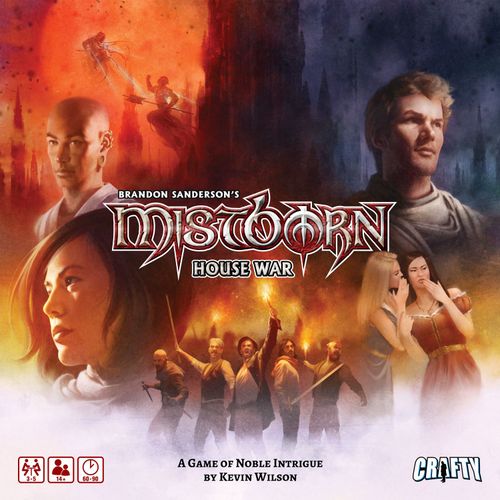
Mistborn: House War
Mistborn: House War Rulebook
Table of Contents
Table of Contents
Components & Set Up
1. Board
Unfold the board. Set the Kelsier pawn or Unrest token on the zero (0) space of the board's Unrest track.
2. Problem Deck
Find the Vin Problem card and set it aside. Shuffle the rest of the deck and deal the cards into four roughly equal face-down piles. Shuffle the Vin card into one of these piles and set that pile aside.
The length of the game is controlled by placing one or more of the other three piles on top of the Vin pile, with the remaining piles under the Vin pile.
If this is your first time playing Mistborn: House War, we recommend a short game to get a feel for things.
Once the Problem deck is built, place it face down on the space marked on the board.
- Short Game (60 to 90 minutes): 1 pile on top of the Vin pile, 2 piles below
- Medium Game (90 to 120 minutes): 2 piles on top of the Vin pile, 1 pile below
- Long Game (120 to 180 minutes): 3 piles on top of the Vin pile, 0 piles below
3. Personality Deck
Shuffle the Personality deck and place it face down on the space marked on the board.
Thanks to our Kickstarter backers, Mistborn: House War also includes The Great Houses expansion — 22 unique Personality cards based on characters appearing in or inspired by Mistborn: The Final Empire. You can identify these cards by the icon near the title.
We recommend removing these during your first game. When you're ready to include them, follow the instructions on page 22.
4. Favor, Disgrace, & Ruined Tokens
Place the Favor and Disgrace scoring tokens near the board, within easy reach of all the players. These are face up until collected.
Also place the Ruined tokens nearby.
5. Resource Supply
Place the following resource tokens on the Available Resources space on the board. Place the remaining tokens in the game box. They are not used in this game.
- 3 Players: 6 Atium tokens*, 8 of each other resource token
- 4 Players: 7 Atium tokens*, 10 of each other resource token
- 5 Players: 8 Atium tokens*, 12 of each other resource token
Atium is rare because it's a wild resource. You can spend it as any other resource.
The resource types are: Food, Money, Prestige, Skaa, Warriors, and Atium.
6. Houses & Starting Resources
Randomly deal a House sheet to each player.
All players immediately collect the resources and the number of Personality cards shown along the sides of their House sheet.
Example: A player with House Tekiel starts with 2 Money, 1 Food, 1 Prestige, and 2 Personality cards.
7. Starting Problems
Draw 1 Problem card per player. Place each face up on the board immediately when it is drawn. Each Problem starts in the column matching its starting Urgency (the Roman numeral in the upper left corner of the card). If a card starts in a full column, move it to the right until it finds an empty space.
Example: Column II is full. The Koloss Assault Problem card moves to Column III.
Note: In a 3-player game, do not use the bottom row (each column may only hold up to 2 Problems).
Example: This is a 3-player game, so the bottom row is unavailable.
8. First Active Player
The player with the House highest on this list is the Active Player and takes the Inquisitor pawn or Active Player token. They start the game by taking their first turn.
- Steel Ministry
- House Venture
- House Hasting
- House Elariel
- House Tekiel
- House Lekal
- House Erikeller
- House Erikell
- House Haught
- House Urbain
- House Buvidas
- House Bylerum
Mistborn readers may notice this is the standing of the Great Houses during Mistborn: The Final Empire.
How to Play
You lead a Great House of Luthadel during the tumultuous time of Brandon Sanderson's novel, Mistborn: The Final Empire. The world is troubled on many fronts and the Lord Ruler demands you put an end to the myriad crises threatening his age-old dominance.
Unfortunately, the challenges facing the Final Empire are huge and resources are scarce. Much of the time you won't be able to solve these Problems on your own. Instead, you will usually collaborate, broker, and break deals with the other players to leverage your combined resources.
In each turn, you collect the resources and Personality cards listed on your House sheet. Problems already on the board move to the right (closer to eruption), and a new Problem is added. Then you may attempt to solve a Problem, or instead pass to collect another resource or draw another card.
Solving a Problem earns the Lord Ruler's Favor, which is (usually) the way to win the game. The best deals earn you great Favor at little cost to you. Contribute a few resources for the lion's share of the credit and you may find yourself standing at the Lord Ruler's side in no time.
Problems ignored for too long erupt, often resulting in Disgrace or other consequences for one or more Houses. Manipulating Disgrace is powerful. Laying the blame for failure at another House's doorstep can mean the difference between ultimate victory and bitter defeat — unless of course the Final Empire collapses. Then the Lord Ruler falls and you want to be as far away from him as possible.
The game continues until the Final Empire crumbles under the weight of growing Unrest or the story naturally ends with the arrival of Vin, the heroine of the Mistborn novel trilogy. Vin is one of the Problems facing the Empire, and failing to solve this Problem — allowing the events of The Final Empire to unfold as written — causes great Unrest. This can easily tip the empire into collapse and end the Lord Ruler's reign.
Vin (Problem card, Urgency I, Erupts at 15): When this Problem is solved or erupts, the game ends. Erupt effect: Add 4 Unrest. "I bring you a message from a friend of ours," she said quietly. "He wanted you to know that he's not dead. He can't be killed. He is hope."
Winning the Game
When any of the following occurs, the game immediately ends and scores are totaled. No further cards may be played, and no further deals may be made.
- If the Vin Problem is solved, the Final Empire is saved and the player with the highest score wins.
- If the Vin Problem erupts and the ending Unrest score is 7 or lower, the Final Empire is (just barely) saved and the player with the highest score wins the game.
- If the ending Unrest score is 8 or higher, the Final Empire collapses and the player with the lowest score wins the game.
In the first two cases, the winner is closest to the Lord Ruler and their House enjoys privilege over all others as the Final Empire rebuilds.
In the third case, the winner is furthest from the Lord Ruler and best positioned to take advantage of the world that emerges from the ashes of the Final Empire.
A Delicate Balance: Early in the game, it's a good idea to keep your options open. Solve Problems that hurt you and make as many allies as you can. Unrest can leap up unexpectedly and you don't want to have too high a score if the Final Empire crumbles. Cunning players keep their scores close to their opponents', leaving their options open until the ultimate fate of the world is clear.
Your score is equal to all Favor you have earned minus any Disgrace you have suffered (usually due to Problems erupting and other game effects).
Certain Personality cards, like the Financial Heir below, are played face down in front of you during the game. These often affect your score.
Financial Heir (Personality card): LASTING — Play face down on your turn. Stays in play. At the end of the game, reveal this Personality. You gain 2 Favor or 2 Disgrace (your choice) for each Money in your House supply.
Breaking a Tie
If two or more players have the same final score (including revealed Personalities), the player with the most resources in their personal supply wins. Their House is most prepared for the future.
If tied players also have the same number of resources, they share the victory. Together they are the new face of nobility on the world.
Example Final Score: Favor (positive scoring) tokens of 1 + 5 + 5 + 10 = 21. Disgrace (negative scoring) tokens of -1 + -5 = -6. Final score: 21 - 6 = 15.
Taking Your Turn
On your turn, you are the Active Player and control the Inquisitor pawn. Take these steps, in this order.
- Collect Resources & Cards
- Problems Worsen
- Add New Problem(s)
- Pass or Deal
- End Turn
These steps are explained further in the following sections.
1. Collect Resources & Cards
Collect the resources and draw the number of cards shown on your House sheet. No other players collect resources or cards. If this is the first turn of the game, you will have double the resources and cards shown on your sheet.
If there isn't enough of a resource in the supply, you may STEAL the missing resources from the other players, in any combination you wish. The resources you steal must be the same ones you usually collect.
Example: Peter is playing House Tekiel. He is the starting player and on his first turn he has 4 Money, 2 Food, 2 Prestige, and 4 Personality cards.
Example: Later in the game on Peter's turn, the supply is short 1 Money and 1 Food. Peter can steal both these resources from one other player, or 1 Money from one player and 1 Food from another player.
If there aren't enough resources in the supply or among all other players (typically because resources have been destroyed), then you collect only what is available. The balance is lost.
Tokens on the Destroyed Resources area are out of play and cannot be collected.
No More Personalities to Draw? If there aren't enough Personality cards in the draw pile, shuffle the discards to form a new Personality deck.
2. Problems Worsen
Move each Problem card already on the board 1 column to the right. You can move the Problems in any order but each Problem must move once. Problem cards always move one at a time.
Each time a Problem is moved into a new column, it fills the lowest available space in the column. Remember that in a 3-player game the bottom row is unavailable.
When a Problem moves into a full column, it skips forward to the next column, and this continues until it finds an empty space. If any Problem erupts, its eruption effect is applied immediately.
Should a Problem move past Column IV, into the Problems Erupt space, that Problem erupts. Immediately apply the listed eruption effect and then discard the Problem card. An eruption usually has consequences for one or more players (see Eruptions, page 13).
Multiple Problems may erupt on the same turn.
The order in which you move Problems on your turn is key to controlling the flow of trouble facing the Final Empire. When the option is available, you could fill a column before a Problem is moved into it, forcing that Problem to move an extra step to the right. With careful timing you might even be able to arrange for a Problem to erupt on a particular turn.
Important Rules to Remember
- The Active Player determines how Problem cards move.
- Problem cards skip full columns when they move.
- In a 3-player game, the bottom row is unavailable.
Example: In a 3-player game, only the top two rows are available. All-Out War must move 1 column to the right but Column II is full. Instead, it moves to the first available space, which is in Column III.
Example: This Koloss Assault has festered too long and erupted! Everyone loses their Personalities.
Example: In a 3-player game, there are 3 Problems to move. Setup: All of these Problem cards must move. Here are two ways to move them. Option 1: The Problem in Column III moves and then the other two Problems move. Option 2: Major Heist moves first, skipping Column III. One of the remaining Problems moves into the available space in Column IV and the other erupts!
3. Add New Problem(s)
Draw 1 new Problem and place it face up on the board in the column matching its starting Urgency (the Roman numeral in the upper left of the card). If this column is full, the Problem moves to the right until it finds an available space, as usual.
After adding a new Problem, if only one Problem remains on the board, draw 1 additional Problem and add it to the board. There must always be 2 or more Problems on the board at the end of this step.
4. Pass or Deal
In this step, you may do one of two things (not both):
PASS
Place the Inquisitor pawn on the "Pass the Turn" space. Collect either 1 resource of any type (including Atium) from the game supply or draw 1 Personality card. Remember that Atium is a wild resource and may be spent as any other resource.
Example: Peter bides his time and passes. He places the Inquisitor pawn as pictured and either collects 1 resource of any type (including Atium) or draws 1 Personality card. This concludes his turn.
DEAL
Place the Inquisitor pawn on any 1 Problem card remaining on the board. This triggers a deal phase where ALL players negotiate with you to jointly pay the resources shown on the Problem card. Generally players offer to pay some of the resources shown in exchange for some of the Favor if the Problem is solved. You choose who may participate in the deal, and no player may be forced to take any deal they don't want. If an agreement is reached the Problem is solved, the players pay the resources they promised, and the Favor shown on the Problem card is distributed as negotiated. See page 14 for more about this process.
Example: Brandon wants to solve the Vicious Gossip Problem. Placing the Inquisitor pawn on the Problem card begins negotiation with all other players at the table (see page 14).
I Don't Have the Resources I Need! Great Houses are rarely without options, and they can often use resources in unexpected ways. When spending resources to pay any cost, including a contribution to solve a Problem, you may do the following.
- Spend 1 Atium as any 1 other resource (Atium is a wild resource)
- Spend any 2 resources as any 1 other resource (you can spend the same 2 resources or 2 different ones)
You may convert resources like this as often as you like, though you may NOT combine resources with another player when converting.
5. End Turn
Once you pass or negotiation ends, your turn is over. The player to your left takes the Inquisitor pawn, becomes the next Active Player, and takes their turn following these same steps.
Problem Cards
The Great Houses face many challenges. Massive volcanoes vomit smoke and ash that blot out the sun and blanket the earth. Skaa laborers turn on their masters in riot and rebellion. Eerie mistwraiths haunt the night and rampaging koloss stalk the land, laying siege to the world of men.
In Mistborn: House War these myriad challenges are collectively known as Problems, and they appear in the Problem card deck. Problem cards have the following features.
- Starting Urgency: This is the relative importance of the Problem when it first enters play. When a Problem card is drawn, place it in the Problem track column matching this numeral. If that column is full, move the Problem to the next available space to the right.
- Traits: A trait is a keyword that triggers a game effect. Traits interact with particular Problems, Personalities, Houses, and rules but have no effect on their own. There are two Problem card traits in the base game: REBEL and STEEL MINISTRY. Expansions may introduce others.
- Favor Reward: This is the amount of Favor awarded when the Problem is solved. In most cases this reward is divided between multiple players, as agreed upon during a deal to solve the Problem.
- Resource Cost: These resources must be spent to solve the Problem (see pages 14–17).
- Flavor Text: This excerpt from the Mistborn novels showcases the Problem in action.
- Rules: This area is for any additional game rules that apply when the card is in play, when the Problem is solved, and in other cases.
- Eruption: An effect after a volcano icon occurs when the Problem erupts. This has consequences as described in the Eruptions section (see page 13).
Ministry Audit (Problem card, Urgency III, Favor Reward 5): STEEL MINISTRY — When solved, add 1 Unrest. Eruption: Each House destroys 1 of their resources. "We put on a good show, and the others assume that we have more than we do... The only way we maintain so much power in this city is through income. Secret income."
The Lord Ruler: The Lord Ruler's eyes are on you when this card is in play. All Favor and Disgrace gained is doubled. This effect is always applied before any other modifiers to Favor & Disgrace, such as the Terringdwel Personality card and the Sazed Problem card.
The Lord Ruler (Problem card, Urgency II): This Problem cannot be solved. While this Problem is in play, all Favor and Disgrace gained by players is doubled. "You cannot lie to the Lord Ruler, child... He can see things in the way your heart beats, and can read your emotions in your eyes. He can sense the moment when you lie."
Urgency
A Problem card's Urgency is always equal to the column it is in.
- A Problem's starting Urgency is shown in the upper left corner of the card. When the card is drawn, place it in the column matching this numeral. If that column is full, move the Problem to the next available Problem track space to the right.
- As soon as a Problem moves, its Urgency changes to match the new column it is in. Likewise, when a Problem's Urgency increases, it moves accordingly.
Example: The Spook Problem card moves to Column IV. Its Urgency is now IV.
A Problem's Urgency may also decrease, usually because a Soother Personality card is played. When this happens, the card moves to the left. The same occupancy rules apply when moving a Problem in either direction.
Example: A Soother is played on this Corrupt Obligator. The Problem moves back to Column I.
If a Problem moves off the left side of the board (i.e. its Urgency drops below I), place it face down on top of the Problem deck. It will be the next Problem card drawn.
Example: A Soother is played on the Cult of the Survivor. The card is placed back on top of the Problem deck. It will be drawn next.
Highest and Lowest Possible Urgency: Some Problems are added or returned to the board at the "highest possible Urgency" or the "lowest possible Urgency." The highest possible Urgency is the rightmost available space on the Problem track, while the lowest possible Urgency is the leftmost available space on the Problem track.
Example: In this 3-player game, Column IV is full. After erupting, Kelsier returns to the board in Column III.
Eruptions
Problems left unsolved can have serious consequences for the Houses, including political disgrace, bankruptcy, destruction of resources, and even assassination of Personalities.
When a Problem moves to the right of Column IV, it erupts. Immediately apply the effect after the Problem card's volcano icon.
When an eruption effect has a target, the Active Player chooses that target.
After an eruption effect is applied, discard the Problem card.
Eruption Effects
These are common eruption effects. Some Problems have other effects, as indicated on each card.
ADD PROBLEM(S) TO THE BOARD
Add the indicated number of Problems to the board, one at a time. These Problems are added as in Step 3 of your turn (see page 10).
ADD UNREST
Move the Kelsier pawn the indicated number of spaces to the right on the Unrest track. If Unrest reaches 8 or above, the game immediately ends (see Winning the Game, page 7).
DESTROY RESOURCES
The target House(s) must choose the indicated number of resource tokens from their supply and move them to the Destroyed Resources space on the board. Destroyed resources can no longer be collected or used, unless they're retrieved with a Lurcher Personality card.
DISCARD CARDS
Players controlling the target House(s) must discard Personality cards as indicated. Unless specified, these cards may be from their hand or from cards in play in front of them.
"EACH HOUSE..."
Many Problems indicate that each (every) House must do something. In these cases the Active Player only makes the choice for his or her own House. Each other player makes the choice for their own House.
Example: When Ashfall erupts, the Active Player chooses any Food on any House sheet or Personality card currently in play. A Ruined token is placed over that icon, and that Food resource is no longer collected during Step 1 of that player's turn.
GAIN DISGRACE
The target House(s) gain the indicated amount of Disgrace and adds those tokens face down in their scoring pile. Disgrace is subtracted from a player's score at the end of the game (see page 7).
RETURN RESOURCES TO THE SUPPLY
The target House(s) must choose the indicated number of resource tokens from their supply and move them to the Available Resources space on the board.
RUIN A RESOURCE
Choose any resource icon on any House sheet or Personality card in play. Place a Ruined token over that icon. Ruined resources are not collected during Step 1 of your turn (they are effectively removed from the sheet or card).
Ruined tokens are dismissed with Lesser Noble Personality cards. This lets the owner collect the resource again.
Deals (Solving a Problem)
During Step 4 of your turn, you may attempt to solve a Problem. This process is triggered as soon as you place the Inquisitor pawn on a card on the Problem track. At this point all players may freely negotiate to solve the chosen Problem. As the Active Player for the turn, you control all negotiations.
Can We Negotiate Which Problem to Solve?
Negotiation may not begin until the Inquisitor pawn is placed. To avoid the game slowing down with "pre-negotiation" of multiple Problems on the board, you must make your Step 4 choice with no input from other players. The other players may talk and scheme with each other before the pawn is placed, however.
Who Can Negotiate?
As the Active Player, you're always part of any deal you start. All players may negotiate freely but you may ignore any offers as desired. You may exclude any or all players when negotiating a deal started on your turn.
A Typical Deal
In most deals, the other players will offer to contribute some of the resources required to solve the Problem in exchange for some of the Favor when the Problem is solved.
Example: Peter places the Inquisitor on A Matter of Honor. Seeing an opportunity to get in the Lord Ruler's good graces, Brandon offers to contribute 3 of the Skaa required to solve the Problem. Preparing to be talked down, Brandon asks for 5 of the 7 Favor earned if the Problem is solved.
What Else Can I Offer?
Deals aren't limited to resources and Favor. Any player may offer to contribute any of the following.
- Any resources in their House supply (including any they plan to convert as described on page 17)
- To play a Personality card from their hand
- A promise to take a future action, or to make a future choice allowed by the rules
- Anything else accepted by the entire play group (see House Rules, opposite)
Scoring tokens may never be offered or demanded in any deal. Once a player gains scoring tokens — Favor or Disgrace — they remain with that player until the end of the game.
Personality cards already in play may not be offered. This is true whether they're face up (e.g. Advisors) or face down (e.g. Heirs).
Bribes
Bribes are allowed. Any player may offer to give another player any number of resources as part of a deal, even if those resources aren't required to solve the Problem.
Personality cards may never be offered as a bribe. However, you can threaten to play Personalities from your hand if you think it will help your case. For example, you could threaten to play a Coinshot to discard a crucial Advisor. Or you could threaten to play a Lurcher to steal the resources needed to make a deal and solve a Problem.
May I Show my Hand?
You may show any number of Personality cards in your hand at any time, but if you do you must show them to everyone at the table. You may also ask to see another player's Personality card(s) — for example, to prove they have a card they promise to play during a later turn — but they may decline if they wish.
No player may be forced to show their hand at any time, except with a Seeker Personality card. This is also the only way to privately see a player's hand.
Should I Ask to See a Card? Any offer that must be delivered this turn is binding (see page 18), so it's generally safe to trust a player when they claim to have a card they will play immediately. An offer becomes much more dubious when a card won't be played until later (e.g. when a player offers to use a Hazekiller as protection from the next card played against you). In these cases it's often a good idea to ask to see the card as proof the player can do as they say. Remember, however, that if you ask to see a card in another player's hand, everyone must see it.
Must I Accept a Deal?
No player may be forced to take any deal. Everyone involved in a deal must agree to the terms before the deal may close.
What if We Can't Agree?
When negotiation fails for any reason, the Problem is not solved. It remains on the board in the same spot, and all committed resources return to their owners.
Personality cards played during the negotiation have still been played, so they are discarded as normal. Cautious players may want to mention they have a card without playing it, though this reveals part of their hand to the other players at the table. Suspicious opponents may demand to see the card as well.
If you chose the Problem as the Active player, your turn is now over. You may not choose another Problem to solve.
Deal Etiquette
Mistborn: House War encourages table talk, cajoling, trickery, and even a little menace. Deals unfold like rounds of poker, with just as much social interaction as game-driven procedure. Embrace that intent and everyone will likely have a much better time.
When negotiating a deal, be considerate of the other players at the table. Leave room for quiet or shy players to speak up, and encourage them to do so on their own terms. Don't dismiss or talk over other players. Keep your turns down to a reasonable duration (we recommend 3–4 minutes, unless the game hinges on the Problem you're attempting to solve). Your deals don't have to be fair but you should be, and everyone will have a much more rewarding time with the game when you are.
If you're worried about your group dynamic, consider a pre-game discussion about how you'd all like deals to be negotiated. If you encounter problems during a deal, look for a solution that best satisfies everyone right now. Then agree to talk about the process after the game is over. With just a little discussion outside the game, you could avoid friction the next time you play.
House Rules
Deals are intentionally open-ended in Mistborn: House War. You're encouraged to come up with inventive and cunning offers, and to play the game on your terms. If you like, this latitude allows for some really off-the-wall bribes, like a slice of pizza or help moving house!
Keep things simple at first and stick to the basics, especially if you don't know the other players very well. When and if you're ready to expand your negotiations, discuss it with your group before the game and agree on a set of viable offers. Make sure everyone's OK with them and keep your house rules consistent within each game.
Closing a Deal
To indicate negotiations are coming to a close, the Active Player places their hand back on the Inquisitor pawn, then slowly counts aloud to five before taking their hand away.
This is the last chance anyone has to make final offers or play Personality cards to affect the deal. Once the Active Player's hand leaves the pawn, all negotiations are final and except in a few rare cases — as with the Con Artist and Slanderer Personality cards — no further changes can be made.
Once a deal closes, take the following steps in this order.
- Pay the resource cost
- Apply "When Solved" effects
- Apply "Sly" Personality effects
- Award Favor
- Discard the solved Problem card
These steps are explained further in the following sections.
1. Pay the Resource Cost
As agreed, each player pays resources out of their House supply. The total resources paid must match the icons shown at the bottom of the Problem card.
Don't forget to include the effect of any cards that raise or lower a Problem's cost (e.g. Tineyes, Thugs, Lesser Nobles, and Informants).
"Play at Any Time" Cards: Many Personality cards may be played "at any time." Some, like Informants, increase the cost to solve a Problem, making them harder (and in some cases impossible) to solve. It is intended that players use these Personalities to scuttle deals they don't want to close successfully, but in the interest of fairness and simplicity these cards may not be played after the final call (i.e. after the Active Player's hand has left the Inquisitor pawn).
In fact, no cards except Sly Personalities may be played after a deal is closed. For more about Sly Personalities, see pages 17 and 21.
Example: The Growing Suspicions Problem is solved. A total of 2 Food, 2 Prestige, and 2 Skaa must be paid.
Example: Earlier in the turn, Brandon played a Tineye to lower the cost of Growing Suspicions by 2 Prestige. Thus, only 2 Food and 2 Skaa must be paid.
Example: After Brandon played his Tineye, Peter played the Military Informant card to raise the cost of Growing Suspicions by 2 Warriors. Now, a total of 2 Food, 2 Skaa, and 2 Warriors must be paid.
Remember that you may convert resources in the following ways to pay costs.
- Spend 1 Atium as any 1 other resource (Atium is a wild resource)
- Spend any 2 resources as any 1 other resource (you can spend the same 2 resources or 2 different ones)
You may convert resources like this as often as you like, though you may NOT combine resources with another player when converting.
Example: Brandon has 1 Atium, 1 Money, and 1 Prestige. He wants to solve a Problem with a resource cost of 2 Food. Fortunately, he can spend the Atium as 1 Food, and then pay for the other Food with his 1 Money and 1 Prestige.
2. Apply "When Solved" Effects
If the words "When Solved" appear on the Problem card, apply those effects now. These effects work just like eruptions (see page 13).
If the effect has a target, the Active Player chooses that target.
Example: Solving the Rationing Problem saves many citizens of the Final Empire from starving, but it also adds 1 Unrest.
Rationing (Problem card, Urgency I, Favor Reward 9): STEEL MINISTRY — When solved, add 1 Unrest. Eruption: Each House destroys 3 of their resources. "...it brought with it a blight that I have seen infect nearly every part of the land."
Example: Solving the Crackdown Problem ruins 1 resource. The Active Player chooses which resource to ruin.
Crackdown (Problem card, Urgency II, Favor Reward 7): When solved, ruin any 1 resource. Eruption: Add 1 Unrest. "Does that mean that the Lord Ruler will order more people beheaded? How long can that continue before there just aren't any Skaa left?"
3. Apply "Sly" Personality Effects
Some Personality cards are labeled "Sly." These cards may be played after the Active Player has removed their hand from the Inquisitor pawn. Sly card effects are resolved in this step.
When a Sly card effect has a target, the target(s) are chosen by the player who used the card.
Example: The Con Artist lets you steal all the Favor from a closed deal. The Lord Ruler may love you, but no one else will.
Con Artist (Personality card): SLY — Play after you solve or help to solve a Problem. You gain all Favor from solving this Problem. The deal is still closed and cannot be canceled. All other agreements made during this deal are unaffected.
4. Award Favor
Each player involved in the deal collects the Favor they were promised, as agreed. These tokens are added to each player's scoring pile, face down.
Scoring tokens may never be shown to anyone, nor may they be bartered or negotiated. They must remain face down in front of each player until the end of the game.
You may trade scoring tokens to "make change" (e.g. trading five 1s for a single 5). If you do, you must show the tokens you're returning to the supply and the ones you're taking back to everyone at the table.
5. Discard the Solved Problem Card
Finally, discard the solved Problem. This ends your turn. Pass the Inquisitor pawn to the next Active Player, who takes their turn as normal (see page 8).
How Long is a Deal Binding?
The conditions and terms of a deal are binding for the rest of the current player's turn. No player may go back on their word in that time.
However, any offer or promise that extends to the next turn or later may be ignored or reneged without penalty — unless an Obligator or High Prelan card is played.
The Obligator & The High Prelan
The Final Empire has a solution for duplicitous deal-makers. These two Personality cards make any deal binding until all offers, promises, and other terms are fulfilled.
Anyone may play an Obligator or High Prelan, even a player who isn't involved in the deal. Uninvolved players may find it helpful to ensure certain deals persist, especially when they stand to benefit from them.
Obligator (Personality card): LASTING · SLY — Play face up when a deal is closed. Stays in play. While the Obligator is in play, all terms of this deal are binding and must be obeyed. If a player cannot meet these terms, discard 1 of their resources to the supply (your choice). Discard the Obligator when all terms are met.
The High Prelan (Personality card): LASTING · SLY — Play face up when a deal is closed. Stays in play. While The High Prelan is in play, all terms of this deal are binding and must be obeyed. If a player cannot meet these terms, discard 1 of their resources to the supply (your choice). Discard The High Prelan when all terms are met. (Ministry): If a player cannot meet these terms, discard 2 of their resources to the supply (your choice).
What if Someone Can't Do as They Promise?
It's a legitimate tactic to promise you'll do something during a later turn, only to renege when the time comes. Alternately, you may make a promise you simply can't keep later (e.g. vowing to dedicate a resource to a Problem the next Active Player will negotiate, only to have that resource removed from your supply beforehand).
With an Obligator or High Prelan in play, you could be required to do something beyond your power. In this case the player controlling the Personality returns 1 of your resources to the supply. When a High Prelan is Allied, 2 resources are returned instead. You may only lose resources you currently possess.
An Example of a Deal
In a four-player game between House Elariel, House Lekal, House Venture, and the Steel Ministry, House Elariel and the Steel Ministry have formed a loose alliance. This has let these Houses build up a supply of resources while forcing the other two Houses to frequently work together out of necessity.
During Step 4 of his turn, Lekal places the Inquisitor pawn on the Disobedience Problem, signaling the start of negotiation. Lekal cannot solve this Problem on his own, as he is short 1 Prestige. As expected, the Steel Ministry player leans back and stays silent, having no interest in furthering Lekal's objectives right now. Elariel is a shameless opportunist, however, and jumps in with an offer before Venture can say anything.
Elariel: "I can convert my 1 Money and 1 Warrior for the resource you need, Lekal, but it will cost you."
Lekal is dubious but willing to humor Elariel, if only to get a sense of her ambition.
Lekal: "How much?"
Elariel: "3 Favor."
Three Favor is almost half the reward for Disobedience, and a lot more than 1 resource is worth. Lekal snorts and looks to his regular ally in this game, House Venture.
Venture: "Let's make this simple. I'll commit a Prestige for only 2 Favor."
Lekal smiles. This deal seems fair to him and it will eliminate the immediate threat. Lekal reaches for the Inquisitor pawn to make the final call. Elariel intrudes again, playing an Agricultural Informant, which increases the Problem's cost by 2 Food. This is more than Lekal and Venture can pay together.
Elariel: "Seems you're a little short."
Lekal: "Maybe, maybe not."
Lekal plays a Smoker, redirecting the Agricultural Informant's effect to the Cult of the Survivor Problem. The deal is back on. Out of cards and options, Elariel finally gives up, raising her hands in defeat. Lekal once again reaches for the Inquisitor pawn but the Steel Ministry unexpectedly speaks up.
Steel Ministry: "I have a counter-offer."
Surprised by the Steel Ministry's reengagement, the other players listen for details. Lekal is nervous. He has reason to be.
Steel Ministry: "I have a friend..."
The Steel Ministry player holds up a Hazekiller card where it can be seen by everyone. She is clearly showing the card and not playing it... yet.
Steel Ministry: "This friend could be convinced to eliminate your Smoker... unless I call him off."
If the Hazekiller were to cancel the Smoker, the Agricultural Informant would increase the cost of the Disobedience Problem after all, and Lekal and Venture would once again be unable to solve the Problem — unless they had help. Lekal suspects the Steel Ministry is trying to muscle his way into the deal.
Lekal: "I suppose you want some of the Favor for your 'friend's' cooperation?"
Steel Ministry: "Just 1 point, and a promise."
Lekal: "Which is...?"
Steel Ministry: "Next turn I will require the Skaa you have remaining to help solve a Problem of my choosing. You will offer them, and you will accept only 1 Favor in return."
Lekal is sure Steel Ministry is planning to solve the Cult of the Survivor Problem, unless something better is drawn next turn. Cult of the Survivor is worth a whopping 11 Favor, and with Lekal's 1 Skaa the Steel Ministry could do it all on his own, yielding 10 Favor in one turn.
Fortunately, that's not until next turn and there's no reason Lekal has to comply.
Lekal: "You have a deal."
Venture: "This could be a trap, Lekal."
Lekal places his hand on the Inquisitor pawn, hoping the Steel Ministry player doesn't have another trick up his sleeve.
Lekal: "...4...5. The deal is closed."
Unfortunately, Venture's warning is validated as the Steel Ministry plays his third card: an Obligator. He smiles.
Steel Ministry: "...and it is binding."
Next turn the Steel Ministry will earn the Lord Ruler's attention, but the House War is far from over.
Personality Cards
Personality cards bring powerful allies and important individuals from all over the world into Mistborn: House War. They include mercenary Allomancers, deadly Hazekillers, noble advisors, cagey informants, sly decoys, and hugely powerful, versatile Mistborn.
Personality cards are not resources and may not be destroyed or ruined. A player may promise to use a Personality card as part of a deal, but may not offer Personality cards as a bribe.
If the Personality deck runs out at any time, shuffle the discard pile to form a new deck.
Personality Card Attributes
Some Personality cards have attributes listed in bold at the top of the card effect. There are two Personality card traits in the base game: LASTING and SLY. Expansions may introduce others.
- Lasting: A Lasting Personality remains in play. Some Lasting Personalities are played face up and others are played face down. Lasting Personalities have an ongoing game effect, or affect end game scoring. For more about Lasting Personalities, see opposite.
- Sly: A Sly Personality may be played after a deal is closed. Sly card effects are applied during Step 3 of closing a deal (see page 16).
Provocateur (Personality card): LASTING — Play face up on your turn. Stays in play. At the end of each of your turns, add 1 Unrest. Each time the Unrest rises (for any reason), gain 1 Disgrace.
Con Artist (Personality card): SLY — Play after you solve or help to solve a Problem. You gain all Favor from solving this Problem. The deal is still closed and cannot be canceled. All other agreements made during this deal are unaffected.
Personality Card Timing
Every Personality card says when it can be played. Most can be played at any time. For example, you could play a Soother to reduce a Problem's Urgency right before it erupts, or play a Coinshot to discard an Advisor right before its owner collects resources for the turn.
Cards that may only be played on your turn can be played at any time during your turn.
Only Sly Personalities may be played to affect a deal after it is closed (see page 16).
Personalities are resolved in the order they are played, and each must be resolved completely before another Personality card is applied.
Example: A player targeted with a Seeker — a Personality that lets you look at another player's hand and steal one of their cards — cannot play any of their cards before one is stolen.
There are a couple exceptions to this rule: Hazekillers can cancel another Personality card as it's played, and Smokers can redirect the effects of a Personality card as it's played. For more about these special Personality cards, see "Play when another Personality card is played" and the Coinshots vs. Hazekillers sidebar, both opposite.
When two or more Personality cards are played at the same time, or so close to each other that your group can't definitively say which card was played first, the cards are resolved in clockwise order, starting with any card(s) played by the Active Player.
You may not take back a Personality card after it is played. This is true even when you play a Personality card during a deal that doesn't close, or when two players play cards at the same time that don't interact as expected.
Example: Brandon and Peter both want to prevent a Problem from erupting. They each play a Soother at the same time. Brandon is the Active Player and so his Soother card is applied first. Then Peter's Soother card is applied as well, whether he wants to reduce a Problem card's Urgency or not.
Revealing Your Card(s)
You may voluntarily say that you have a card at any time, even if you don't actually have it. You may show any card in your hand, though you must show it to everyone at the table. You may not selectively show it to only some players and not others.
Personality Card Effects
If you're unsure what a card does, start by looking up its attributes and phrasing in this section.
"LASTING" PERSONALITIES
When you play a Lasting card, it stays in play (all other cards have an effect and are immediately discarded). Place a Lasting card you play on the table near your House sheet. Some Lasting cards are played face up and others are played face down, as noted on the card.
A Lasting card usually offers an ongoing or end game effect so long as it remains "in play" (on the table and not yet discarded by another game effect).
Lasting Personalities may be discarded with a Coinshot Personality card but are unaffected by Hazekillers (see the sidebar below for more about these two cards).
Labor Advisor (Personality card): LASTING — Play face up on your turn. Stays in play. Gain 1 Warriors. While this remains in play, collect 1 additional Warriors each time you collect your House sheet resources.
"PLAY WHEN ANOTHER PERSONALITY CARD IS PLAYED"
Hazekillers, Smokers, and other cards are played as a reaction to another card being played. These reaction cards are resolved before the target Personality is resolved, interrupting the normal flow of the game. This is an exception to the normal rules for Personality timing.
Coinshots vs. Hazekillers: Coinshots and Hazekillers both discard other Personalities, but there are strict limitations when using either card. The easy way to know whether you can target another card is the Lasting attribute.
- A Coinshot can discard a Lasting Personality, but cannot discard a Personality without the Lasting attribute.
- A Hazekiller can discard a non-Lasting Personality, but cannot discard a Personality with the Lasting attribute.
"SLY" PERSONALITIES
These are the only cards that may be played after a deal is closed. Sly card effects are applied during Step 3 of closing a deal (see page 17).
Slanderer (Personality card): SLY — Play when a player gains Favor. The chosen player gains no Favor. Instead, that player gains an equal amount of Disgrace.
"FACE UP" AND "FACE DOWN"
Personalities that stay in play are placed either face up or face down, as indicated on the card. Typically, face-up Personalities are useful during the game, while face-down Personalities affect scoring at the end of the game.
Face-up cards apply their effects so long as they remain face up. Face down cards stay in play but have no other effect until revealed or turned face up.
"WHEN YOU SOLVE OR HELP TO SOLVE A PROBLEM"
Con artists and other Personalities are played when you contribute to a Problem that is successfully solved (i.e. the Problem card's resource cost is paid and the Problem is discarded). These Personalities may be played on a deal you close (when a Problem is solved on your turn), or on a deal you help to close (when a Problem is solved on another player's turn).
Some Personalities with this trigger are also Sly, meaning the card can be played anytime up to Step 3 of closing a deal (see page 17).
"LOWER / RAISE A PROBLEM'S COST"
Certain cards — like the Tineye, Thug, Mistborn, and Lesser Noble — lower a Problem's cost, eliminating resources that must be spent to solve the Problem. You can never use these cards to eliminate more resources than are printed on a card.
Conversely, Informants increase the cost of a Problem, adding resources that must be spent to solve it.
The effects of all these cards last until the end of the turn.
Thug (Personality card): Play at any time. Until the end of the turn, the cost to solve 1 Problem is lowered by 2 Warriors, or 2 Skaa, or 1 Money.
ADVISORS
These Personalities let you collect an additional resource during your turn. They act like an additional resource icon printed on your House sheet. A resource granted by an Advisor can be ruined, and the resource is also lost if the card is discarded for any reason.
Allies
Some Personalities are labeled as Allies to certain Houses. When you use or benefit from a Personality with an Ally tag matching your House, you may use the Ally text instead of the Personality's normal effect.
Example: Becky is House Elariel and plays the Shan Elariel Personality card. Shan lowers the cost to solve a Problem by 2 resources until the end of the turn. Since Becky qualifies for Shan's Ally ability, she may instead choose to lower the cost of the chosen Problem by 3 resources until the end of the turn.
Shan Elariel (Personality card): Play at any time. Until the end of the turn, the cost to solve 1 Problem is lowered by any 2 resources (e.g. Skaa + Prestige, or Money + Food). Ally (House Elariel): The cost to solve the target Problem is lowered by any 3 resources.
Lesser Nobles
When you play a Lesser Noble, you may choose either of these two effects (but not both).
- You may lower the cost to solve a Problem by 2 Food until the end of the turn. This option may be canceled by a Hazekiller or similar game effect.
- You may discard the Lesser Noble along with another Personality card from your hand to remove 1 Ruined token from any card or sheet in play. The formerly ruined resource may then be collected normally. This option may not be canceled in any way, even with a Hazekiller card.
Smokers
A Smoker may be played when another Personality card is played, or when an eruption effect is applied. The person playing the Smoker redirects the Personality card or eruption effect to another valid target.
The second target must meet all the conditions of the card or eruption effect, as decided when the first target was chosen. A Smoker may not change the full original effect it is redirecting. The entire effect is passed along, without modification.
A Smoker may only be used to redirect Personality cards and eruption effects. It may not redirect anything else, including When Solved effects (see page 17).
Example: Peter plays a Lurcher card to steal 2 of Becky's resources. Becky doesn't want her resources stolen and plays a Smoker card to redirect the effect. Of the other players, only Brandon has 2 resources, so Becky may only redirect the effect to Brandon.
"REVEAL AT THE END OF THE GAME"
Certain Personalities, like Heirs and Honor Hostages, are played face down and revealed at the end of the game. These cards usually affect scoring in some fashion.
These "end game" cards are always resolved immediately before scores are totaled.
The Great Houses Expansion
Thanks to our Kickstarter backers, Mistborn: House War includes The Great Houses expansion — 22 unique Personality cards based on characters appearing in or inspired by Mistborn: The Final Empire. You can identify these cards by the icon on the right side of the card.
Two unique Personalities reflect the particular character of each House, from the indiscriminate bloodlust of the Steel Inquisitor and the Tin-eyed senses of Straff Venture to the business savvy of Telden Hasting and the exceptional Allomancy of Mistborn Shan Elariel.
Each Personality in this expansion has the Ally trait, which makes them even stronger when hired by their normal House (see left).
We recommend removing the Great House cards for your first game. When you're ready to include them, there are two ways to do so. You can...
- Shuffle all the Great House cards into the Personality deck. This introduces a wide swath of characters from the novels.
- Add only the Personalities allied with Houses being played in the current game. This adds between 6 and 10 new cards and produces a more focused, thematic experience.
Both are fresh and fun ways to play Mistborn: House War.
Strategies & Tactics
While Mistborn: House War is a board game with strict rules and subtle nuances, victory is rooted in knowing your foes. Cleverly surmising when to make (or break) an alliance, when to promise (or threaten) your opponents, and when to honor (or betray) agreements are all key to coming out ahead.
Equally important is understanding how Problems march across the board, and when maneuvering one or more of them will give you a decisive advantage. Many Personality cards and eruption effects help with this, but you can get a lot of mileage out of simply moving Problems in a particular order on your turn.
Always look for opportunities to move Problems so they erupt on your turn, or on the turns of your allies. As the Active Player you can direct eruption effects to help your cause, or to hurt your opponents.
Tactically fill columns so you can skip select Problems past them. If you can, solve Problems whose eruption effects will impact you most severely. If you can't, use Soothers to hold them back until an ally can get to them.
Sometimes it's a stronger play to offer most of a Problem's Favor to other players than to let a Problem erupt — which brings us to the heart of the game: negotiation. Deals are essential, especially in early turns when resources are tight. Be ready to wheel and deal, and to accept help when you need it.
Working with your opponents can triple or even quintuple your opportunities to score Favor. Earning even 1 or 2 Favor every turn can quickly add up over the course of the game.
Remember: seizing a big lead early on isn't necessarily beneficial. If you pull too far ahead and the game ends due to rising Unrest, you may find yourself on the wrong side of history. There's also a social cost to decisive scoring. House leaders are wont to pick on an obvious leader in a way they might not a quiet giant.
Experienced House War players are cagey, forging many alliances and keeping the scores close until an end game is clear.
Mistborn: House War An official board game based on the best-selling novels by BRANDON SANDERSON
Game Design: Kevin Wilson Development and Additional Game Design: Alex Flagg Production and Editing: Patrick Kapera Art Direction: Alex Flagg and Patrick Kapera 3d Models: Thomas Lishman, based on concepts by Ben McSweeney Board Design: Peter Wocken Graphic Design: Michal E. Cross Cover Illustration: Tommy Arnold Board Illustration: Waclaw Wysocki Card and Other Illustration: Emanuele Desiati, Michele Giorgi, Jesse Hibbs, Anna Kay, Djamila Knopf, Miranda Meeks, Georgi Minkov, Lee Moyer, Abigail Platter, Marko Radulovic, Júlio Cesar Oliveira Rocha, Martin Sickree, Oliver Specht, T-Rex Studios, Artur Treffner, Waclaw Wysocki
Playtesting: Sherri Beioley, Simon Beioley, Matthew Bernard, Sharon Betterton, Joshua Bilmes, Roger Bixby, Beau Bogart, Mackenzie Branagan, Carl Brannon, James Bryan, John Bryan, Matthew Bryan, Christina Bryant, Mike Buzzerio, Jon Criss, Steve Crow, Andy C. Davis, Devin Durnal, Becky Flagg, Brian Flory, Jeremy Gibson, Brian Grist, Austin Gundersen, Andrew Hamilton, Anthony Hamilton, Jeffrey Hamilton, Jaron Harold, Ed Healy, Matthew Howes, Jenna Huff, Nathan Huff, Eunice Hung, Bowen Jacobs, Kaily Jacobs, Patrick Kapera, Allison Kmichik, Dusty Kock, Nancy Lambert, Kat Landis, Sharon Lithgow, Tim Lithgow, Krystyna Lopez, Keith Mackenzie, Colin Maynard, Max McInroy, Sarah McInroy, Scott McInroy, Brady McReynolds, Sam Morgan, Jeff Mudge, Joshua Reason, Lisa Rodgers, Bethany Romans, Michael Russell, Taylor Seidlitz, Joey Turco, Michael Tabet, Luke van Tricht, Enoch Ulmer, Amberlie Wecks, Josh Wilkins, Troy Zweber
Based on the Mistborn novels by Brandon Sanderson, copyright © 2006, 2007, 2008, 2011, 2015, 2016 by Dragonsteel Entertainment, LLC and used with the express permission of Dragonsteel Entertainment, LLC. Mistborn® is a registered trademark of Dragonsteel Entertainment, LLC. Mistborn: House War ©, Crafty Games, and all related logos and marks are trademarks Crafty Games, LLC. All rights reserved.
No part of this product may be reproduced without specific permission.
For comments, questions, & suggestions, email [email protected].
Reference
This condensed reference reproduces the manual's own closing summary of setup, closing a deal, and winning the game.
Closing a Deal
The Active Player touches the Inquisitor pawn or Active Player token, slowly counts to five, and takes their hand away. Then take these steps, in this order.
Note: Only cards with the Sly trait may be played after the final call (see Step 3, below).
-
Pay the Resource Cost: As agreed, each player pays resources out of their House supply. The total resources paid must match the icons shown at the bottom of the Problem card.
Cards that raise or lower the Problem's cost are applied now (e.g. Tineyes, Thugs, Lesser Nobles, and Informants).
You may convert resources in the following ways to pay costs.
- Spend 1 Atium as any 1 other resource (Atium is a wild resource)
- Spend any 2 resources as any 1 other resource (you can spend the same 2 resources or 2 different ones)
You may convert resources like this as often as you like, though you may NOT combine resources with another player when converting.
-
Apply "When Solved" Effects: The Active Player chooses the effect's target, if any.
-
Apply "Sly" Personality Effects: The Player controlling the card chooses the effect's target, if any.
-
Award Favor: Each player involved in the deal collects the Favor they were promised, as agreed. Add these tokens to each player's scoring pile, face down.
-
Discard the Solved Problem Card: This ends the current turn. Pass the Inquisitor pawn to the next Active Player, who takes their turn as normal.
Winning the Game
The game ends when any of the following occurs. No further cards may be played, and no further deals may be made.
- If the Vin Problem is solved, the Final Empire is saved and the player with the highest score wins.
- If the Vin Problem erupts and the ending Unrest score is 7 or lower, the Final Empire is (just barely) saved and the player with the highest score wins the game.
- If the ending Unrest score is 8 or higher, the Final Empire collapses and the player with the lowest score wins the game.
Total Your Score: Add your Favor together and subtract any Disgrace you have. Reveal any face down cards that affect your score now. If tied, the player with the most resources in their personal supply wins.
Components & Set Up
-
Board: Unfold the board. Place the Kelsier pawn or Unrest token on Unrest 0.
-
Problem Deck: Set the Vin card aside. Shuffle the rest of the deck and deal the cards into four roughly equal face-down piles. Shuffle the Vin card into one of these piles and set that pile aside. Stack the deck as follows, based on the desired game length. Place the Problem deck on its board space.
- Short Game (60 to 90 minutes): 1 pile on top of the Vin pile, other piles under
- Medium Game (90 to 120 minutes): 2 piles on top of the Vin pile, other piles under
- Long Game (120 to 180 minutes): 3 piles on top of the Vin pile, other piles under
-
Personality Deck: Shuffle the Personality deck and place it on its board space.
-
Resource Supply: Place the following resource tokens on the Available Resources space. Place the remaining tokens in the game box. They are not used in this game.
- 3 Players: 6 Atium tokens, 8 of each other resource token
- 4 Players: 7 Atium tokens, 10 of each other resource token
- 5 Players: 8 Atium tokens, 12 of each other resource token