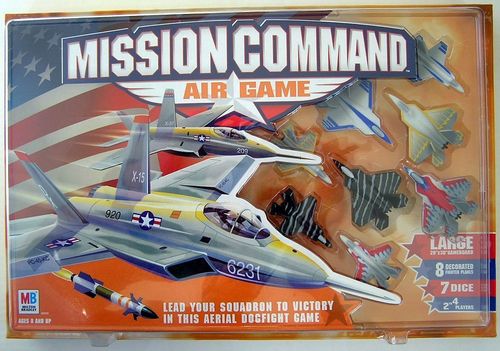
Mission Command Air
Mission Command Air Rulebook
Table of Contents
Table of Contents
Setup
- If you haven't done so already, remove all of the planes, plane stands, and dice from the display package.
- Carefully remove all cardboard pieces from the parts sheet.
- Shuffle the Navigation cards and deal 7 facedown to each player.
- Set the remaining Navigation cards facedown in a pile within reach of all players. This is the draw pile. Leave room next to the draw pile for a discard pile.
- Each player chooses a squadron by taking two matching planes. For example, if you want to be the Blue squadron, take the two blue decorated planes. NOTE: If there are only 2 players, one player must use the Blue decorated planes (Blue squadron) and the other must use the Flame decorated planes (Fire squadron). Place the Yellow (Eagle squadron) and Black (Tiger squadron) planes back in the box out of play.
- Attach a plane stand to each of your planes by inserting the ball on the top of the stand into the hole in the bottom of the plane. See Figure 1. We recommend lifting your planes by using the stands so they stay attached.
- Now, each player takes the Squadron Board matching his/her planes, and 11 Missile Tokens. Your F-35 will start this mission with 5 missiles and your F-22 will start with 6 missiles. Place the Missile Tokens on the Squadron Board near the picture of the appropriate plane. If you like, you can make up a code name for each of your planes and write it in pencil in the Call Sign on the Squadron Boards.
- Place your planes on their matching colored start spaces and you're ready to begin. Figure 2 shows a 2-player game set up.
Contents: Gameboard; 8 plastic planes with stands; 4 Squadron Boards; 60 Navigation cards; 50 Missile Tokens; 45 Damage Markers; 4 black dice; 3 red dice.
Figure 1: Plane and plane stand.
Figure 2: Game setup for 2 players. Shown components: Draw Pile; Gameboard; Hand of 7 cards (don't show to opposing player) for each player; Blue Squadron Board with 5 Missile Tokens for F-35 and 6 Missile Tokens for F-22; Fire (red) Squadron Board with 5 Missile Tokens for F-35 and 6 Missile Tokens for F-22; 4 Black Dice; 3 Red Dice; each player's planes on their matching colored start spaces.
2 Player Rules - Gameplay
The game is played in rounds.
Here is a brief look at what will happen.
- At the start of every round, each squadron leader draws enough cards from the draw pile to bring his/her hand up to 7 cards. It doesn't matter who draws first.
- Squadron leaders then look at their hands of cards and choose one card for each plane they control. (See The Cards.) Both leaders do this at the same time. Place the cards facedown near your Squadron Board next to the plane you chose the card for. NOTE: Cards are only played for planes still on the board. If one of your planes has been destroyed, you no longer play cards for it.
- Now, at the same time, both leaders turn over their facedown cards (all of them!). See Figure 3. The plane with the lowest numbered card goes first. Then the second lowest, etc. The squadron leader, controlling the plane with the lowest numbered card, begins by moving the plane, following the instructions on the card, and firing at one of his/her opponent's planes. IMPORTANT: Firing is OPTIONAL and may be done either before or after the plane moves. The turn then passes to the squadron leader controlling the plane with the next lowest numbered card.
- A round ends after both leaders have completed turns with all of their planes.
Figure 3: Choose your cards.
The Cards - Moving Your Planes
At the beginning of each round, look at your squadron and decide which way you want your planes to fly. All cards have a number in the upper left corner (see Figure 4).
Figure 4 (callout beside the card illustration): The plane with the lowest numbered card goes first, followed by the second lowest, until all planes have had a turn. The cards allow you to move your planes and, sometimes, your opponent's planes.
There are 3 types of cards:
STANDARD MOVE CARDS - WINGMAN CARDS - DISRUPTION CARDS
Standard Move Card
When it's your turn to move one of your planes, do the following in order:
- Roll the number of black dice shown on your Navigation card and add up the numbers rolled.
- Move your plane the sum of the dice roll in the direction the card shows. You must move the full amount of your roll. You can fly over other planes as you move. If your move ends on a space occupied by another plane, you must move your plane, in the direction you're moving, to the next available space. See Figure 5 for an example of how to move.
After moving your plane, discard your Navigation card face-up to the discard pile. If this is the first card discarded, create a discard pile next to the draw pile.
Figure 5: Standard card movement, BANK RIGHT. Your roll of 4 black dice totals 7.
F-35 Special Move Rule: When moving your F-35 you can add one to your total rolled, if you choose to.
Wingman Card
You may play this card as a Standard Move card OR, as long as neither of your planes have been destroyed, you may use the special Wingman power to move this plane to any space directly next to (including diagonal) your other plane. See Figures 6A and 6B.
Figure 6A: Wingman card movement, BANK LEFT. Your roll of 2 black dice totals 6.
OR
Figure 6B: Wingman card movement. Wingman move adjacent to other plane.
NOTE: You cannot use looping (see next page) during Wingman movement to position planes at opposite ends of the gameboard.
Disruption Card
Play this card to move one of your opponent's planes. You still get to move your plane, too. See Figures 7A and 7B. You can move your plane first or move your opponent's plane first. You can fire any time before or after you move your plane. (See Firing at Your Opponent on page 4.)
Figure 7A: Disruption card movement, STRAIGHT. You decide to move your plane first. Your roll of 1 black die totals 2.
AND
Figure 7B: Disruption card movement, DISRUPTION MOVE. You then roll 2 black dice for your opponent's plane. You roll a total of 5. As the card states you bank left your opponent's plane 5 spaces. Great! Now you just put your opponent's plane within your missile's firing range.
Looping - Special Plane Movement
Looping allows your plane to fly off one end of the gameboard and re-enter on the opposite side. Here's how it works:
- If you reach the end of the gameboard and still have more moves left on your dice roll, you must "loop" your plane to the opposite side of the gameboard and re-enter on the space with the next number in sequence. See Figures 8A and 8B for examples.
- Continue moving your plane, in the same direction, the number of spaces remaining on your roll. Be sure to count the space you re-entered on as one move of your dice roll.
Let's look at Figure 8A. Your plane is at 10 and 35 (use the numbers on the outer edge of the gameboard). You play a Navigation card that tells you to roll 4 black dice...bank right. Your dice roll adds up to 9. Move your plane six spaces to 70 and 95. Then "loop" your plane to the opposite side of the gameboard onto space 80 and 15 and move right 2 more spaces for a total of 9 spaces.
Figure 8A: Looping, BANK RIGHT. Your roll of 4 black dice totals 9.
Figure 8B: 2X Looping, BANK RIGHT. Your roll of 4 black dice totals 12.
If your move ends on a final space at the edge of the gameboard, leave your plane on that space. You may be able to loop your plane on your next turn. REMEMBER: If your move ends on a space occupied by another plane, you must move your plane, in the direction you're moving, to the next available space. So if your move ends on a final space on the edge of the gameboard and this space is occupied, loop your plane and re-enter on the next number in sequence on the opposite side of the gameboard. REMEMBER: Looping does not apply to a Wingman move.
Firing at Your Opponent
When to fire: FIRING IS OPTIONAL. You can fire at an opponent before or after you move your plane, as long as your opponent is within your cone of fire. See Figure 9 for an example. You can fire one shot per turn at your opponent's plane (even if another plane is in the firing path).
Figure 9: Cone of fire.
Choose your Weapon: To fire at an opponent, you must first decide what kind of weapon you want to use: missiles or cannons. The firepower you choose will depend on the distance between you and your opponent and the amount of ammunition you have remaining.
- Missiles will travel anywhere within a plane's cone of fire in either a straight, diagonal or curved (combination of diagonal and straight) direction. To fire a missile, place a missile token from the plane that is firing back in the box out of play, and roll 3 red dice.
- Cannon fire will only travel straight or diagonally - never in a curved direction. To fire a cannon roll 2 red dice.
Figure 10A: Missile and cannon fire. Key: A = DIAGONAL: within cannon or missile firing range. B = STRAIGHT: within cannon or missile firing range. C = CURVED: within missile firing range only.
Identify the target: After deciding what type of weapon to fire, you must announce which plane you are attacking.
Fire: Roll the appropriate number of red dice (as explained above) and add up the numbers rolled. Then count the spaces from your plane to the target. NOTE: Missile and Cannon fire cannot "loop" from one end of the board to another, as planes can. If the sum of the numbers rolled is equal to or greater than the distance between your plane and your target, you score a hit. If not, you miss. See Figures 10B, 10C, 10D, and 10E.
Figure 10B: Missile fire hit. Missiles roll 3 red dice; your dice roll totals 7.
Figure 10C: Cannon fire hit. Cannons roll 2 red dice; your dice roll totals 5.
Figure 10D: Missile fire miss. Missiles roll 3 red dice; your dice roll totals 5.
Figure 10E: Cannon fire miss. Cannons roll 2 red dice; your dice roll totals 2.
REMEMBER: Missile and Cannon fire cannot loop around the gameboard.
Damage Control
Scoring on your Squadron Boards: To determine what part of the opponent's plane was hit by your missile or cannon, you (the attacker) roll the 4 black dice and add up the numbers rolled. Your opponent must find that number on his/her Squadron Board (see Figure 11). Take a damage marker and mark that area as hit. If the attacking missile or cannon fire didn't reach its target, the black dice are not rolled. Make sure to take damage on the correct plane.
Figure 11: Squadron cards with damage markers. Shown: F-35 (5 missiles, 20mm cannon; May add 1 to movement) and F-22 (6 missiles, 20mm cannon; Stronger Body: roll 3 red dice for targeting with missiles, roll 2 red dice for targeting with cannons). The example shows a roll of 3, 3, 3, 1 = 10.
Damage zones as printed on the Squadron Boards. The printed boards label each zone only with its number, and do not name the sections. The zones are listed here by number, as they appear on each plane's board. The section names used in the rules are given in the shot-down rules below.
- F-35 (5 missiles, 20mm cannon): 4; 12; 7,8,9; 7,8,9; 7,8,9; 10,11; 10,11; 5,6; 5,6 (9 zones).
- F-22 (6 missiles, 20mm cannon): 4; 12; 7,8,9; 7,8,9; 7,8,9; 7,8,9; 10,11; 10,11; 5,6; 5,6 (10 zones).
For example: A roll of 10 or 11 scores 1 hit to the engine. Place a damage marker on the engine to mark the hit. If this plane gets hit 1 more time in the engine, it is shot down and removed from the game.
A plane is shot down and out of the game when it is hit:
- Twice in the tail section, or...
- Twice in the engine, or...
- Once in the fuel tank, or...
- Once in the cockpit.
Also, an F-35 is shot down if it is hit three times in the wings, and an F-22 is shot down if it is hit four times in the wings.
When a plane has been shot down, remove it and its missiles from play. You no longer play any cards for this plane.
Winning the Game
Shoot down both of your opponent's planes and you WIN!
4-Player Team Game
Use all the same rules as the 2-Player game except the following:
- Fire and Eagle squadrons are on the same team.
- Blue and Tiger squadrons are on the same team.
- The first team to eliminate one of the other team's squadrons wins.
3-4 Player Free-for-All Game
Use all the same rules as the 2-Player game except the following:
- Players choose any squadron they want.
- If you lose your 2 planes you are out.
- The last player in the game wins.
Maximum Damage
Use all the same rules as the 2-Player game except the following:
- Planes cannot move through other planes but they can collide.
- If a plane moves into another plane, it stops on the space before the collision.
- Both planes roll for damage and place damage markers accordingly.
Storage
Remove the planes from their stands and return all of the contents to the box for easy storage.