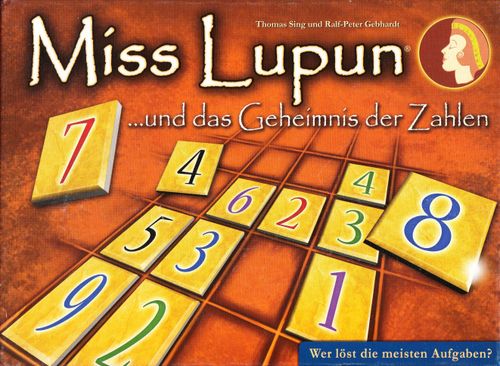
Miss Lupun…und das Geheimnis der Zahlen
Miss Lupun…und das Geheimnis der Zahlen Rulebook
Table of Contents
Table of Contents
Game Idea
"Miss Lupun und das Geheimnis der Zahlen" is an exciting strategy game in which everyone from schoolchildren to game experts gets their money's worth. The simple rules are understood immediately. Each player tries to solve 3 tasks by placing the matching number tiles on the correct spaces of the game board. Along the way, the other players can get quite in your way, or unintentionally help you. A player who uses his numbers tactically from the very beginning and takes the moves of his opponents into account has good chances of solving his tasks and winning the game.
Components
- 1 game board
- 139 task cards
- 7 joker cards and 3 win cards
- 60 number tiles with the numbers 0 to 9 in 6 different colours
- 7 joker tiles
Setup
The empty game board is placed in the middle. Each player chooses a colour and takes all 10 of its number tiles. He places them in front of himself, visible to all other players, with the circled number facing down. The 139 task cards are shuffled well. The entire stack is placed face down on the matching space on the game board. Now it is time to switch on your brain, and off you go!
The Game Board and the Task Cards
The Miss Lupun game board consists of 24 spaces, with rows 1 to 6 and columns A to D. Every row, every column and every space therefore has a unique designation.
Each task card shows a task that must be solved on the game board. To illustrate it, every task card carries a diagram that graphically shows which spaces of the game board the task refers to. Below the diagram, the task is usually stated in the form of a small calculation formula. (The explanation of the mathematical symbols can be found in the appendix to these rules.)
In the upper left corner of the task card is the point value (in the examples shown on the right, 3 and 6 points), which the player receives for solving this task. This point value (between 1 and 9 points) is at the same time an indication of how difficult the task is. The more difficult, the more points can be scored with the task. The goal of each player is to solve as many of his tasks as possible during the round by placing his numbers skilfully over the course of the round (ideally, of course, all three).
Selecting the Tasks
Each player secretly draws 4 task cards from the stack. From these 4 task cards, each player chooses 3 tasks for himself, which he keeps secret from his fellow players. The fourth task card, which was not selected, is placed back under the stack by each player.
Playing the Game
The first player places one of his number tiles on any space of the game board. After that, the other players take turns, each placing one of their number tiles on an empty space of the game board.
Each player tries to solve his 3 own tasks and, whether he wants it or not, at the same time supports or disrupts the solving of his fellow players' tasks.
Since each player has each number only once, he must think carefully about which of his numbers he uses for which of his 3 tasks. The approach to each individual task also needs careful consideration.
For example, if a player has the task "Row sum 5 < 12", it makes sense to place a small number in this row early on. Which specific number is best to use, however, also depends on the other two tasks.
If a player can no longer solve a task himself because he no longer has the corresponding numbers, a fellow player may still bring about the solution unintentionally. It is therefore important that one's own tasks remain unrecognised for as long as possible. Conversely, it helps a great deal to guess as early as possible which tasks the other players are pursuing. If a player places, for example, the 8 and the 9 in one row, one may assume that he needs a high row sum there, and then spoil his calculation by placing a low number in that row.
End of the Round and Scoring
The round ends as soon as all 24 spaces are occupied or (with 2 players) all 20 number tiles have been placed. After each round, each player presents his task cards and adds up his points for the tasks he solved. The player with the highest point total is the winner!
(With 2 players, 4 spaces remain unoccupied at the end. Tasks that involve unoccupied spaces are not solved.)
Tip: Before the game begins, it can be agreed to play several rounds, for example as many rounds as there are other players. Then the player with the highest total point score wins.
Variant: Joker and Win Cards (More Excitement)
Setup
The 7 joker cards and 3 win cards are shuffled into the stack of task cards.
Using the Front and Back of the Number Tiles
The front and back of the number tiles bear the same number. The number on the back of the number tile is circled. This distinguishing feature is used in this variant for counting and for playing over several rounds.
At the start of the game, all players place their numbers in front of themselves with the circled side facing down, as in the basic game. At the end of each round, players may turn over their number tiles in the amount of the point total they have achieved, so that the circled number lies visible on top.
Selecting the Tasks
Each player secretly draws 4 task cards from the stack. For every joker card among these 4 cards, the player receives one joker tile and one additional task card. As in the basic game, the player then decides on three of the four tasks.
The Joker Card
For every joker card you draw, you receive one joker tile. A joker tile can take any number from 0 to 9. When it is your turn, you may place it on any empty space of the game board, just like a number tile. If you do not use the joker, it is lost. It is not possible to save the joker for the next round.
When scoring at the end of the round, you may assign the joker the number that is best for you. But be careful: your fellow players can also benefit from your joker. If the joker happens to lie in such a way that the tasks of the other players are affected, those players may also make use of the joker during their own scoring and choose for it the number that is best for them. It is very annoying when your fellow players profit more from your joker than you do yourself.
Tip: Since you may assign only a single number to the joker, it is clever to choose for the joker the task that brings the most points. You are a real expert if your chosen joker number helps you with several tasks.
The Win Card (Optional)
Now it is one against all. This card opens the chance to decide the entire game yourself, even when your point total is hopeless.
When you draw a win card, place it face up in front of you. You do not receive a fourth task card this time. Now it is important to keep your nerve. If you manage to solve all 3 of your tasks, you have won the entire game, regardless of the current point total!
For the opponents, on the other hand, the rule is: pay close attention, make loud guesses, and try together to thoroughly spoil the win player's plans – and perhaps, in the process, still quietly solve one or another of your own tasks.
If you do not manage to solve all 3 tasks, the game is scored normally and each player may credit himself with the points he has earned.
End of the Round and Scoring
After each round, each player presents his solved and unsolved tasks and adds up the points he has achieved. Then he turns over his number tiles in the amount of this point total, so that the circled number lies visible on top. If a player has, for example, scored a total of 13 points in one round, he may turn over the number tiles 9 and 4, or the number tiles 3, 4 and 6, or any other combination of number tiles whose sum is 13 points (or less). The game then continues as normal and the next round begins. The turned-over tiles are from now on used with the circled number facing up. The number tile 0 can, by the way, be turned over right at the beginning.
The overall winner is whoever first turns over all of his 10 number tiles, or can win a round with the win card. If 2 players turn over the last number tile in the same round, the winner is the one who scored more points in the last round.
Handicap and Shortening the Game
Small Lupuners may ask large Lupuners for a handicap by being allowed to turn over one or more of their number tiles before the game begins. If all opponents turn over one or more number tiles before the start of the game, the total playing time is shortened accordingly.
Example of Play with Joker and Win Cards (3 Players)
Each of the 3 players has secretly chosen exactly 3 of 4 task cards from his hand and keeps them hidden from the others. You can see these cards in the illustration below. Each player now tries to solve as many of his task cards as possible.
Player 1 was lucky enough to draw a joker card. For this he receives a joker tile. When it is his turn, he may place it instead of a number tile on one of the empty spaces of the board.
(The board illustrations show the task cards of each player: Player 1 (red) has the tasks "Column sum C = 24", "A3 = C2" and "Row 5 = 3 odd numbers, 1 even number"; Player 2 (green) has "Row sum 4 = 26", "C3 > each of the 4 surrounding numbers" and "D5 = A5 + B5"; Player 3 (blue) has "Row sum 1 > 9", "Square = 9 different numbers" and "A chain of 3 consecutive numbers in one column". The board after the round is also shown.)
Alternately, each player places one tile on the board. The board is shown on the right after the round has ended. Now it is checked which player has solved which of his task cards and how many points he has thereby scored. Each player then decides which number tiles he turns over.
Player 1 (red):
- Task 1: For the joker, the player may insert any number from 0 to 9. Naturally he chooses the 5. The column sum of C is thus 24. Task solved: 5 points.
- Task 2: The number 4 lies on both space A3 and space C2. Task solved: 3 points.
- Task 3: In row 5 there are exactly 3 odd numbers. Task solved: 4 points.
Total points: 12. Player 1 decides to turn over the tiles 3 and 9.
Player 2 (green):
- Task 1: The sum of row 4 is 27 (not 26). Task not solved: 0 points.
- Task 2: Lucky break. Player 2 may also make use of the joker on C3 belonging to Player 1. He naturally chooses the 9. Task solved: 4 points.
- Task 3: Unfortunately, Player 1 placed the 3 on A5. Task not solved: 0 points.
Total points: 4. Player 2 decides to turn over the tile 4.
Player 3 (blue):
- Task 1: The sum of row 1 is greater than 9. Task solved: 1 point.
- Task 2: He almost solved this difficult task. But here too Player 1 spoiled a task by placing the 4 on C2. Task not solved: 0 points.
- Task 3: Column D contains the chain 2, 3, 4. Task solved: 3 points.
Total points: 4. Player 3 decides to turn over the tiles 1 and 3.
Appendix: Explanations
The board is made up of the 4 columns A, B, C and D. A column consists of 6 spaces in a vertical arrangement.
The board is made up of the 6 rows 1, 2, 3, 4, 5 and 6. A row consists of the 4 spaces in a horizontal arrangement.
Column sum: the numbers on all 6 spaces of a column are added together.
Row sum: the numbers on all 4 spaces of a row are added together.
Number tile: a tile showing one of the numbers 0 to 9.
= equals (examples: 6 = 6 or 9 = 4 + 5)
< less than (example: 3 < 4)
> greater than (example: 7 > 5)
+ plus (add, or count on)
- minus (subtract, or take away)
x times (example: 2 x 3 = 6)
: divided by (example: 8 : 4 = 2)
Divisible: a number is divisible by another number if the division works out without a remainder.
Even: any number that is divisible by 2 without a remainder. That is: 0, 2, 4, 6, 8, and so on.
Odd: any number that, when divided by 2, leaves a remainder of 1. That is: 1, 3, 5, 7, 9, and so on.
Prime number: a prime number is a number greater than 1 that is divisible only by 1 and by itself. From 0 to 100 there are the following 25 prime numbers: 2, 3, 5, 7, 11, 13, 17, 19, 23, 29, 31, 37, 41, 43, 47, 53, 59, 61, 67, 71, 73, 79, 83, 89, 97. (Note: the number 1 is not a prime number.)
A2B2 (with a bar drawn over the two spaces): if 2 spaces (for example A2B2) are connected by a line drawn above them, this represents a two-digit number. If the number tile 4 lies on A2 and the number tile 9 lies on B2, then A2B2 is the number 49.
Chain: a chain is a sequence of consecutive numbers. The smallest number may stand at the beginning or at the end of the chain. (Examples: 3, 4, 5, 6 or 9, 8, 7)
Square (2 x 2): four spaces forming a 2 x 2 block.
Rectangle (2 x 3 or 3 x 2): six spaces forming a block of 2 x 3 or 3 x 2.