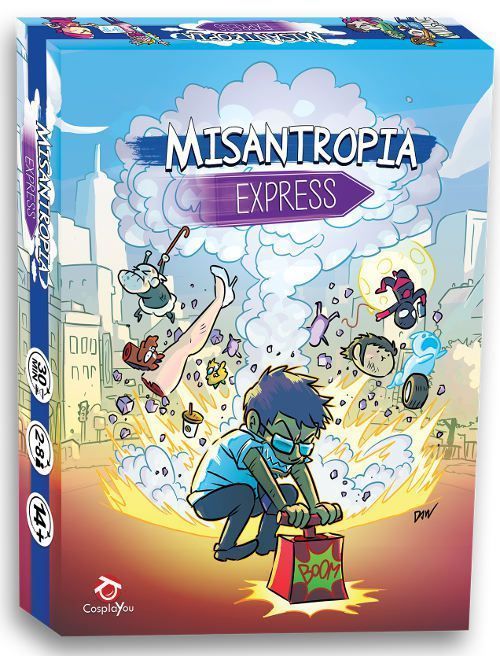
Misantropia Express
Misantropia Express Rulebook
Table of Contents
Table of Contents
Components
- 6 Location cards
- 8 Character cards
- 38 Phobia cards
- 10 Job cards
- 54 Event cards
- 20 Goods cards
- 30 Clue cards
- 5 Empty Clue cards
- 20 Misanthropy tokens
- 7 red Misanthropy tokens
- 20 Money tokens
- 8 Gold Money tokens
- 8 Patience tokens
- 8 Player tokens
- 1 Time token
- 1 Murphy's die (a normal die is fine)
Setup
- Choose a Location card at random and place it in the centre of the table. You may also fight among yourselves to impose your preferred Location card. Once decided, make sure to make the corpses disappear and return the remaining Location cards to the box. They will not be used in this game.
- Take the Event deck, shuffle it and place it face down next to the Location card. The side written horizontally is the front of the card, which must face up.
- Take the Goods deck, shuffle it and place it face down next to the Location card. Take 3 cards from the deck and place them face up in a row next to it. The face-up cards represent the Global Market.
- Divide the remaining card decks by back, shuffle them and place them face down near the Location card.
- Place the Misanthropy tokens in a common supply next to the Location card.
- Place the Money tokens in a common supply next to the Misanthropy tokens.
- Place the Time token on the space 1 MON., to the left of the Location card. If you are playing with 6 or more, place it on the space 2 TUE.
- Each player must perform the following actions:
- Choose one of the Character cards, take a Patience token and place it on space 7 of the Character card. Then take the Player token of the same colour as the card.
- Take 1 Money token and 1 Misanthropy token from the respective supplies.
- Draw a Job card and a Phobia card, but resolve only the effects highlighted in the violet box, if any. Each Phobia must in any case be "interpreted" during the game (see the paragraph "Phobias").
- The player who has the most years of paid work behind them takes Murphy's die. The die indicates the First Player, and it must be passed clockwise among the players at the end of each Day (that is, each game turn).
Aim of the Game
Be the player with the highest Mental Sanity at the end of the last Day of the game. Having a Job and possessing Goods raises the value of Mental Sanity; having developed Misanthropy and Phobias, on the other hand, lowers it.
Once the sums are done (see the paragraph "End of the game"), the player with the highest Mental Sanity value is declared the winner and may take home the advanced panettone from last Christmas.
Overview of a Game Turn
Labels on the sample Location card: A. Name; B. Location effect; C. Event effect; D. "Same place" bonus; E. Choice spaces; F. Days of play.
Each turn of the game represents a Day of work, and must be carried out respecting the effect of the Location, written at the top next to the name (B).
Anyone caught not respecting it must lose 1 Patience each time.
If you are physically in the same place shown on the Location card, the "Same place" effect (D) also applies.
At the start of each Day in which you still have a Job, you receive a salary. Yes, we know this is science fiction, but if we had recreated the real conditions of the world, the game would never have worked, so that is it, ok?
At the start of the Day, each player who has a Job in front of them takes 1 Money from the supply.
All players now simultaneously choose one of the 4 spaces of the Location card, placing their Character token on it or, if preferred, next to the illustration showing the chosen space.
But if you think your plans for the day will go smoothly as you have made them, perhaps you have not paid attention to how life works. Murphy's Law says: "If something can go wrong, it will."
Once all players are satisfied with their choice, the First Player rolls Murphy's die, and everyone loses the Patience indicated by the space they chose, in correspondence with the value of the die.
Example. We are at the Pub. Marcaldo has a bit of a hangover and chooses the "Stuzzichini" (Snacks) space; Gionaveffa drinks only Beer (third space), and Antonimo, as usual a pig, gobbles up the Paninazzi (last space). Piergiangiorgio is the First Player and rolls Murphy's die: it comes up 4. Marcaldo loses 1 Patience, Gionaveffa loses 2 Patience, and Antonimo instead loses 4 Patience, as specified by the relevant space each one chose. Piergiangiorgio, who chose the first space, will not lose any Patience, but will directly suffer the malus indicated on the space.
Then, starting from the First Player and proceeding clockwise, each player resolves the effects indicated on their chosen space (see the paragraph "Space effects").
Once all effects have been resolved, the Day ends and each player recovers 2 Patience (see the paragraph "Patience") minus 1 for each type of Critical Phobia (see the paragraph "Job") they possess, down to a minimum of 0.
The First Player of this turn passes Murphy's die to the next player clockwise, moves the Time token to the next space below (if this was not the last Day), and a new Day begins.
End of the Game
The game ends after the 6th Day.
Each player calculates their Mental Sanity score. Add up the value of all the Goods in their possession (a "Free" Good is worth 0), then modify the total as follows:
- +3 if you have a Job card in front of you;
- -2 for each Phobia still in front of you;
- -1 for each Misanthropy token (red Misanthropy tokens are worth -3).
If there is a tie, the player with fewer Phobias is the winner. If there is still a tie, the player with fewer Misanthropy tokens is the winner. If there is still a tie, the player who has more years of paid work behind them wins.
In case of further ties... oh, you broke it, in this game everyone loses! Draw lots and go to bed, damn it: do not go to work, tomorrow?!
Space Effects
Labels on the sample Event card: A. Name; B. Text; C. Choice 1; D. Choice 2; E. Result of Choice 1; F. Result of Choice 2.
Draw an Event
When a player must resolve this effect, they draw a card from the Event deck.
Unsolicited advice: we humbly suggest drawing from the bottom of the deck and discarding on top of the deck, especially when someone has already played several games. Well, oh, do as you like; you have already paid the money anyway.
If the card shows a ! symbol, the effect indicated on the Location is resolved immediately.
Then the player continues by reading the card aloud (B). If there is a choice, the player must choose one of the two possibilities (C or D) and then turn the card in the direction indicated by the arrow (for a card with no choice, follow the arrow of the only possible choice). The player then reads the remaining text (contained in the box of the same colour as the chosen option), including the game effects indicated, and resolves them one at a time.
Some Event cards refer to a particular Phobia or to a type of Goods: if one of these is in front of the player, that player follows the effects reported on the Event card.
Buy a Good
A player may buy a Good from the Global Market by choosing one of those available face up, paying its cost and placing it in front of them. After each purchase, the player reveals a new card to replace the Good bought.
Get Treated
Some situations are so pleasant that they relieve your madness, making you discard a Phobia. It is not so automatic.
A player who chooses this space draws and reveals a card from the Clue deck. They now have 30 seconds to try to explain to the others how the subject depicted on the card can help them get rid of one of their Phobias.
At the end of the 30 seconds (which we hope someone has timed; do we really have to explain everything?), the other players decide together whether the attempt was successful. In case of disagreement, a vote is taken and, if the majority of votes are in favour, the attempt is successful.
If the attempt is successful, the player immediately discards that Phobia. Otherwise, they take 1 Money from the supply.
Note, and a good one: do not try to be clever! If, during the explanation, the player being treated laughs or has other unseemly reactions, it means the attempt is successful! Make them discard the Phobia and do not break!
Finally, regardless of the outcome of the attempt, the player being treated may discard any Phobias still in front of them, paying 3 Money for each Phobia discarded in this way.
Additional Game Elements
Patience
Each time a card or a Location effect shows this icon, you gain or lose the respective number of Patience. Keep track of your Patience by moving your token on your Character card.
At any time you cannot have more than 7 Patience, just as you cannot lose further Patience when you are at 0.
If your Patience drops to 0, you must immediately draw a Phobia card. Once you have finished reading the Phobia card, and any other Phobias triggered in a chain, reset your Patience to 5.
Example. Pangiacolo has 1 Patience, and an effect forces him to draw a Phobia card. What a charming joker. The card drawn is "Vestifobia" (Clothes Phobia) and, since he does not want to undress, it makes him lose 4 Patience (the snowstorm outside the venue has surely influenced the decision). Pangiacolo goes to 0 Patience and must draw a new Phobia. If this one, too, would make him lose further Patience, simply ignore that effect. Once this second Phobia has been read, reset his Patience to 5.
Misanthropy
Misanthropy is hatred of humanity. Unlucky events will increase this inner value, which you may also have to show outwardly.
Each time a card or a Location effect shows this icon, you take or discard the respective number of Misanthropy tokens. When you gain some, take them from the supply and place them in front of you with rage and frustration. When you discard them, move them (if you have any) from in front of you back to the supply, with calm, measured movements, emitting a slight murmur of enjoyment, possibly looking the other players in the eye.
Accumulating Misanthropy tokens increases the malus given by some Event cards.
Box (standard token): Misanthropy token.
Box (red token): this token is worth 3 Misanthropy tokens, and you may use it to simplify counting as you gain tokens.
Money
Each time a card or a Location effect shows this icon, you take or discard the respective number of Money tokens. Money can be used to buy new Goods at the Market, or to get rid of Phobias.
Box (standard token): Money token.
Box (gold token): this token is worth 3 Money tokens, and you may use it to simplify counting as you gain tokens.
Very important note, without which you cannot play: the name of the game's currency is "soldo" (plural "soldi"). One soldo, three soldi, and so on. In this translation the currency is written as "Money".
Phobia
Labels on the sample Phobia card: A. Type of phobia; B. Name of phobia; C. Description of phobia; D. Text of the card; E. If the card has text on a violet background, that effect remains active for as long as the card stays in play.
The type symbols are: Judgement, Environment, Objects, Emotions, Irrationality, Thought, Physicality, People, and Special.
Sample card: Macrophobia. "Develop the fear of long waits." Another player times you. Remain motionless for 47 seconds. When you want, shout Stop! Take 1 Misanthropy for each second more or less than you remained motionless. If you were playing in a restaurant or pub and had ordered something that has not yet arrived, take 1 Misanthropy every 5 minutes of waiting.
Every time a card or a Location effect tells you to draw a Phobia, draw a card from the corresponding deck and follow its effects. If instead it tells you to discard or get rid of a Phobia, discard one of your choice among those you have.
These cards describe the phobias you have contracted by force of living in this crazy, stressful world, continuing to lose patience and to increase your hatred of humanity.
Every Phobia Must Be Interpreted
Every Phobia that a player develops MUST be interpreted!
For example, if you contract Nelophobia (fear of glass), in addition to following the rules written on the card, you must play for the rest of the game (or until you discard the Phobia) without having any contact with anything made of glass!
If you become Venustraphobic (fear of beautiful women), you must even avoid the glances of the coquettish young ladies playing with you!
Meaning that "interpreting a phobia" means having reactions of fear or disgust towards the object of the phobia, each player must keep an eye on the others. If someone is caught breaking one of their Phobias, that person must immediately lose 1 Patience, unless the card itself specifies otherwise.
Some Phobia cards ask the player to draw further Phobia cards. A player cannot draw more than 3 Phobia cards in a row in this way. If you would have to draw a further Phobia in this way, take 2 Misanthropy from the supply instead.
Job
Labels on the sample Job card: A. Job; B. Description; C. Types of Critical Phobias.
Someone once said that a steady job is monotonous... so here in Misanthropy you will not be bored, because you will have to change jobs continually!
Each time a card or a Location effect tells you to draw a Job, you may take a new one, drawing at random from the corresponding deck. If it instead tells you to discard your Job, you must return the Job card you have in front of you to the deck at random, if you have one.
It is never possible to have more than one Job at a time. If a player obtains a new one while already having one, they must choose which to keep and discard the other.
If your Job card has the same symbol as one of the Phobias in front of you, that Phobia is Critical. For each of the symbols, if you have at least one Phobia of the corresponding type, you recover 1 Patience less at the end of the Day.
Goods
Labels on the sample Goods card: A. Name of the Good; B. Cost in Money tokens; C. Description; D. Type of Good.
The sample card is "Independent House", described as "The house suited to a true misanthrope", of the type "Dwelling".
"Money does not buy happiness", sure, sure... but it lets you buy it!
Goods will help you slow down your descent into madness... and to win the game, if that is all you are interested in. There you go!
Each time a card or a Location effect tells you to draw a Good, you may take a random new one from the corresponding deck, without paying its cost. If it says to take it from the Global Market, the indicated cost must be paid. Some Goods cards show the cost as "FREE"; these cards may be taken without paying any cost.
Some Event cards refer to certain types of Goods. If you possess a card of the indicated type, follow the effects on the Event card.
Other Rules
If a card contradicts a rule of this manual, always follow what the card says first. Cards, or Location effects, always take precedence over these rules.
If at any time all the cards in a deck run out, shuffle the discards of that deck and form a new one to draw from.
The player with the most years of paid work behind them always has the last word in case of discussions, diatribes, quarrels and ius primae noctis, and must always be left the last taste of the food and drink.