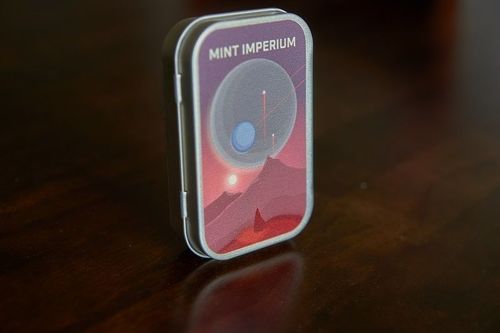
Mint Imperium
Mint Imperium Rulebook
Table of Contents
Table of Contents
Game Overview
Players will participate in a struggle between the Rebels and the Imperials. Each faction has different strategies and objectives. The Rebels are outnumbered, must remain hidden, use diplomacy, and employ hit-and-run tactics. The Imperials strike fear, conquer planets, and have advanced ships.
Setup
- Prepare the Game Board (see below).
- Objective Deck - Sort cards by number on the back (I, II) and shuffle each pile. Then place the I pile on top of the II pile. The Rebel Player draws and keeps the top card.
- Prepare Mission Decks - Each player takes their four starting mission cards into their hand and shuffles the remaining cards into a facedown mission deck.
- Pick Starting Planets - Randomly choose a production planet in sector 2 for each player (F, G, or H).
- Imperial Setup - Place 1 capital and 1 star fortress between the starting planet and Imperium. Then the player chooses and places 5 starfighters in any amount between Imperium and the starting planet.
- Rebel Setup - Place 2 starfighters on the starting planet. Secretly pick a planet from the probe deck to keep facedown as the hidden base. Shuffle the probe deck.
Prepare the Game Board
Arrange planet cards into 3 rows grouped by their sector number. Randomly shuffle each row and place Imperium at the middle of sector 1. Place the transparent cubes on each spot on the time track. The red cube is the objective token and the green is the time token. The leader pool consists of 3 faction leader cards and their meeples. All remaining cubes create the supply.
Playing the Game
Mint Imperium is played over a number of rounds. Each round, players will resolve four phases in this order:
- Planning - Players assign leaders to missions.
- Operations - Players resolve missions or move ships.
- Objective - Players score revealed objectives.
- Refresh - Return leaders, gain new objectives & probes, and produce and deploy new units to planets.
Planning Phase
Each player draws 1 new mission card into their hand. During this phase, players assign leaders to missions. Each player has a hand of mission cards that have different outcomes. To assign a leader to a mission, a player takes the card from their hand and places it facedown on the table. Then they place a leader meeple on top of the mission card. The Rebel player will plan all of their missions first and then the Imperial player.
Operations Phase
During this phase, players can move their units or reveal their missions. Starting with the Rebel player, players alternate taking turns by doing one of the following:
- Move a Fleet - Use a leader from their pool to move ships on the game board. If Rebel and Imperial units are on the same planet, begin combat.
- Reveal a Mission - Attempt a facedown mission.
- Pass - Forfeit future actions this round. Can't move a fleet or reveal a mission (opposing a mission is ok).
Moving a Fleet
Select any planet that does not have the player's leader meeples and move any number of ships orthogonally 1 card. Place any leader from the player's pool on the destination. Rebels can move any ships, but Imperials can only move starfighters if a capital ship is also moving. The Star Fortress is considered a capital ship for movement rules.
Revealing a Mission
To reveal a mission, the player chooses a facedown card and flips the card and chooses a target planet that fulfills the listed requirement on the mission card. Some missions can be opposed. If the attribute is empty, the mission can't be opposed and is successful.
The mission card layout is labelled as follows: Starting Mission (marker), mission name, Attribute (icon), Requirement (planet type, e.g. "Planet with Imperial units"), Reward in 2-player game, Reward as solo player, and Bot's reward in solo game.
Opposing a Mission
After the player reveals a mission, the opposing player may oppose the mission by placing 1 leader meeple from their pool or from any planned mission card to the target planet. If the opposing leader is from a planned mission, return that card to their hand. If there are any opposing leaders, captured included, the mission is opposed and must be attempted.
Attempting a Mission
Each player rolls 1 die and adds +1 to the result for each leader attribute that matches the mission attribute. Do this for all leaders on the planet, even captured ones. The mission is successful if the player has a higher or equal value than the opposing player. If successful, perform the reward listed. Then discard the mission regardless of the outcome. Return the card to your hand if it is a starting mission instead.
Objective Phase
The Rebel player scores each objective card they revealed during the Operations Phase by moving the objective token forward 1 space and discarding the objective card.
Refresh Phase
- Retrieve Leaders - Each player takes all of their non-captured leader meeples and places them back on their cards in the leader pool.
- Launch Probes - Imperial player draws 1 probe card.
- Draw Objective - Rebel player draws 1 objective card.
- Advance Time - Move time token one space along the time track. Then build units if the time token is on a space with this icon: (build-units icon)
Build Units
Each player will build units by placing them on the build queue from the supply pile. Each planet has a production tab showing what units to build and which spot on the build queue to add them. Only planets that are faction aligned, and don't have a disrupt token, will build units.
The planet card diagram labels Sector, Name, Production Tab, Production Units, and Queue spot. Planet types shown are Remote, Production, and Rebel Loyal (the Rebel Loyal planet has a red production tab).
Faction Aligned Planets
- Imperial aligned - Planets that have at least 1 Imperial unit and are not loyal to the Rebels.
- Rebel aligned - Planets that have no Imperial units and have loyalty to the Rebels.
Deploy Units
Starting with the Rebel player, each player slides all units down the build queue 1 space (towards the end of card). Any units that slide off can be deployed. The player can place these units on any of their faction aligned planets. The Imperial player can always deploy to the planet with the Star Fortress. The Rebel player may also deploy to their hidden base card. Each planet can have a maximum of 2 units deployed to it per round. Begin a new round.
Winning the Game
- Imperial player wins the game if there is an Imperial unit on a revealed Rebel Base, OR the planet with the Rebel Hidden Base is destroyed by the Star Fortress.
- Rebel player wins if the objective token touches or passes the time token on the time track.
Objective Cards
Objective cards are kept secret from the Imperial player. The Rebel player may reveal an objective if that card's condition has been met at the end of the phase listed on the card. Objectives are scored during the Objective Phase.
Objective cards show a Condition and a Phase at which the condition is checked. The example card in the rules is "Network", with the condition "5 Production planets with either Loyalty, disrupt token, and or Rebel units" and the phase "Operations Phase".
Combat
Combat ends when one or both players have lost all of their units. At the start of combat, each player takes their units and places them next to the time track. The player's base card will list the starting HP values for each ship. Place them next to their starting values. This card helps keep track of their HP and damage.
Combat happens in waves which has 3 phases:
- Attacking player rolls - roll dice and assign hits
- Defending player rolls - roll dice and assign hits
- Remove destroyed ships - place 0 HP ships into supply.
Rolling Dice
Each unit in the battle adds dice to roll. The base cards show which color dice each unit rolls. Combine dice from all units with maximum of 3 white and black dice. Units at 0 HP still count for adding dice until they are removed to the supply.
Assigning Hits
Slide the ship down 1 HP value for each assigned hit. Basic hits can damage one type of ship based on the color of the dice. Black = starfighter. White = capital. Critical hits can damage any type. The following shows the values for basic and critical hits:
- Basic Hit - a white or black die showing 4 or 5.
- Critical Hit - a white or black die showing 6.
The Star Fortress can only be destroyed in combat if the Rebel player has the Secret Plans objective.
Additional Rules
Capturing and Rescuing Leaders
The Imperial player can only capture 1 leader at a time. Rebel leader cards have a captured and non-captured side to keep track of captured leaders. The Imperial player can move captured leaders when moving units. Rebels can rescue a leader by playing a rescue mission card or eliminating all Imperial units on the planet with the captured leader.
Rebel Base
While hidden, the Rebel player may move units during the Refresh-deploy step from the hidden base card to any Rebel aligned planet, without a disrupt token, following the maximum deployment rules.
Disrupt Tokens
A planet with a disrupt token can not produce units. Additionally, units can not be deployed to it unless there is a Star Fortress or is the revealed Rebel Base.
Destroyed Planet
If the Imperial Obliterator mission destroys a planet, replace the planet with the destroyed card. Units can still move to and from the destroyed planet card.
Probe Cards
Probe cards are kept facedown and secret from the Rebel player.
The unit legend printed on the Additional Rules page shows: Starfighters (red square and green square), Capital Ships (red octagon and green octagon), and Star Fortress (green star).
Transcription note: the printed words "Addtionally" (Disrupt Tokens) and "asigned" (Assigning Hits) are corrected here to "Additionally" and "assigned".