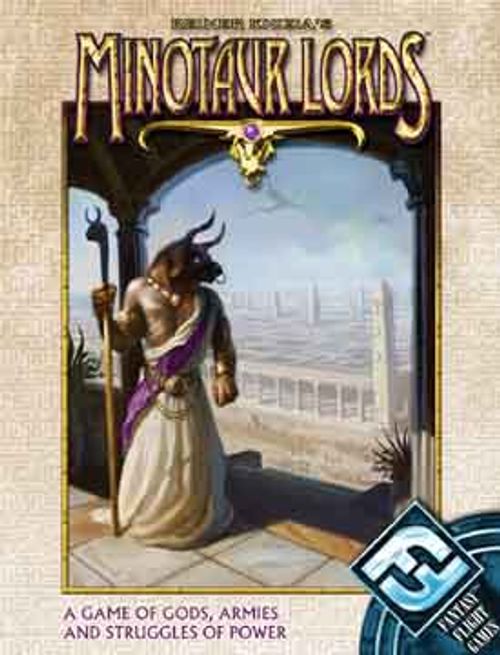
Minotaur Lords
Minotaur Lords Rulebook
Table of Contents
Table of Contents
Object of the Game
Control Cresos by claiming supremacy in military, economic, and religious power.
Cresos is divided into two regions (upper and lower Cresos), and each region is divided into three areas of conflict called columns (military, religious, and economic). To win the game, you must have supremacy in two of the three columns in both regions. You also win the game if your opponent runs out of cards in his deck.
Components
- Board: This is placed between the two players. It is divided into two regions (upper and lower Cresos), each of which is divided into three columns (military, economic, and religious).
- Supremacy Counters: These 6 wooden bullhead-shaped tokens are used to keep track of which player has won supremacy in each of the columns.
- Curse Counters: These circular cardboard counters are placed on cards when they are cursed, and removed from cards when they are uncursed. A cursed card has a power of 0 and no special abilities.
- Cards: There are 84 cards, divided into two 30-card game decks (red and blue) and one 24-card bonus deck (white). The bonus deck is only used in the advanced game.
Game Setup
- Place the board in the middle of the playing area, between both players, as shown in the layout diagram. Place the six supremacy counters at one end of the board and the curse tokens at the other end. Finally, separate the cards into three decks, sorting them by the colored stripe down the left hand of the card.
- Randomly choose one player to take the House Miron (red) deck. The other player takes the House Vess (blue) deck. The remaining 24 cards are placed to the side. (They are only used in the advanced game, explained at the end of these rules.)
- Both players shuffle their decks, place them face down in their respective playing areas, and draw 6 cards for their opening hands.
Layout Diagram
The board lays out as follows:
- Discard Pile and Deck sit at one end of the board.
- Leaders occupy one row, above the Gods area in the center.
- Minions and Buildings occupy their own row.
- Curse Tokens sit at one side of the board, opposite the Supremacy counters.
- The same arrangement — Leaders, Gods, Minions and Buildings, Deck, and Discard Pile — mirrors on the opposing side of the board for the other player.
Game Basics
Discarding Cards
Some effects may force you to discard cards from your hand or from play. When you discard a card for any reason, place it face-up in your discard pile.
Cursing and Uncursing
During the game, cards may become cursed. A curse counter is placed on that card to indicate that it is cursed. A cursed card is considered to have a 0 power rating and no text. It is effectively a blank card. You may curse a card that is already cursed, and put an additional curse counter on it, but doing so has no additional effect.
Cursed cards can also be uncursed. When you uncurse a card, remove one curse counter from that card. If additional curse counters remain on the card, however, it remains cursed and still has no power rating or text.
Playing the Game
Decide randomly which player takes the first turn. Each player completes his or her entire turn before play passes to the opponent. Play passes back and forth in this fashion until one player wins.
Turn Sequence
On your turn, first check to see if you have won the game (see Game End, later in the rules). If you haven't, exercise one of the following two options:
Option A
You may perform the following four phases in order:
- Phase 0: You may take any number of "phase 0" actions.
- Phase 1: You may take one "phase 1" action.
- Phase 2: You may take one "phase 2" action.
- Supremacy: Determine, then exercise your supremacy.
If you have trouble gaining economic supremacy, you'll want to refresh when you're low on cards...
Option B
Refresh: Discard as many cards from your hand as you wish, then draw back up to six cards.
Important: During your turn, you must always play or discard at least one card from your hand.
First Player Rule
On the first turn, if you are the first player and you choose option A, you must skip 2 phases of your choice. If you choose option B, you refresh as normal.
Action Phases (Phases 0–2)
Phase 0, 1, and 2 are also known as the Action phases. During phase 0, you can take any number of actions, while during phases 1 and 2, you can take one action each phase.
For one action, you may do one of the three following things:
- Play a Card
- Activate a Card
- Uncurse a Card
Alternately, you may choose to pass during one or more of your action phases and do nothing, so long as you remember that you must always play or discard at least one card from your hand during your turn.
Action: Play a Card
You may use one action to put a card from your hand into play on your side of the board. Each card, as explained later, belongs to one specific phase. You may only play a card that belongs to the current phase. For example, you can only play a phase 2 card during phase 2 of your turn.
In addition, most card types have other restrictions on where and how they are played, as described on the next page.
Card and Board Breakdown
The Board
The board represents the land of Cresos, and is divided into two regions (upper and lower Cresos). Each region is further divided into three columns (military, economic, and religious) representing the three areas of conflict. There are six columns on the board: three in upper Cresos, and three in lower Cresos.
Board Breakdown
Upper Cresos: Economic Column, Military Column, Religious Column.
Lower Cresos: Military Column, Gods (center), Religious Column, Economic Column.
The Cards
The 30 red cards belong to the House Miron deck. The 30 blue cards belong to the House Vess deck. The 24 white cards belong to the neutral bonus deck. Before beginning the game, arrange the cards into their three respective decks.
Anatomy of a Card
- Title: The name of the card.
- Power: The power value of the card, which indicates how much it helps you to achieve supremacy in its column.
- Phase: Indicates which phase (0, 1, or 2) that this card belongs to. It may only be played or activated during this phase.
- Icons: Indicates into which column(s) — military, religious, or economic — this card may be played. (Military, Religious, Economic)
- Card Type: Indicates whether the card is a minion, building, leader, god, or fate.
- Card Text: Describes the card's special abilities or rules. Card text in italics is flavor text; it has no game effect, but describes the world of Minotaur Lords.
Card Types
The cards are divided into five types: minions, buildings, leaders, gods, and fate.
Minion Cards
These cards represent the people and creatures that help your house in its bid for supremacy. Each minion card is played into one of the six columns and has a power rating. If you have the most power in a column at the end of your turn, you achieve supremacy in that column. (Power and supremacy are explained later in the rules.) Once played, minion cards remain in play until removed.
Play Restrictions: Minions may only be played into columns that correspond to one of their icons. For example, a minion with the economic and religious icons can only be played into an economic or religious column.
Building Cards
Building cards represent the places of power in Cresos. Building cards are played into columns and have power ratings, just like minion cards, but usually have higher power ratings and come into play with curse counters on them. (Curse counters are explained below.) Once played, building cards remain in play until removed.
Play Restrictions: Buildings may only be played into columns that correspond to one of their icons.
Leader Cards
Leader cards represent the heroes, nobles, and wizards who serve your House. Leader cards are played into columns and have power ratings like minion and building cards, but you may only have one leader card in each column. Once played, leader cards remain in play until removed.
Play Restrictions: Leaders may only be played into columns that correspond to one of their icons. In addition, you may only have one leader in each column. If you already have a leader in a column, you may play a new leader into that column, but doing so forces you to discard the first leader.
God Cards
These cards represent the favor of the gods of Cresos and are played in the center of the board instead of a column. Once played, god cards are immediately activated (see Action: Activate a Card) and remain in play until removed. God cards have neither power nor icons.
Play Restrictions: You may have no more than three god cards in play. If you play a fourth god card, you must discard one of your three god cards in play. Also, only one player may have god cards in play. If you play a god card, your opponent must discard all of his or her god cards from play.
Fate Cards
Fate cards represent the will of the gods. Once played, fate cards take effect immediately and are then discarded. Fate cards have neither power nor icons.
Play Restrictions: None, aside from the phase restriction.
Action: Activate a Card
Many cards have special game effects listed in their text. Some cards' text is passive while other cards' text is active. Text that begins with "Action:" is active text; all other text is passive.
Passive text takes effect immediately when its card is played, and stays in effect as long as its card remains in play (and uncursed).
Active text also takes effect immediately when its card is played, but it only takes effect again when you spend an action to activate it. You may use one action to activate the effect of one card, but only during that card's phase. Thus, a phase 1 card can only be activated during phase 1 of your turn.
Remember, God cards with active text are immediately activated when played, just like all cards.
For example, John has the phase 2 god "Jalal" in play. Jalal has the text, "Action: Discard one minion from play." During phase 2 of his turn, John activates Jalal and chooses one of his opponent's minions to discard. John's phase 2 is now complete.
Action: Uncurse a Card
You may use one action to remove one curse counter from a card. If there are multiple curse counters on the card, you may still only remove one for each action. You may only uncurse a card during that card's phase. For example, you may only uncurse a phase 2 card during phase 2 of your turn.
Supremacy Phase
In this phase, you must:
- Determine Supremacy: Determine supremacy for each column on the board and adjust the supremacy counters accordingly.
Afterwards, you may:
- Exercise Supremacy: Exercise supremacy in one or more of the columns you control, one at a time, in order to use their powers.
Determine Supremacy
At the start of your supremacy phase, you must determine which player has supremacy in each of the six columns.
To determine supremacy in a column, add up the total power (contributed by minions, buildings, and leaders) on both players' sides of a column. (Note: Cursed cards have no power.) The player with the most total power in a column claims supremacy in that column. Indicate this by placing a supremacy counter on that player's side of the board in that column.
If both players' totals are tied, neither player has supremacy in that column. No supremacy counter is placed on the board in that column. If there is already a supremacy counter on the board in that column, it is removed.
For example, John has a 2 power minion and a 3 power leader in a column, while his opponent only has a 4 power building in that column. Since John's total power of 5 is higher than his opponent's total power of 4, John wins supremacy in that column, and puts a supremacy counter on his side of the board in that column to show that.
Exercise Supremacy
After you have determined supremacy for all six columns, you may "exercise supremacy" for each of the columns in which you have supremacy (i.e. each column in which you have a supremacy counter on your side of the board). Exercising supremacy has a different effect for each of the three types of columns (military, religious, and economic), as described below. You may choose not to exercise supremacy for a column.
Important: Only you exercise supremacy during your supremacy phase. Your opponent does not!
Note that because there are two columns of each type (one in the lower region and one in the upper region), it is possible to exercise the same type of supremacy twice if you have supremacy in both columns.
Military Supremacy
When you exercise military supremacy in a column, your opponent must discard the top card of his or her deck.
Religious Supremacy
When you exercise religious supremacy in a column, you may curse one of your opponent's minions, buildings or leaders in the same region (either the upper or lower Cresos) as that column. Place a curse counter on the cursed card to show that it is cursed. You may curse a card that already has one or more curse counters on it.
Remember, cursed cards have no power rating, and their text has no effect.
Economic Supremacy
When you exercise economic supremacy in a column, you draw one card from your deck.
Game End
At the beginning of your turn, you win if:
You have supremacy in two of the three columns in both the upper and lower regions of the board
OR
Your opponent has no cards left in his or her deck.
Advanced Rules
The advanced rules are the same as the basic rules except that players must win two out of three games, and are allowed to modify their decks after each game.
After the first and second games, both players simultaneously remove up to five cards from their decks and place them into the bonus deck.
Then the loser of the previous game replaces each of his or her discarded cards with an equal number of cards of his or her choice from the bonus deck. (Note that the replacement cards may include cards that either player has discarded.)
Next, the winner of the previous game replaces each of his or her discarded cards with an equal number of cards of his or her choice from the bonus deck.
After both player decks have been customized, the next game begins. The loser of the previous game is the first player in the next game.
Combining Minotaur Lords and Scarab Lords
It is possible to combine Minotaur Lords and Scarab Lords to play the different decks against each other. When doing so, keep the following things in mind:
- Scarab counters (found in Scarab Lords) are a type of curse counter. Effectively, the two are identical. When a card refers to one, it refers to the other as well, and the terms can be used interchangeably when combining the two games.
- When playing with the advanced rules, you only have access to cards with the same backs as your deck. For example, if you are playing the House Vess deck from Minotaur Lords, you do not have access to the white bonus deck from Scarab Lords, and may only choose white cards from the Minotaur Lords bonus deck.