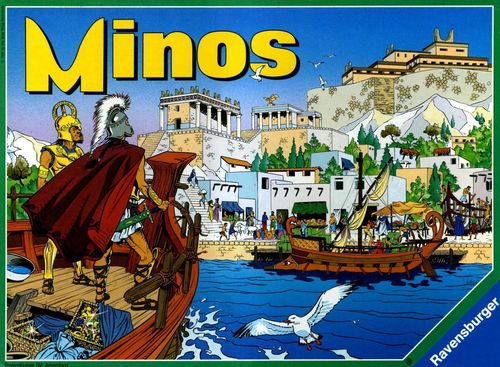
Minos
Minos Rulebook
Table of Contents
Table of Contents
Aim of the Game
The game ends when all the city sites have been settled and at least two full cities have been built. The winner is the player with the highest income at this point, as marked on the scale around the edge of the board. A tie is resolved in favor of the player with the most cash in hand.
Contents
The board depicts the Mediterranean Sea and the areas around. Settlements are established on the lightly colored semi-circular areas on the coasts and on the bigger islands. Each settlement has its own harbor, marked by a dot in the water. The settlement and harbor together represent one area, and the sea area around the harbor is a separate area.
The red spots mark paths on land that soldiers may follow from settlement to settlement. The seas are divided into areas to regulate the position and movement of ships.
The numbered boxes around the edge of the board (1-49) are used to mark the current income derived from a player's settlements. Each box is worth 1 Talent.
The Talent was the first means of payment used in Crete and therefore in Europe. One Talent was represented by one copper bar weighing 64lbs. Since there was no smaller change, the bar had to be exchanged for goods of its full value.
The building pieces represent warehouses (brown), houses (white), and shipyards (blue). The coins represent 10 Talents (gold), 5 Talents (silver), and 1 Talent (copper). The black rings are "battle rings". These are all held in the bank. Player pieces are ships and soldiers, plus an indicator piece.
Preparation
Each player receives playing pieces of one color and 25 Talents in money. Each player places the colored score indicator piece in the 0 box of the income track. Each player receives one ship of their color, placed in the central Mediterranean Sea in the space marked by a fish.
Game Start
The oldest player starts the game, and play thereafter passes clockwise. A player always starts his turn by rolling the six symbol dice. These determine the actions that a player may take in his turn. The dice may be rerolled twice more, keeping dice aside or rerolling them as in poker dice. Dice put aside for the first reroll may be rolled again on the third reroll!
Dice Symbols
Each die may be used once for the indicated action. If a symbol appears several times on different dice, then the action may be taken several times.
- Scales: The player receives income from his settlements. The amount is indicated by the position of his piece on the track around the board.
- Arrow: The player receives 1 battle ring free of charge. The player may also now purchase additional battle rings at cost of 10 Talents each.
- Seagull: The player receives 5 movement points which may be used to move ships and soldiers around the board.
- Building: The player receives 1 building permit which may be used to construct settlements on the same turn.
- Joker: This pattern is the Joker and may be used as any one of the above symbols.
- Star: This adds one point to the value of any one symbol above. It has no value on its own and is not a Joker. The star has no value by itself.
A Joker and a Star may only be used once in a combination.
Examples
Scales + Joker (as Scales) + Star = 3 income
Seagull + Joker (as Seagull) = 10 movement points (5 + 5)
Building = 1 Building permit
Or:
Scales = 1 income
Seagull + Joker (as Seagull) + Star = 11 movement points (5 + 5 + 1)
Building + Joker (as Building) = 2 Building permit
Or:
Scales + Joker (as Scales) = 2 income
Seagull = 5 movement points
Building = 1 Building permit
Joker (as Arrow) + Star = 2 battle rings
Illegal Combinations
- Scales + Star + Star (only one Star allowed per combination)
- Building + Joker + Joker (only one Joker allowed per combination)
- Arrow + Joker + Joker (only one Joker allowed per combination)
- Seagull + Star + Star (only one Star allowed per combination)
Movement
One movement point is necessary to move one space. This applies to soldiers as well as ships. Note: the movement points gained by the die may be distributed among several different pieces.
Soldiers may only be moved on land, following the line of red positions. In one settlement area any number of soldiers of the same color may be positioned; on any other position only one soldier per color is allowed. It is not possible to jump over occupied positions.
Ships move from area to area, if the areas have a common border. A ship cannot leave an area via its corner (diagonally). On each area of the water and in each harbor only one ship may be positioned. Jumping over occupied areas is not possible.
If a ship enters a harbor, this requires 1 movement point.
If a ship leaves a harbor, this also costs 1 movement point.
Building of Houses and Founding of Cities
Buildings may only be constructed on the settlement areas at the coast or on the bigger islands. Before being able to do so a player has to move a ship or soldier onto an unoccupied settlement area.
Please note: A ship reaches a settlement area via its harbor.
In the same turn a player may construct one or more buildings if he has the relevant building permits and the required finances.
Up to four buildings can be built on the same settlement area (on the game board the buildings are put on top of each other). 4 buildings on one settlement area represent a city. In a completed city, building activity may not be continued.
A city must have a city wall (beige-colored building). The other buildings may be of any type, number and combination. Players may construct the buildings in any chosen order.
Exception: The first building on a settlement area may not be a city wall.
In order to construct buildings, permits and money are necessary. The amount depends on how many buildings have already been built in a city:
- The first building costs 1 permit + 5 Talents
- The second building costs 2 permits + 12 Talents
- The third building costs 3 permits + 18 Talents
- The fourth building costs 4 permits + 25 Talents
Building a city wall always costs 4 permits and the cash price depends on when it is being built. For example, if a city wall is the third building of a settlement, it will cost 4 building permits + 18 Talents.
When a player builds the first building of a settlement he receives a soldier from the store free of charge. He puts this guard onto the settlement area.
He may enlarge the settlement area in any subsequent turns if he obtains the relevant building permits and the necessary cash, until eventually the settlement becomes a city.
Income
The total value of all settlements in each player's possession is marked by his indicator on the scoring value. With each new building the value of a settlement goes up. As soon as a player constructs a new building, his score indicator is moved along the scale. He moves up one position for each Talent. The new score is decided by the type of building:
- Harbor building: up 1 Talent
- Citizen's houses: up 1 Talent
- Warehouses: up 2 Talents
- City wall: doubles the value of the settlement
Examples
- Harbor + Citizen's house: up 2 Talents
- Harbor + Citizen's house + City wall: up 4 Talents
- Harbor + Warehouse: up 3 Talents
If a further harbor building is constructed in the second example, the value will go up by a further 2 Talents because the doubling effect of the City wall also extends to buildings which are being built later.
No building may be demolished again.
A settlement or a city only belongs to a player as long as he maintains at least one guard or ship on that settlement. If he takes these away, he loses the value of this settlement. Therefore the indicator on the scoring scale will be set back accordingly. A settlement without an occupier may be taken over without conflict by another player.
Buying Soldiers and Ships
Additionally to the actions achieved by throwing the dice, a player may purchase more guards and ships during his turn, provided he has enough cash and settlements to make this feasible.
If a player possesses a settlement with 2 Harbor buildings, he may build a ship in its harbor, provided there is no other ship in the harbor. The ship will cost 5 Talents.
If a player possesses a settlement with 2 Citizen's houses, he may build a soldier piece there. This will cost 5 Talents.
For each settlement or city this type of action is only possible once per turn. The acquired soldiers and ships will have to be positioned immediately.
The possibilities for this action are limited by the playing pieces available. If a player has used all of his soldiers, he receives no further ones should he found a new settlement. He will not be able to recruit new soldiers, even if he possesses settlements with two Citizen's houses. Furthermore, new ships and buildings can only be introduced into the game as long as they are available.
Conflicts
If a player's ship or soldier encounters an opponent's ship or soldier during a turn, the player has to interrupt his movement and fight a "dice duel". If he wins he may continue with movement points after the battle.
Please note: fights may only be fought after the first round of play. During the first round players must move in a way that avoids conflicts.
Object of the fight: to conquer an opponent's settlement or city, or eliminate another player's soldier or ship.
Fighting Value of Dice
- Arrow = 3 points
- Joker = 2 points
- Star = 1 point
- Seagull/Building permit/Scales = zero points
Scales cannot be re-rolled with a battle ring.
Special Fighting Combination
The combination "Arrow + Joker + Star" has a value of 10 points which is 4 points more than the actual result of counting the individual dice. Therefore the highest possible result of any throw is 20 points.
Examples
- Arrow + Joker + Joker + Building + Building + Seagull = 7 points
- Joker + Star + Star + Seagull + Scales + Scales = 4 points
- (Arrow + Joker + Star) + Star + Seagull + Scales = 11 points
Function of Battle Rings
The use of battle rings allows each player (attacker and defender) to possibly improve their result in rolling the dice.
All dice are thrown. The first rolling of dice is free of charge. Each further rolling of dice costs 1 battle ring. Any random number of dice can be put aside as well as re-used for repeat throws. Except for dice that show the Scales, which may not be used again and cannot be rerolled.
The utilized battle rings are placed back in the box. During a conflict, a player may not buy new battle rings.
Battle Process
The attacker (the player whose turn it is) is the first to roll the dice. After his result has been established, the defender rolls the dice according to the same rules. The player who achieves the higher result in points wins the conflict. In case of a tie the defender wins.
Consequences
The losing player removes his soldier or ship off the game board. The winner stays in place. If the attacker has won the conflict and is still in possession of movement points, he may continue his movement. (The rules are not specific about the remaining movement points if the attacker loses. But since it is allowed to distribute movement points among all soldiers and ships, it may be permissible to divide the remaining movement points among other figures or ships.)
A player who has neither soldiers nor ships on the game board has to leave the game. During a turn, several conflicts may be fought.
Conquering a Settlement
In order to conquer a settlement or city, an attacker must defeat all defenders (soldiers and ships), no matter whether he attacks by ship or with soldiers. Therefore there may be fights between ships and soldiers. A ship in harbor must always be attacked first.
The fight for a settlement ends when only the playing pieces of one of the two players remains in the settlement. If a settlement changes hands, then this is immediately indicated on the scoring scale; the old owner loses the value of the settlement and the new owner gains it.
If a player conquers a settlement by ship, he may position a new soldier free of charge on that settlement immediately after the conquest.
End of the Game
As soon as there is at least 1 building in each settlement area, and two cities have been established, the game ends. The player whose indicator is in the lead on the score wins the game. The amount of cash is only relevant if two players have achieved the same score. If the two players also have a tie in their cash, then there are two winners.
Rules for Two and Three Players
In a game with three players, any five settlement areas are covered with a gold coin each before the start of play. These areas should be distributed evenly across the playing board. They stay out of the game.
In a game with two players, any six settlement areas are covered with a gold coin each before the start of play. They thereby stay out of the game and should be evenly distributed across the game board. Each player receives double the equipment: one player uses red & violet playing pieces while the other uses yellow & green.
Advanced Rules
One soldier unit may be transported across water by a ship, from one settlement to another. The journey must be completed in one turn and the ship may not get involved in a fight with another ship on its way. If the destination is an opponent's settlement, it must be conquered. First, the ship fights with the settlement, then the soldier.
To shorten the game, remove up to 8 settlement areas at the start of the game by marking the sites with a gold coin.
House Rules
- For each movement point move a soldier two positions (makes soldiers a more valuable playing piece).
- At the start of the game, roll action dice once and use the conflict values to determine who takes the first turn.
- At the start of the game, each person places a ship, soldier and either a citizen's house or harbor building on a field. Give everyone a chance to place, then in reverse order, place another ship, soldier, and either a citizen's house or harbor building. Not only does it speed up the game, it makes the game a little more balanced.