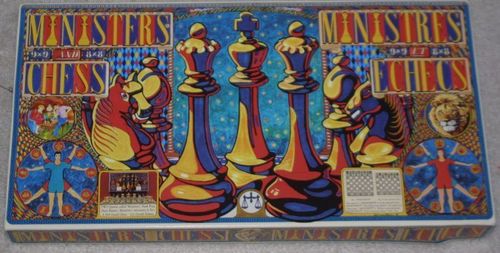
Ministers Chess
Ministers Chess Rulebook
Table of Contents
Table of Contents
Board
The board is square and is uniformly divided into 81 squares, with nine squares on each side. The squares may be coloured alternately light and dark for better visibility. The players, designated White and Black, sit on opposite sides of the board.
A row parallel to one side of the square board is called a rank. A row at right angles to the ranks is a file. The board has nine ranks and nine files.
The four corners of the board have the same colour, in contrast to the conventional chess board where two corners are dark and the other two are light.
An algebraic notation may be used to designate the squares of the board. The files are lettered a to i from left to right, and the ranks are numbered 1 to 9 from White's side. Thus the central square of the board is square e5. Alternatively, a geometric notation may be employed with the central square of the board as the origin of cartesian coordinates, i.e., the point (0,0). In this system the bottom left hand corner square is designated as the square (-4,-4).
The board has four axes of symmetry: the horizontal axis X-X, the vertical axis Y-Y, and the inclined axes W-W and Z-Z. In contrast to regular chess the board has a unique central file (the e file), a unique central rank (the fifth rank) and a unique central square (square e5).
Pieces
Each player has 18 pieces: a king, nine pawns and eight major pieces. The major pieces are in four pairs: two princes, two rooks, two bishops and two knights.
A prince is identical to a queen in regular chess. Thus each player has two princes, each having the power of the queen of regular chess. All other pieces have substantially the same significance, rules of movement and rules of capture as those associated with them in regular chess.
The symmetry of the game implies positioning the two bishops on squares of identical colour, and hence their moving along diagonals of the same colour. They can thus reinforce each other's action considerably, particularly when they are both on the same diagonal. On the other hand, left alone with their king they would not be able to force a mate on the adversary king.
Initial Set-up
In this game the 18 pieces of each player are set up so that symmetry about the line joining the two opposing kings (the central file) is obtained. Regular chess does not have this symmetry. It is achieved here by adding an extra queen (prince) and enlarging the board.
As shown in FIG. 2, the king of each player stands at one end of the central file, with the king pawn standing on the square adjacent to it on the central file.
The major pieces (the pair of princes, the pair of rooks, the pair of bishops and the pair of knights) of White are situated on the first rank, on the four squares to the right and the four squares to the left of the king, such that each pair of a kind (a pair of knights for example) is symmetrically positioned with respect to the king. That is, the right and left members of each pair are equidistant from the king. Thus, for example, if a prince is positioned on square f1, the second prince should be positioned on d1.
The remaining eight pawns are situated on the right and left side of the king pawn, on the second rank.
Black's pieces are positioned in a similar way on the ninth and the eighth rank, as shown in FIG. 2.
The Course of the Game
The rules of movement and capture are substantially the same as for regular chess.
Fine details, such as the number of squares a pawn can move from its base line (the second rank for White) and capturing en passant, can be adopted for this game, but need not be rigidly kept in all set-up variations.
Adopting identically the rules of movement, capturing and pawn promotion of regular chess yields a very interesting game where controlling the central square and the diagonals of the board, the beauty of perfect symmetry and the large dimension of the "battle field" (the board) are factors that add to the pleasure of the player, stimulate his imagination and tax his skill and ingenuity.
Castling
Castling on the left or the right side is equally useful. It may be performed in a way identical to queen-side castling of regular chess.
This is not a necessary condition. Castling may instead be replaced by a castling similar to king-side castling of regular chess, where the king ends up at the second square from the edge of the board (squares b1 and h1 for White).