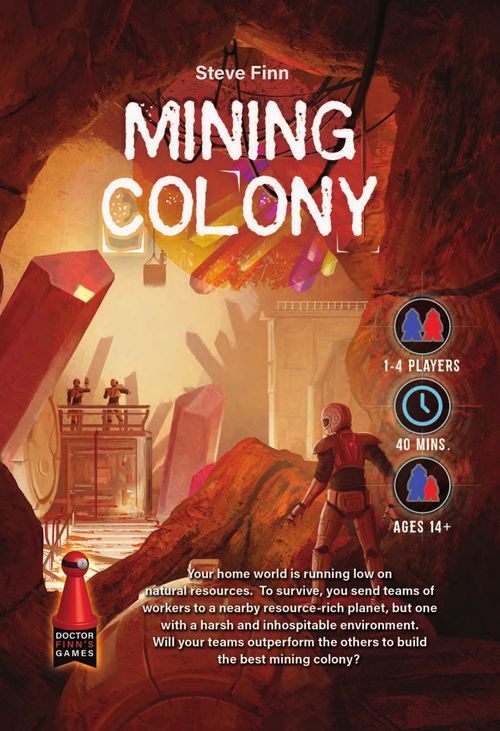
Mining Colony
Mining Colony Rulebook
Table of Contents
Table of Contents
Components
- 1 Game Board
- 4 Colony Boards (1 per player)
- 48 Excavation Cards (12 per player)
- 10 Resource Cards
- 50 Development Tiles (10 of each size)
- 12 Science Stations (3 each in 4 colors)
- 48 Crystals (12 each in 4 colors)
- 15 Ships (5 each in 3 colors)
- 15 Workers (5 each in 3 colors)
- 9 Outposts (3 each in 3 colors)
- 30 Build-Over Tokens
- 25 Credit Tokens
- 1 Score Sheet Pad
Setup
- Place the game board in the center of the playing area.
- Each player takes a colony board and 12 excavation cards in one color. Each player shuffles their excavation cards and places face-down in a draw pile.
- Sort the development tiles into piles for each of the 5 different shapes.
- For each pile, shuffle the pile and place on matching space on game board.
- Shuffle the 10 resource cards and place face-down in a draw pile.
- Sort the remaining components by type and place nearby in a supply.
- Use 1 fewer outposts and science stations of each color than the number of players. For example, in a 2-player game use only 1 of each color. Return others to the box.
Player boards are double-sided. For your first game, use this side. All players should always use the same side.
Overview
The object is to score the most victory points by collecting resources and building structures in one's colony.
The game lasts 10 rounds. In each round, excavation zones are filled with resources. Players compete for these resources using excavation cards. Players develop their colonies on their colony boards with the resources gained. The player who best develops her colony will be victorious.
The rules first describe the game for 2-4 players. The game also includes a solo mode, described later.
Playing the Game
The game lasts 10 rounds, each with 3 phases:
- Phase 1: Discover
- Phase 2: Excavate
- Phase 3: Develop
Phase 1: Discover
Flip the top resource card and fill the excavation zones with resources. To speed up play, all players should help perform this task.
- Each resource card has 4 zones.
- Fill one zone per player, starting with zone 1. E.g., in a 3-player game, fill zones 1-3 and leave zone 4 empty.
- For each zone, place the matching resources from the supply into the corresponding zones on the game board, then discard the resource card.
Example: After a resource card is flipped, players place a 5-square development tile, a purple crystal, and a yellow crystal into zone 1. They then fill the other zones as shown on the card for the number of players.
Phase 2: Excavate
- All players simultaneously draw 3 cards from their decks.
- You may spend 1 credit to return the 3 drawn cards to the bottom of the deck and draw 3 new cards. See "Earning and Spending Credits," p. 7.
- Players then choose 1 card and place it face-down in front of themselves.
- They return the other two cards to the bottom of the deck, in either order.
- When ready, reveal the chosen cards.
- From highest to lowest card played, each player takes a turn to excavate.
- To excavate, take all the resources from one of the zones and place them in front of yourself.
- Leave the played excavation cards face-up until the end of the round.
Note: To speed up play, after excavating, a player may begin Phase 3, while remaining players finish Phase 2.
Example: After both players place a card face-down, the cards are revealed. Red played a 23 while Blue played a 9. Since Red's number is higher, she chooses first. She takes the resources from zone 1, leaving the resources in zone 2 for Blue.
Phase 3: Develop
Players simultaneously use the resources gained in Phase 2 to develop their mining colonies by placing the resources onto their colony boards, according to these rules:
Placing Development Tiles
- You must place the first development tile on your colony board next to one of the six starting spaces (i.e., the darkened spaces).
- Subsequent tiles must be placed orthogonally adjacent to a previously placed tile or next to a starting space.
- A tile must be placed within the board's grid.
- You may not place a development tile over any starting space or another tile.
- The starting spaces and spaces covered by tiles are "developed."
Placing Crystals/Workers/Ships
- Place crystals on storage units.
- Storage units are color-specific. The multi-colored storage unit holds any color crystal.
- Place workers on domes.
- Place ships on landing pads.
- At the top of the colony board is a staging area with a storage unit, dome, and landing pad. These are not "in the colony."
- After taking a worker/crystal/ship, you may put it in either the staging area or in the colony.
- An item may be moved from the staging area to the colony at any time. Staging area items may also be discarded.
- Each building (dome, etc.) holds 1 item.
Building Structures
You may build a "structure" by meeting the structure requirements below. There are 2 structure types: outposts and science stations.
Building Outposts
- If you place a worker and a ship of the same color in the same row or column with exactly one tile space between them, you may build an outpost of the matching color on that tile space.
- A ship or worker used to build an outpost cannot be used to build another outpost.
- The space must be a blank (i.e., no printed buildings), vacant (i.e., empty of physical items), and developed (i.e., on a tile or in starting row).
- Printed items that are not domes, storage units, or landing pads are ornamental and considered blank.
- An outpost may also be built on a blank build-over token.
Example: You place a blue worker (A) in a space that is two spaces from a blue ship (B) placed earlier. You build a blue outpost (C) on the space between the worker and ship, because it is a developed space that is blank and vacant.
Building Science Stations
- You may build a science station if you place two crystals of the same color in the same row or column with exactly one developed space between them.
- A science station matching the crystals' color is placed in that space.
- Otherwise, building a science station follows the same rules as building an outpost.
Example: The player places a white crystal (A) in the same column as another white crystal (B), with a developed space between them that is vacant and blank. So, he builds the white science station (C) and places it in that space.
Limited Structures and Timing
The number of structures per color is limited to one fewer than the number of players. If multiple players can build the same structure during the same phase, the player who played the higher excavation card (still showing from the prior phase) builds first.
Build-over tokens are also limited to those in the supply, so players with higher excavation cards get priority.
Discard Excavation Cards
After players have finished developing, discard the face-up excavation cards from the game.
Return to Phase 1
If 10 rounds have not been played (i.e., if there are still resource cards to flip), return to Phase 1. Otherwise, move to game end.
Game End
After 10 rounds, score victory points (VPs) for the following:
Structures (2 VPs)
Each structure in your colony (outpost/science station) scores 2 VPs.
Resources (1 VP)
Each worker, ship, and crystal in your colony scores 1 VP.
Credits (1 VP for 2)
Every 2 credits score 1 VP.
Unplayed Cards (6/3/1 VPs)
Players sum the numbers on their 2 unplayed excavation cards. The player with highest sum scores 6 VPs, the second highest scores 3 VPs, and third highest 1 VP. In case of ties, the player whose lower-valued card is higher wins the tie.
Undeveloped Spaces (- 1VPs)
For each undeveloped space in your colony, subtract 1 VP.
The player with the most VPs wins. For ties, use the higher unplayed card total as a tie-breaker.
Solo Variant
Build the best possible colony and compete with an imaginary player named Zorlord. Play the game with the normal rules but with these changes.
Setup
- Set up the game for 2 players: you and Zorlord.
- Give Zorlord a set of excavation cards, but not a colony board.
- Shuffle Zorlord's excavation cards and place face-down on the opposite side of the board.
- Choose a difficulty level to play (see "Using Credits" below).
Phase 1
- Fill zones as if there are 2 players.
Phase 2
- After choosing an excavation card, flip the top card of Zorlord's deck.
- If Zorlord's card is higher, Zorlord first takes resources from an excavation zone based on his card played. If the excavation card is odd, Zorlord takes the resources from zone 1. If the excavation card is even, Zorlord takes resources from zone 2.
- If your card is higher, you choose first and he takes resources from the unchosen zone.
- When Zorlord takes resources, place them into his supply.
- Final round: In the tenth round, if your unplayed card total is higher than Zorlord's take and use 4 credits.
Using Credits
- A build-over token costs 1 - 4 credits based on your chosen difficulty level (1 = easy; 2 = moderate; 3 = hard; 4 = very hard).
- You may spend 1 extra credit to place the build-over token directly on an undeveloped space, where it counts as developed.
- You may spend 1 credit to exchange any worker, ship, or crystal (not yet placed) with a different colored one of the same type from Zorlord's supply.
Game End
If you build a structure of each color (i.e., 7 different structures) and completely develop your colony you immediately win. Otherwise, after ten rounds you lose if you do not complete this task.
Intermediate Difficulty Levels
You may create intermediate difficulty levels by allowing the placement of build-over tokens directly on the board at no extra cost.
Game Summary
Phase 1: Discover
- Flip resource card.
- Fill one zone per player, starting with Zone 1.
Phase 2: Excavate
- Draw 3 excavation cards.
- Spend 1 credit to refresh hand, if desired.
- Choose 1 card, return 2 to deck bottom.
- Simultaneously reveal chosen card.
- Excavate, in turn order, from high to low excavation card.
Phase 3: Develop
- Place development tiles adjacent to starting row or previously placed tiles.
- Place resources into colony or staging area.
- Build outposts with ship and worker of same color; build science stations with two crystals of the same color. Space must be blank, vacant, and developed.
- Discard crystal/ship/worker for 1 credit.
- Discard development tile for credits equal to number of squares.
- Spend 1 credit to buy and place build-over token on developed space.
- Discard credits above 5 at end of Phase 3.
Game End
Game ends after 10 rounds. Score as follows:
- 2 VPs for each structure.
- 1 VPs for each crystal/ship/worker.
- 1 VP for every 2 credits.
- 6/3/1 VPs for first, second, or third place of sum of 2 remaining excavation cards.
- Subtract 1 VP for each undeveloped space.
Point of Emphasis: Items placed in one's colony cannot be moved or removed. Items may be moved or discarded from the staging area at anytime.