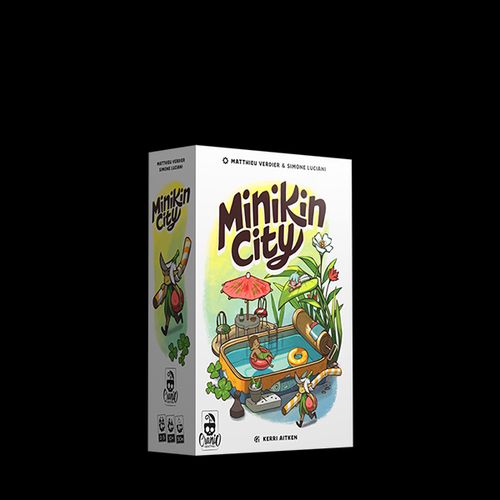
Minikin City
Minikin City Rulebook
Table of Contents
Table of Contents
Components
- 61 City cards
- 18 Reward cards (9 for 2-3 players, 9 for 4-5 players)
- 2 Endgame tiles (1 for 2-3 players, 1 for 4-5 players)
- 45 Reward markers (9 per player)
- 10 Bonus tokens
- 75 Minikin pawns
- 1 Scoring pad
Setup
- Choose the 9 Reward cards with a number of white circular spaces equal to the number of players. There are 9 cards with one side for two players and the other for three players, and 9 cards with one side for four players and the other for five players. Shuffle and place the 9 selected cards in a row in the center of the table, and return the 9 unused cards to the box.
- Choose the Endgame tile corresponding to the number of players (again, with the correct side facing up). Place the Endgame tile on top of the ninth Reward card, so that its hole reveals that card's color. Return the unused tile to the box.
- Place the 10 Bonus tokens face up next to the play area.
- Place the Minikin pawns next to the play area to create a supply.
- Shuffle the 61 City cards to create the City deck. Place it face down next to the Reward cards.
- Deal 6 City cards to each player: each player keeps 4 cards in their hand and places the 2 unchosen cards at the bottom of the deck.
- Each player chooses a color and takes the 9 Reward markers of that color.
- Choose randomly the 1st player.
Overview
The game is played over 8 rounds, which are represented by the Reward cards of the row (the first Reward card on the left stands for the first round, and so on). On each round, players will play a City card from their hand to build their city and apply the effects of the card. At the same time, the color and value on the City card they play is used to establish a ranking to get rewards from the Reward card for that round. The color of the Reward card determines the best color for that round.
After 8 rounds, players will define a last ranking based on the value of the cards still in their hand that match the color shown by the Endgame tile. They will finally score Victory Points (VP) for the rewards they have gained and the effects they have activated, and the player with the most points will win the game. Be careful though, because only the cards filled with Minikins will give you points in the end!
Gameplay
Each round is divided into 3 steps.
1) Create the display
Reveal X (number of players + 1) City cards from the deck and place them face up next to the deck to create the open display.
Example: in a 4-player game, reveal 5 City cards in the open display.
2) Play a City card and determine the ranking
The 1st player chooses any card from their hand and places it face up in front of them. The next player in clockwise order does the same, and so on until each player has played a card from their hand.
If the card you have played has an Instant effect (see City Cards below), activate it.
Then, determine the players' ranking based on the cards played:
- Cards of the best color, from highest to lowest value, first;
- Then, cards of other colors, from highest to lowest value.
The best color is the color of the Reward card that corresponds to the current round. In case two players have played City cards with the same value and both are not of the best color, the player who played their card first (in clockwise order from the 1st player) is considered higher in the ranking.
Based on the ranking, each player places one of their Reward markers on the spaces on the Reward card for the current round accordingly, from top to bottom, and gets the corresponding reward (see Reward Cards below).
Example: The best color in the first round is blue. Ralph is the 1st player and plays the Blue 5. Sergio is next and plays the Red 3, followed by Jade, who plays the Blue 15, and Aurelia, who plays the Green 11. The highest card in the best color is the Blue 15, so Jade places her marker in the topmost position of the Reward card. The second-highest blue card is Ralph's 5, so he places his marker in the second position. No other blue cards have been played, so they must check the highest card of other colors. It's Aurelia's Green 11, so she places her marker in the third position. Sergio's Red 3 is the lowest card, so he places his marker in the last position of the Reward card.
3) Take a new card
In reverse ranking order (i.e., according to the players' position on the Reward card, from bottom to top), each player chooses one of the City cards available in the open display, and adds it to their hand. The remaining card is placed at the bottom of the deck.
Example: Sergio is last in the ranking of this Reward card, so he's the first player to choose a new City card from the open display.
You are now ready to play the next round.
NOTE: The 1st player of each new round is the topmost player in the previous round's ranking. Remember that cards are always played in clockwise order (don't follow the ranking order). Play the new rounds' cards next to the previous ones, so that all cards played will be still visible at the end of the game.
Reward Cards
There are 4 different rewards depicted on the Reward cards:
- Minikin reward: Immediately take the indicated number of Minikin pawns from the supply. See Minikin Management below.
- Bonus token reward: Immediately choose an available Bonus token from the supply, take it and place it in front of you. See Appendix below for the explanation of their icons.
- Victory Points and Cockades rewards are calculated at the end of the game. See Final Scoring below.
City Cards
City cards have a color (red/green/blue) and a value (between 1 and 20). Most City cards provide one or more symbols on the top right corner. These symbols are used to trigger the effects of the same card, and of other cards.
Most City cards have a Scoring effect. To activate their Scoring effect, you must fill the spaces illustrated on the card with Minikin pawns. These cards can host from 1 to 5 Minikins.
Some City cards have an Instant effect: activate it as soon as you play them from your hand.
Example: You must place 2 Minikin pawns on this card to activate its Scoring effect.
City cards can show the following types of Instant and Scoring effects:
- If/then effect: If you have what's indicated to the left of the arrow, you gain what's indicated to its right. Example: if you have at least 5 of one thing and 2 of another on the cards you have played, you gain 7 VP.
- Multiplier (×) effect: You gain what's indicated to the left of the X for each item indicated to its right you have. Example: gain 1 Minikin for each Instant effect on the cards you have played so far.
- Simple reward: A simple reward, as on the Reward cards.
NOTE: The City card with value 21 has no color. It's always first in the ranking, but has no other effect.
In the Appendix below, you can find the explanation of all other icons you can find on the cards' effects.
Minikin Management
When you gain Minikin pawns (due to a City card's Instant effect, a Reward card's or a Bonus token's reward), take them from the supply. You MUST immediately place them on any empty space on your City cards. If you have multiple cards that can host them, you can freely choose where to put them.
Example: Jade gains 3 Minikins as a reward from her Reward card position. She can place them on the available spaces on City card Blue 19 or Red 3. She decides to place them all on City card Blue 19, so that its Scoring effect will be activated at the end of the game.
If you can't place one or more Minikin pawns because you don't have City cards that can host them or enough empty spaces, simply keep them in front of you. You MUST place these Minikin pawns on the next City card you play with a Scoring effect (i.e. with spaces that can host Minikins). Fill that card to its maximum, and keep any extra pawns in front of you, waiting for the next available spaces.
Example: Aurelia gains 4 Minikins from the Instant effect of the City card she has just played. Since she doesn't have City cards that can host Minikins, she places them in front of her, for now. On the next round, Aurelia plays the Green 16, which can host 3 Minikins. She must fill it with the Minikin pawns she has in front of her. The remaining Minikin pawn will be placed on the next City card Aurelia will play that can host it.
Endgame Tile Ranking
At the end of the 8th round, resolve a final ranking. Starting with the 1st player (the player who was first in the ranking on the previous round) and proceeding in clockwise order, all players reveal their hand and add up the values of all their cards of the best color. The best color is the one revealed below the Endgame tile. If a player has no cards of this color in their hand, their value is 0. In case of a tie, the player who revealed their hand first wins the tie.
In descending order, players place their last marker on the positions of the Endgame tile and get the corresponding rewards.
The winner of this last ranking can play 1 additional City card from their hand, adding it to the City cards already played (you can resolve its Instant effect, if any, or place Minikins on it, if any).
Example: The best color in the final ranking is red. Ralph is first because he won the ranking in the previous round. He reveals his hand and shows a total value of red cards of 33. Sergio is next and reveals a total value of red cards of 35. Jade is next and reveals a total value of red cards of 24. Aurelia is last and also reveals a total of 24. Sergio places his marker in the top position, and can play one of the cards from his hand. Ralph is in second position. Between Jade and Aurelia, Jade is considered third because she revealed her hand before Aurelia.
Final Scoring
After the Endgame tile ranking, proceed to the final scoring. You can use the Scoring pad to record your game.
Players gain Victory Points (VP) as follows:
- VP from their Reward markers on the Reward cards and from the Bonus token;
- VP from the City cards' effects, only for those cards activated by the required number of Minikins;
- Cockade symbols on City cards, Reward cards, and Bonus token: 1/3/6/10/15/21 VP if they have 1/2/3/4/5/6+ Cockade symbols.
The player with the most VP wins the game. In case of a tie, the tied player with the most unused Minikin pawns wins the game. If there is still a tie, tied players share the victory.
Example: At the end of the game, Jade will score:
- 13 VP for her markers on the Reward cards;
- 10 VP for the City card Green 1 (she has 5 of a symbol in her city);
- 5 VP for the City card Red 7 (she has 2 sets of a card in each color);
- no VP for the City card Green 9 because it is not filled with the required number of Minikins;
- 21 VP for 6 Cockade symbols (2 on Reward cards, 1 on the Bonus token, 1 from the City card Blue 15, 2 from the City card Red 4).
Jade's final scoring is 49 Victory Points!
Appendix
Explanation of the icons found on card effects:
- Additional symbol: For any effect, you have this additional symbol.
- 1 set of each symbol: You have 1 set of each symbol.
- Additional Cockade: During the final scoring, you have 1 additional Cockade symbol.
- Additional VP: During the final scoring, you gain 2 additional VP.
- Blue card multiplier: Immediately gain 1 Minikin for each blue card you have in your city.
- Wildcard symbol: For any effect, this icon counts as 1 City card of a color of your choice.
- Minikin multiplier: 1 VP for every 3 Minikins (both on your cards and unused).
- 1 set of a card in each color: You have 1 set of a card in each color.
- Symbol variety: Every different type of symbol you have.
- Value range: Each card of value between 1 and 5 (included) you have in your city.