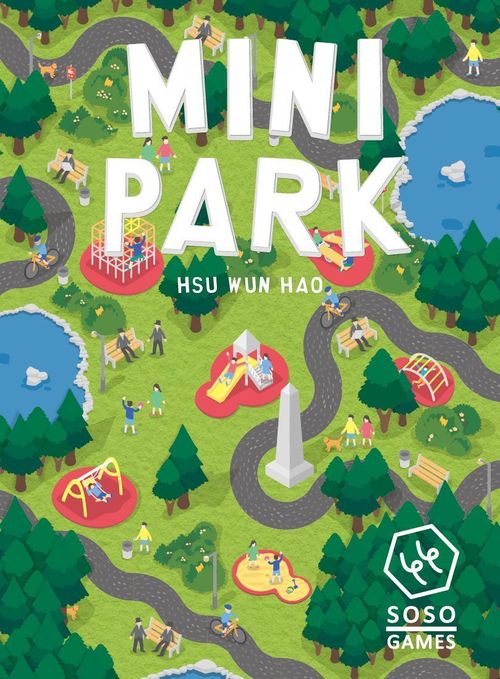
Mini Park
Mini Park Rulebook
Table of Contents
Table of Contents
Game Components
- 40 park tiles
- 18 structure tiles (bench, bush, playground)
- 12 nature tiles (trees, lake)
- 10 expansion tiles
- 6 character cards
- 6 objective cards
- 6 character markers
- 30 victory point tokens (1 x12, 3 x6, 5 x6, 10 x3, 20 x3)
- 1 Chinese rulebook
- 1 English rulebook
Setup
There are two ways to play the game: the basic rules, and the advanced rules. Before starting the game, players choose which rules they want to use.
- Place the character cards and the victory point tokens to a side.
- Based on the rules being used, turn the character cards to the corresponding side (Basic character cards, yellow; Advanced character cards, brown).
- Place the character markers next to the corresponding character cards.
- Shuffle all the tiles, and stack them face down.
- Randomly turn a tile face-up, and place it at the center of the table to serve as the starting tile.
- Turn two tiles face-up. These tiles may be selected by the players during the game.
- Advanced rules: randomly place an objective card face-down next to each character card.
Expansion Tiles
Expansion tiles are optional. Decide whether to use them when setting up the game.
- When setting up the game, decide whether to use the expansion tiles or not.
- During setup, randomly draw a number of expansion tiles equal to the number of players, and place them face-up to a side.
- When a player selects a character to place for the first time in a game, they also select one expansion tile and place it to the park.
- When placing an expansion tile, normal placement rules must be followed, but no victory points are scored for placement.
- A tile with a hammer symbol may be stacked onto an existing tile in the park. Normal placement rules must be followed.
Expansion Tile Descriptions
Nature tiles
- Wooded Island: at the end of the game, the Wooded Island can be scored as a tree tile or a lake tile.
- Fountain: score 4 victory points immediately after placing this tile.
Structure tiles
- Pavilion: at the end of the game, the tile can be scored as a bench, playground, or bush.
- Monument: no special effect.
Road tile
- Arched Bridge: this tile has a single connected road, and a single connected area.
- Branched Road: no special effect.
- Construction zone: the roads and on this tile are not connected to each other, and the areas on this tile are also not connected to each other.
Flow of Play
The player who last visited a park is the start player, and play proceeds clock-wise. On a player's turn, they can either place a tile or place a character.
1. Place a Tile, and Score
Select one of the two face-up tiles, or randomly draw a face-down tile. If one of the two face-up tiles is selected, draw a new tile to replace it.
Place the selected tile according to the following rules:
- The newly placed tile must touch at least one other tile.
- Roads cannot be interrupted. A road on an edge of a tile must connect to another road in an adjacent tile (if there is an adjacent tile).
Score victory points: Score 1 victory point for each tile the newly placed tile is connected to.
2. Place a Character
Select a character marker and place it on a tile corresponding to the picture on the character card. For example, the picture for a bird is trees, so the bird must be placed on a tree tile. Take the character card and place it in front of you.
- Basic rules: each player may only take this action once.
- Advanced rules: When taking a character card, the player also takes the corresponding objective card, which will also be scored at the end of the game.
- In a 2 or 3 player game, each player may take this action at most twice.
- In a 4 or 5 player game, each player may take this action once only.
Game End
When all the tiles are drawn and placed, the game ends. Proceed to end-game scoring.
End-Game Scoring
Score the character cards and the objective cards according to the basic rules or the advanced rules. The player with the most victory points wins.
Basic Rules
Each player scores victory points for their character.
- Child/working man/cat: identify the continuous road that passes through the tile which the character is on. For each structure corresponding to the character's picture that is on this road, score 2 victory points.
- Bird/fish: Respectively, for each tree/lake tile adjacent to the tile the character is on, score 2 victory points.
- Cyclists: count the number of tiles the cyclist is connected to by road. Score 1 victory point for each tile.
Advanced Rules
Score victory points according to the character cards. A region is a connected area not divided by roads.
- Child: for each playground in its region, score 3 victory points.
- Working man: for each road with at least one working man, score 3 victory points; if the character is on the longest road, score an additional 3 victory points.
- Cyclist: count the number of tiles the cyclist is connected to by road. Score 1 victory point for each of the first six tiles, and score 2 victory points from the seventh tile onward. The tiles may be connected by branching roads.
- Bird: move the bird seven tiles from its original tile. For each tree tile it passes through, including the starting and ending tile, score 3 victory points.
- Fish: multiply the number of fishes in the same lake as the fish (counting the fish character itself), by the size (in tiles) of the lake the fish is in. Score this amount of victory points. For example, the fish is in a lake spanning 3 tiles, and there are 5 fishes in this lake. Then score 3 x (5+1) = 18 victory points.
- Cat: multiply the number of bushes in the cat's region by the number of characters (counting the cat itself) in the cat's region, and add 4. Score this amount of victory points. For example, there are 2 bushes and 3 characters in the cat's region, then score 4 + (2 X 3) = 10 victory points.
Objective Card Scoring
Each objective card shows a character. Score half the point scored by that character, rounded down.