Mini Make 'n' Break
Mini Make 'n' Break Rulebook
Table of Contents
Table of Contents
Contents
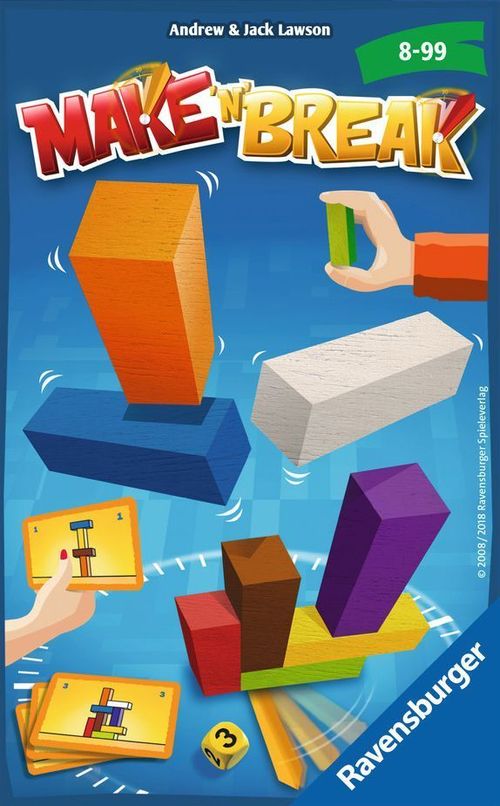
8 wooden bricks, 30 cards with 60 buildings and 1 die.
Aim of the Game
With little time available to the player, they must recreate the constructions represented on as many cards as possible.
Preparation
For stable construction, playing on a flat surface is recommended. Use paper and pencil to record the scores.
Shuffle the cards and place them face down in the middle of the table. The youngest player will start the game as the architect. Place the bricks in front of them and the deck to one side so that it can be reached comfortably. The player on their left will be the timekeeper - the die is used for this.
Building
The current architect calls out "ready, set, go" and takes the first card on the deck and begins to recreate the construction represented on the back of the card. If the construction is made of gray brick, they only need to look at the shape of the construction - the color of the bricks does not matter. However, if the figure is made of colored bricks, it must be built exactly as represented on the card. Once the construction is completed (such that it can stand for at least a moment) it can then be broken down. The current architect then takes a new card from the deck and start a new construction. They have all of the bricks at their disposal again. If the deck runs out during the game the discard pile can just be turned over or reshuffled.
Time available for building
As the architect says "go", the timekeeper starts to throw the die. The die has the numbers 1, 2 and 3, and three blank faces. If they roll a blank face nothing happens and they continue to roll. However, as soon they see a number the value should be announced out loud. The timekeeper continues tossing the die, and if they roll a new number its value should be added to those already rolled before.
Example: the timekeeper rolls a 2 on the die and says "2" aloud. On the next roll a 3 is rolled, so they say "5" aloud (i.e. the sum of rolls 2 + 3). The next time they roll a blank face and say nothing. The result of the next roll is a 1, so they say "6" aloud (the old result +1).
When they reach a sum of 15 (or more), the timekeeper yells "Stop". The architect must then immediately stop the construction in progress. As the architect builds and the timekeeper rolls, all of the other participants in the game must pay attention to ensure that both the construction and the sum of the rolls are correct and without errors.
Calculation of points
Each card has a blue number. The architect adds these together, thus obtaining the score achieved in that turn. Obviously, if they cannot or did not complete a construction it cannot be added to their score.
Record the points below the player's name and put the used cards into the discard pile. The next architect and timekeeper will be the next players to the left.
End of Game
When all players have been architects 5 times, the game is over. The winner is the player with the highest total score.
Playing with young architects
If some players are experts, it is possible to agree to a higher time being available to the younger players. In this case, the timekeeper will add the result of the die until the rolls add up to a total of 20 (or more).