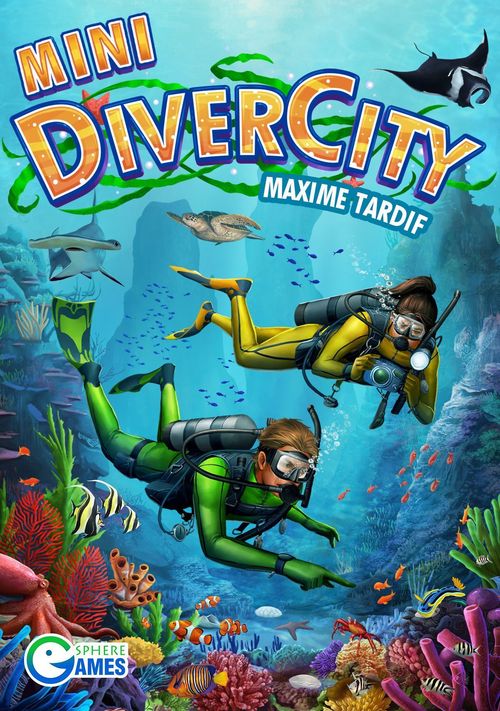
Mini DiverCity
Mini DiverCity Rulebook
Table of Contents
Table of Contents
Box Content
- 12 Species Tokens
- 107 cards divided into:
- 60 Species Cards (A)
- 27 Corporation Cards (B)
- 8 Diver Cards (C)
- 6 Scale Cards (D)
- 6 Hotel Cards (E)
- 1 Rulebook
Setup
- Shuffle the Species and Corporation Cards and create a deck of each.
- Deal each player a Diver card, either randomly or selected by the player. Place them face-up on the table.
- Create the Species Scale by putting the Scale cards in a column with the Green side to the right (Survival), and the Red side to the left (Extinction).
- Place the Species Tokens over their associated species.
- Place the 6 Hotel Cards around the Species Scale (as shown) with the island side facing up.
- Deal each player 3 Species Cards (4 for a 2-player game) facedown in front of them. Do not look at your cards!
- Determine the first Active Player. This will be the person who was most recently in contact with water, either through swimming, showering, or taking a bath.
Note: The 7th player is for the industrialist variant only! (p2)
Game Objective
All players must work together against the Corporations, so you will either win as a team, or lose as a team.
You Win if you can save the number of species shown on the Difficulty Level you have chosen. (Survival)
You Lose (Extinction):
- If the Corporations kill the number of species shown on your Difficulty Level, or
- If 6 Hotels are built, or
- If the Species Cards deck runs out and you cannot take further actions.
| Difficulty Level (Number of species needed) | Divers Win | Corporations Win |
|---|---|---|
| Poseidon | 9+ | 3 |
| Jacques Cousteau | 8 | 4 |
| Instructors | 7 | 4 |
| Assistant Instructors | 8 | 5 |
| Divemasters | 7 | 5 |
| Advanced Divers | 6 | 5 |
| Open Water Divers | 5 | 5 |
Saved and Extinct Species
A Saved Species is one whose token has moved outside of the Species Scale coming out from the Survival side.
An Extinct Species is one whose token has moved outside of the Species Scale coming out from the Extinction side.
Once a species has been Saved or became Extinct, it can no longer be moved, either by the corporations or divers.
Gameplay
The two most important rules of the game are:
- Players may never look at their own cards. They must be held facing the other players.
- Players may not talk to one another about strategy. You are all diving in different parts of the coral reef.
The game is played in Rounds, divided into two Turns: The Corporations' Turn and The Divers' Turn.
The game may end at any time during either of these turns. Once the winning or losing conditions are met, the game is over.
The Corporations' Turn
The Active Player flips the topmost card on the Corporation Deck and immediately applies its consequences. There are three Corporations, each with their own consequences.
The Oil Platform
Drilling through coral reefs doesn't bother us, all we love is sweet, sweet oil money.
The Active Player picks a species card in their hand (without looking at its species side), then discards it. If it's not already Saved or Extinct, move that Species Token one space toward Extinction. That player draws a new Species Card.
The Dynamite Fishers
Blasting for big bucks, we don't care what we blow up!
Flip over the topmost card on the Species Deck and discard it. If it's not already Saved or Extinct, move that Species Token one space toward Extinction.
Example: The Dynamite Fishers flipped a Nudibranch. Move it one space to the left, toward Extinction. In this case, it will move from the Green Zone to the Blue Zone.
The Hotels
Tourists brings tons of cash, why should we mind if they wreck the reefs and beaches?
Flip the two Hotel Cards indicated by the coloured symbols on the Corporation Card to their Hotel side. If a Hotel Card has already been flipped in this way, leave it that way.
If a card with more than one consequence is revealed, apply the topmost effect first, then the bottom one.
The Corporations icon at the top of some of the cards is used only in the Beginner variant (see variants on page 2).
Used Corporation Cards are placed in a discard pile next to the Corporation Deck.
The Divers' Turn
On your turn, you can perform 1 of 3 possible actions:
1. Play a Species Card
You've discovered a species living in the coral reef!
Play a Species Card from your hand (without looking at it, of course) face-up onto the table. Move the corresponding Species Token one space from its current position toward Survival. The Species Card is then placed in the discard pile. Draw a new Species Card.
Example: You play a Crab. Move it one space right toward Survival. It is now in the green zone, one step away from being permanently saved!
2. Use your Walkie-Talkie
You've successfully told your fellow diver where to find certain species!
Tell one other Player all the species they have in their hand by indicating each card and saying the name of that species.
This is the only direct information you are allowed to share with other players during the game.
3. Close down a Hotel
You've managed to hide a species from the tourists by closing down that hotel. They won't come back here again!
Discard one Species Card from your hand and flip a Hotel Card of your choice back to its Island side. Draw a new Species Card.
No species tokens move during this action.
End of Round
The Player to the left of the Active Player becomes the new Active Player. Begin the next Round with the Corporations' Turn.
Diver Cards
Diver Cards can be used only once per game (Their effects are detailed on page 2).
These powers can only be used by the Active Player during their turn, either before or after performing their action.
Using a Diver Card does not count as the Player's action.
Once used, the Diver Card is flipped over to indicate that it has been used.
Additional Rules and Information
Players can always look through the discard piles to see which Corporation and Species Cards have been played.
When there are no more cards in the Corporations Deck, shuffle its discard pile to form a new deck.
Species Cards are never shuffled to create a new deck. Once the Species Deck runs out, players may no longer draw new Species Cards. If an Oil Platform card is drawn and a player has no more species cards in hand, nothing happens. However, if a Dynamite Fisher Card is drawn and there are no cards remaining in the Species Deck, shuffle the Species Card discard pile and draw a card from it at random.
The Corporations Deck contains 4 instances of each hotel color. Also, the following 3 combinations can never come out: Red + Green, Purple + Yellow, and Blue + Orange. Use that information wisely!
Players can, at any time, declare out loud which cards they believe they have in their hand. Even though the other players cannot visibly agree or disagree, it will give them an idea of what everyone thinks they have.
End of the Game
The game ends when either...
- The players have saved the right number of species. Congratulations! You've convinced the government to transform the DiverCity Archipelago into a protected national park!
- One of the 3 Corporation win conditions has been met. Their win conditions are detailed in the Game Objective section. Oh no! The Corporations' greed has ruined DiverCity's natural beauty!
Diver Card Special Powers
Endurance Specialist
I help the species survive longer.
Move 1 Species Token from the Red column to the central Blue column on the Species Scale.
Diving Specialist
I dive faster and spot the species we need.
Move 1 Species Token from the central Blue column to the Green column on the Species Scale.
Captain
I give orders to help my teammates.
Tell another player to play a Species Card from their hand without looking which one to play. If it's not already Saved or Extinct, move the associated Species Token one space toward Survival. The player draws a new Species Card.
Environmentalist
I limit the impact of tourism on DiverCity's ecosystem.
Flip over one Hotel Card to its Island side.
Visionary
I can feel the threats coming.
Look at the top 4 cards on the Corporations Deck, reorder them as you please then place them back on top of the deck. This can be discussed with the other players.
In the Industrialist Variant, look at the Industrialist's hand and discard up to 2 cards.
Explorer
My curiosity helps me learn faster.
Look at your own hand to know which species you have.
Olympic Swimmer
I swim faster to find other species.
Play one Species Card from your hand without looking at it. If it's not already Saved or Extinct, move the associated Species Token one space toward Survival. Draw a new Species card.
Communication Specialist
I'm fast on the walkie-talkie.
Tell another player all of the Species they are holding in their hand (indicate which species is associated with which card).
Easier Variants
Variant for Beginners
- Remove the Diver Cards. Skip the topmost effect of the Double Corporation Cards, recognizable by the icon above.
- When the Walkie-Talkie action is used, the player can turn the cards around in order to see their species side. This way, players don't have to remember the species and their order in their hand. When new cards are drawn, they are placed in the hand facing away from the player, as usual.
- New difficulty Level - Snorkeling! Save only 4 species to win the game, let the corporations kill 6 species to lose.
Full Team Variant
The Players choose as many of the Diver Cards as they wish, and divide them between themselves. Some Players may end up with more than one Diver Card.
All Variant Rules are optional and may be merged and interchanged to create your own unique diving experience!
Harder Variants
Industrialist Variant
- In this variant, one player plays the Industrialist.
- During Setup, the Industrialist receives a hand of 4 Corporation Cards.
- Instead of playing the standard Corporation Turn, the Industrialist chooses a card from their hand and plays it, triggering its consequences.
- The Industrialist then refills their hand to 4 cards.
- The Industrialist wins the game by making the divers lose!
- Only this variant allows for a 7-player game.
Solo Variant
- Play as though you were 2 different players, following the same Setup rules as a 2-Player game.
- Leave your 2 groups of 4 Cards face-down on opposite sides of the table; you are not allowed to look at the species side of the cards from either group, except for... (as printed)
- When you use the Walkie-Talkie action, turn over the species cards of the opposite 'Player' to their species side. Whenever you draw a new Species Card, leave it face-down until the Walkie-Talkie action is used again.
- The rest of the game plays normally.
Versus Variant
Play with 1 player using the Solo Variant rules above, while the other uses the Industrialist Variant rules.
Real Diver Variant
- Because you are underwater, you can't talk to other players about what they have in their hand. You can only communicate the species by doing hand signals!
- If you need help finding ideas, you can use this website: https://ambergriscaye.com/photogallery/130715.html
The 12 Species of DiverCity (Educational Only)
The information below is from the website www.wikipedia.com. Some information might not be correct or precise.
Nudibranch
Often called sea slugs, there are about 2,300 different nudibranch species that vary widely in shape and colour. Their nicknames, such as "Clown," "Splendid," "Dancer," or "Dragon" reflect this diversity.
Crab
The crab family is a wide one containing 6,793 known species. Most people are already familiar with some species of crab, as they live in all the world's oceans, in fresh water, and on land.
Hammerhead Shark
Forming a family of 9 different species, hammerhead sharks are easily identifiable by the "hammer" form of their head. Many of the species are considered endangered or vulnerable, mostly because of overfishing.
Long-spine Porcupine Fish
A species that lives up to its name perfectly! They can be found in many habitats around the world, including coral reefs. Adults may reach up to 50 cm (1.6 ft) in length, and the wider porcupine fish family includes 18 different species.
Mandarinfish
Also called the mandarin dragonet, the mandarinfish is a unique species that is part of a wider "dragonet" family, which includes more than 182 species. Since they are picky eaters, they are considered hard to keep in aquariums, so we should probably leave them in their natural habitats!
Manta Ray
The biggest species of manta ray can grow up to 7 meters (23 ft) wide! They are filter feeders and feed on zooplankton, so they are not dangerous for humans. The species is considered vulnerable, mostly because of pollution, entanglement in fishing nets, and the fact that they are harvested for use in Chinese medicine.
Lobster
In the wild, lobster can live up to 45 - 50 years. There are around 75 known species. Lobster aquaculture is nearly impossible to set up, as these aggressive creatures will resort to eating each other. The best way to preserve them, therefore, is to leave them where they belong: in the sea!
Eel
Eels are predatory fishes. There are about 800 different species, and the electric eel is not one of them! (They are more closely related to catfish and carp). Eels are born in ocean water, migrate to clear water and later move back to ocean water when they are mature enough.
Octopus
One of the most intriguing species on Earth, the octopus has held a fascination for mankind throughout the ages. As most people probably already know, they have 8 tentacles and are amongst the most intelligent and diverse invertebrates. There are around 300 known species.
Turtle
These slow creatures have adapted incredibly well to their environment since the first ones appeared over 157 million years ago. This fact makes them the oldest reptilian group; older than snakes or crocodilians. 327 species are known today, many of which are highly endangered.
Oyster
178 known species of oysters exist, and they are usually called ostreidae, or the true oysters. Pearl oysters are not considered true oysters and belong to the order of Pterioida (pearl oysters and winged oysters).
Starfish or Sea Stars
This species has existed for 450 million years, and it lives in all the oceans from 6 kilometers (3.7 miles) below sea level all the way to the sea surface. Around 1,500 species are found in a number of different habitats, ranging from polar waters to the tropics.