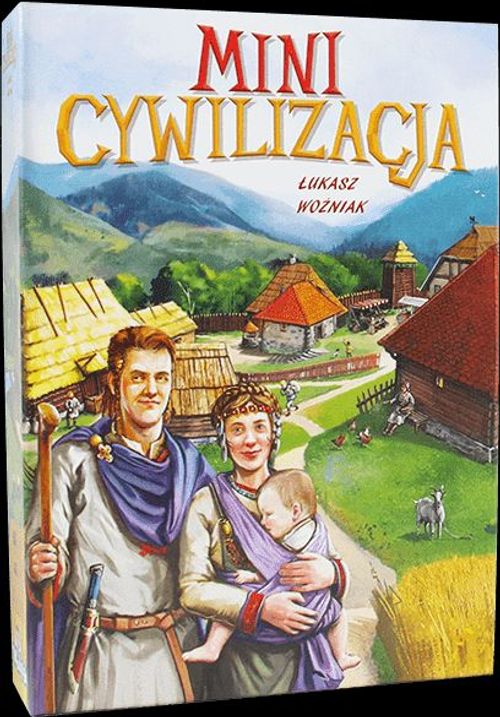
Mini Cywilizacja
Mini Cywilizacja Rulebook
Table of Contents
Table of Contents
Introduction
Note: you do not need to read these instructions. It is enough to visit uWookiego.pl/mini-cywilizacja and watch the video instructions for the game. All players are recommended to watch the video instructions before their first game.
Mini Cywilizacja is a collectible card game. The basic set is 10 cards, and further cards can be obtained entirely for free with every order from the uWookiego.pl shop.
It's simple? Very simple ;)
The game uses only cards, so players should get familiar with their layout, ideally by looking at a few of them before the first game. Each card is divided into 4 parts (2 on each side) and has two uses.
First, cards are building materials. While a player holds a card in hand, it serves only to determine how many materials that player has. On each side of a card there are two shield symbols showing 1 to 3 wood or stone. Wood is a brown shield, and stone is a grey shield.
Second, cards are "buildings". Each card shows 4 buildings, two on each side. Buildings have a cost in wood and stone, a number of Victory Points (VP), and an action. Cards represent buildings, territories, development or military conquest, but for simplicity they are all called buildings below.
The goal of the game is to gain the largest number of Victory Points.
1. Number of cards
Mini Cywilizacja can be played with only the 10 basic cards. Additional cards allow players a longer and deeper game. The more cards the players have, the more people can play and the longer variant of the game can be chosen.
The game is designed so that you can play with 10 cards, but we strongly recommend acquiring more cards. Mini Cywilizacja is addictive, and owning more cards allows for an endless number of games. If you have several copies of the same card, we recommend using different cards and trading the duplicates with a friend. Use at most 2 copies of the same card.
One more thing: before you start playing, we suggest putting the cards into sleeves!
Before the game starts, prepare the deck. To do this, take out the 10 basic cards, which are marked with a red number in the upper right corner, and randomly draw (or choose) the remaining cards from the additional ones. The number of cards depends on the chosen variant: Express, Quick, etc. Shuffle the set of cards and place it on the table; put the cards you are not using aside. The variant determines how many cards are available and also how quickly the game ends.
Variant table (number of cards used in the game):
| Number of players | Express | Quick | Normal | Long | Full |
|---|---|---|---|---|---|
| 2 | 10 | 16 | 18 | 20 | 22 |
| 3 | 20 | 23 | 26 | 29 | 32 |
| 4 | 25 | 28 | 32 | 36 | 40 |
| 5 | 30 | 35 | 40 | 45 | 50 |
Game end (number of buildings built):
| Variant | Express | Quick | Normal | Long | Full |
|---|---|---|---|---|---|
| Buildings to end the game | 3 | 4 | 5 | 6 | 7 |
Example: if you have 10 basic cards and 20 additional cards (30 in total), you can play a 2-player Full variant, a 3-player Long variant, a 4-player Quick variant, or a 5-player Express variant. Playing the 2-player Full variant, you need 22 cards: take the 10 basic cards and randomly draw 12 more, and set the remaining 8 aside.
We suggest that after a game you put the additional cards you used aside and play the next game with different ones. If you want, you can simply draw cards from the whole set and not follow the rule of using the basic cards.
2. Gameplay
Game setup
Before the game, choose a variant and prepare the deck, as described above. Then deal each player a starting hand of building materials. Players receive 1 wood and 1 stone. To do this, players draw cards until they hit these two symbols, and take the two corresponding cards into their hand.
Example of a starting hand: (illustration in the original; not reproduced in the text capture)
A player's hand is their pool of building materials. A player may not analyse the buildings on the cards in their hand, nor turn those cards over. Hold the cards so that the other players can see which materials you have. Materials are shown on the shield in the upper left corner: brown is wood, and grey is stone.
Put the remaining cards in a shuffled stack in a place accessible to all players. From this stack, lay face-up cards on the table, which form the Card Pool (Pula Kart). The pool should contain 4 cards plus the number of players. The direction in which the cards in the Card Pool are laid does not matter.
Pool size:
| Number of players | 2 | 3 | 4 | 5 |
|---|---|---|---|---|
| Cards in the pool | 6 | 7 | 8 | 9 |
The most civilized player, or the player who had the lowest score in your last game, becomes the starting player. You may also choose randomly. Starting with the starting player, the players take their turns in clockwise order.
Player's turn
On their turn, a player has two actions to choose from:
- drawing a material,
- buying a card.
A player must choose only one of them and may not pass, even if they do not want to perform an action. A player always performs exactly 1 action.
Players take their turns in clockwise order.
Drawing 1 material
To draw a material, a player shows a material card from their hand to the other players and places it on the table, turning it over to its other side. Then the player takes from the table a material card that is 1 higher than the material on the card being placed.
Example: a player showed a card with 1 stone and placed the card face-down, turning it over. Next, they take a card with 2 stone into their hand.
Rules for drawing materials:
- A player may have only one card with a given material.
- Example: if a player has 2 stone, they can only exchange it for a card with the 3 stone symbol. The player may not draw a second card with 1 stone.
- This means that a player always has at most 2 cards in hand.
If the player no longer has a given material (because they bought a building), they simply draw a card with the 1 wood or 1 stone symbol.
If there is no card with 1 wood or 1 stone on the table, the player may exceptionally turn over cards on the table until they find the sought material. The player declares what they are drawing (e.g. 1 stone) and turns over one card at a time, in any order. Once a card with the sought material is revealed, the player takes it into their hand at once.
If there is no card with the 2 or 3 wood or stone the player needs on the table, the player may not draw that material. They must perform a different action instead.
After placing a material card, the player always turns it over to the other side. The side the player was showing is now face-down.
After placing and turning over a material card from hand, the player may not draw the material that is on its reverse side.
Turning cards over after drawing a material and buying a building means that both sides of the card are in use during the game.
Minimalistic and elegant, isn't it? :)
Example: Ola has 1 wood and 1 stone in hand and decides to draw wood. There are 3 cards on the table showing 2 wood. Ola shows her 1 wood, places the card and turns it over to the other side. Now she takes one of the three cards showing 2 wood into her hand. In the next round, Ola will be able to exchange it for 3 wood, draw stone, or buy a building.
Buying a card
To buy a card, the player must have the appropriate materials in hand. The player chooses one of the face-up buildings and, before buying, shows the other players that they have the appropriate number of resources to buy it. The material cards used are placed on the table, turned over to the other side.
After placing the materials, the player takes the card and places it so that the building they bought is on top.
The cost of a building is shown on the scroll to the left of the building.
A player may always choose one of the two visible buildings on each card. All face-up buildings are available for purchase by every player.
Example: when there are 6 cards on the table, a player may buy one of 12 buildings.
The source repeats the purchase rules (the paragraphs above and the bulleted rules that follow) as a second, identical copy; they are given once here.
Each building has its cost marked on the scroll on the left side of the building.
- If the cost is only stone or only wood, the player places only the material card of that material (and of course must have the appropriate number of it).
- If the cost is both materials, the player places both material cards from hand (and of course must have the appropriate number of them).
Surplus materials are lost.
Example: a player buys a card costing 1 stone and 2 wood, and pays with both cards in hand. Since the cards placed show 2 stone and 2 wood, they place both cards but do not get the 1 surplus stone they paid with.
After paying, the player turns the card they placed from hand over, which means the side they were showing is now face-down.
Each building has marked Victory Points (VP). Victory Points are counted at the end of the game.
Almost every building has its own action.
Some building actions affect the play itself and make the player's actions easier.
Most buildings, however, have "processing" actions, which means they matter only when points are counted at the end of the game.
Refilling the Card Pool
Each time at any point in the game there are fewer cards on the table than in the initial pool, lay the top card from the stack. Before laying the card, turn it over so that the players do not see which buildings will appear for purchase.
Example: when in a 3-player game there are only 6 cards on the table, the players add a new one.
If there are no more cards in the stack (in the 2-player Quick variant there is no stack at all), the players add nothing. They play with the cards that are available on the table, and the game will probably end soon.
Example of a purchase: Ola decides to buy a building. She sees 3 buildings whose price she is able to pay. She chooses the card "Sztuka" (Art). Ola shows that she has the necessary materials and places both cards, turning them over. She takes the "Sztuka" card and places it in front of her.
What if a player cannot take a turn?
It may happen that a player is unable to take a turn. That is, they can neither draw materials nor buy a building. In this situation, they show their materials in hand to the other players, to show that they really cannot take any turn. Then they may turn cards over, one after another, until they find a material to draw or a building to buy. If, after turning a card over, there is a material to draw or a building to buy, the player must immediately use that option and perform the available action.
"Malicious" variant: in this variant, if a player cannot take a turn, they show their materials in hand and lose their turn.
3. End of the game
The game ends when one of the players builds their 3rd (4th, 5th, 6th or 7th, depending on the variant) building.
Example: in the Long variant, the game ends when one of the players builds their 6th building.
In this case, the current round is completed (for example, if the starting player built the final building, each player still gets one more turn). Then the players play two additional rounds, in which they normally draw materials or buy buildings.
Counting points
When the game is over, players count the VP of their settlement. Each player adds the VP shown in the upper right corner of each building and the VP resulting from the building actions.
In addition, the player divides the sum of the materials they hold in hand by two (rounding down) and receives that many VP.
The player who has gained the most VP wins. In case of a tie, the player with the larger sum of materials in hand wins. If there is still a tie, the players share the victory.
End of the game? Then we suggest another game and building a completely different mini civilization. During play it is worth remembering two things:
- try to buy buildings whose action combines with your other buildings;
- when drawing materials, try to spoil the plans of other players.
Below is a detailed description of all the symbols that may appear on the cards, and examples of counting VP at the end of the game. You do not need to look at them right away; it is enough to refer to them during play.
4. Card symbols
Transcriber note: the symbol icons on the cards are graphics that the text of the online manual does not carry. Where the text refers to an icon without naming it, the icon is marked [icon]. The rules text itself is complete.
Cards that provide materials
These materials appear only on cards. They are used for processing and for gaining Victory Points on other cards, which happens at the end of the game.
- This card gives the player 1 person symbol and 1 cow symbol.
- This card allows the player to copy 1 arbitrary material (animal or good) from a neighbour's card. The player chooses which symbol to copy at the end of the game.
- This card gives 1 arbitrary material (animal or good). The player chooses which symbol to gain at the end of the game.
- This card gives the player 1 person symbol and 1 cow symbol.
- This card allows the player to copy 1 arbitrary material (animal or good) from a neighbour's card. The player chooses which symbol to copy at the end of the game.
- This card gives 1 arbitrary material (animal or good). The player chooses which symbol to gain at the end of the game.
Processing cards
These cards are resolved at the end of the game. When a player meets the condition or conditions to the left of the arrow (they have materials on other cards, or the appropriate cards), they receive what is on the right of the arrow.
The player does not lose the materials and/or cards (unless the appropriate symbol appears on the card) which they use for processing, and may use them again for processing on other cards.
-
For each sheep, the player receives 1 clothing and 2 VP.
-
For each pair consisting of a sea card and a person, the player receives 1 sword and 4 VP.
-
The player gets 2 VP for each grain and each milk. Example: if at the end of the game the player has 2 grain and 1 milk, they score 6 VP.
-
For each person and each meat or milk, the player receives 4 VP. Example: if at the end of the game the player has 2 people, 3 milk and 2 meat, this card brings them 8 VP.
-
The X symbol means that the player loses this material and may not use it for processing on any other card. In addition, above the arrow there is a symbol "x1", which means the player may use this processing only once. The player decides for themselves whether to use the required material in this building and lose it, or to use it to gain VP on other cards.
Example: to use this card, the player loses 1 military symbol (sword) and gains 4 VP.
Example: here the player loses 1 grain and gains 10 VP.
-
This card gives the player a person. Additionally, it allows meat to be processed into 2 VP.
The same card descriptions are repeated in the source's layout; the repeated copies are identical and are given once above.
Support cards during play
These cards make it easier for players to perform actions during the game.
-
When a player draws 2 or 3 materials (wood or stone) and there is no card they need on the table, they may turn over cards lying on the table until they find the required material symbol. In exceptional cases, when they still cannot find it, they may search the card stack, exchange a card, and shuffle the stack.
-
When a player buys a building and already owns a building with this symbol, the purchase cost of the indicated material is reduced by 1. The minimum cost is always 1.
Example: if the player owns a building with the symbol shown on the left and buys a card costing 1 wood, the function of this card does not work. If the card cost 2 wood, the price would drop to 1 wood.
-
When a player buys a building, they may pay 1 additional wood instead of 1 stone less, or vice versa.
Special cards
These cards give VP for various elements of the player's settlement.
- The player gains VP for different kinds of animals. Example: if they have 2 cows, 1 horse and 1 sheep, they gain 3 VP.
- The player gains VP for materials in hand. Example: for holding 2 wood in hand they receive 2 VP.
- The player gains VP for different VP values on the buildings they have bought (shown in the upper right corner) in their settlement.
- The player gains VP for different values and/or material symbols shown in the left corner of the card. This card brings at most 6 VP (1, 2, 3 wood and 1, 2, 3 stone).
- The player gains VP for each card of a given colour. In this case the player gets 2 VP for each blue card.
- This card gives the player 1 VP for each different colour of building they have in their settlement.
- The player gains 4 VP for each set of an animal and grain.
- The player gains 1 VP for each different cost among the buildings they have bought. Different sets of stone and wood count. In the example on the right, the player gets 3 VP.
- After all players have finished their last turn, the player holding this card takes one additional turn. They may buy a building as normal, or draw a material.
The same special-card descriptions are repeated in the source's layout; the repeated copies are identical and are given once above.
Art (Sztuka)
These cards bring VP for various elements of the player's settlement.
Art cards provide the player with the ancient art symbol(s). The more such symbols the player gains, the more additional VP they receive at the end of the game.
Art value table (number of symbols gained → VP gained at end of game):
| Symbols | 1 | 2 | 3 | 4 | 5 | 6 | 7 |
|---|---|---|---|---|---|---|---|
| VP | 0 | 3 | 7 | 12 | 18 | 24 | 30 |
5. Examples
The examples below show only the summing of VP from buildings. Remember that the materials remaining in hand at the end of the game also bring the players VP.
The examples' card illustrations are in the original and are not reproduced in the text capture; the arithmetic is given as printed.
Example 1. The player built 4 cards and scores 16 VP. The Seamstress (Krawcowa) gives the player 2 VP, and the sword in the Barracks (Koszary) is used. The Defensive Formation (Formacja Obronna) gives the player only 2 VP (for the building itself) — the sword is used and lost on the Conquest (Podbój) card.
Example 2. The player built 4 cards and scores 20 VP. The Butcher (Rzeźnik) gives the player 2 VP for meat from the Warehouse (Magazyn). The person gained on the Butcher card is used on the Armoury (Zbrojownia) and Huts (Chaty) cards (it is not lost after being used on one card).
Example 3. The player built the Chief (Wódz) building, which gives them 3 additional VP (it has 3 different VP values on buildings: 2, 3 and 4). They use the Sea to gain a cow, and the Cowshed (Obora) gives them as much as 6 VP (for processing two cows). In total they scored 18 VP.