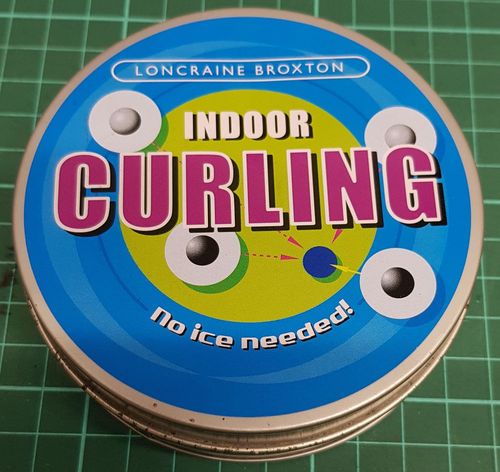
Mini Curling Game
Mini Curling Game Rulebook
Table of Contents
Table of Contents
Components
- 1 roll-out playing track
- 2 magnetic holding bars, to keep the track flat at each end
- 8 curling stones, 4 each in two colors
- 2 sponges, to keep the track clean
- A storage bag for the stones
The Teams
Form two teams of one to four players each. The two teams can have different numbers of players. Each team picks a color and takes the stones of that color.
Playing a Round
To decide which team opens the game, each team throws one stone, in turn. The stone that ends up closest to the T-line decides which team starts the game.
The teams then take turns playing one stone at a time. Each team is free to choose which of its players throws each stone.
A round ends once every stone has been played. The team that won the round starts the next round. In the event of a tie, the team that started the round starts the next one too.
Playing a Stone
For a throw to be valid, a stone must be released while sliding, before it reaches the first line of the track (the hogline).
The stone must pass completely beyond the second hogline to stay in play. If it fails to cross that line, or merely touches it, remove it from play.
Stones that touch or cross the backline, or that leave the track on either side, are also removed from play for that round.
Scoring
At the end of the round, the team with the stone closest to the button wins the round. It scores one point for each of its stones that is closer to the button than the opposing team's best stone.
Only stones inside the house can score points. A stone that touches the outer blue circle of the house counts as being in the house.
Scoring Example
Take the final position of the stones at the end of a round of Mini Curling. The orange team has the stone closest to the button, so it is the team that scores this round. It earns one point for each of its stones that is closer to the button than the best-placed blue stone. In this example, the orange team has two stones better placed than the best blue stone, so it scores two points. The blue team scores no points at all, even though it managed to place more stones in the house than the orange team.
End of the Game
A complete game consists of eight rounds. The team with the most points after the eighth round is declared the winner.
You can also decide, before the game begins, to play a longer number of rounds, or to play to a target score (10 points, for example) to determine the winner.
If the game ends in a tie, play another round until the tie is broken.
Advanced Rules
Want to play like a pro? Play with the first-four-stones rule!
The first two stones thrown by each team can be played to become guards. To do this, they must come to rest between the second hogline and the T-line. If they touch the house, they do not become guards.
These stones cannot be knocked out of play by the opposing team until that team has thrown its third stone. They can still be bumped and moved, as long as they remain on the track. If a guard is knocked out of play before the third stone, put it back where it was before the collision, and remove the stone that knocked it out from the game.
Tips
- Brooms are not used in Mini Curling, but it's still a good idea to keep the track clean.
- If a stone already in play is accidentally moved (by anything other than a thrown stone), the opposing team may put it back where they believe it was.
- Playing the last stone of a round is often a big advantage — take advantage of it!
- A traditional curling match consists of eight rounds. At the Olympics, however, ten rounds are played.
Strategy and Tactics
Mini Curling is a fast, very simple game. But after a few games, you'll discover that, just as in real curling, it isn't just a game of dexterity and precision — strategy and thinking matter too. Here are a few tactical tips:
- Play gently, without too much force, to place a stone; throw more forcefully to knock opposing stones out of the play area.
- Don't always aim for the center: your opponent's next stone will likely use it as a support to take its place and knock it out.
- Placing a few stones in front of the target to block the path of opposing stones can be a good strategy, especially if you are the team that goes first.
- Conversely, if you are the team that finishes the round, try to keep the "center lane" clear so you can more easily place your last stone.
- Keep in mind that a stone bounces slightly backward when it hits another stone. By hitting the right spot at the right speed, you can control that rebound.
Fair Play
Curling is a sport known for its fair play and friendly spirit. Inappropriate behavior, rude or aggressive language, and misuse of the equipment are strictly forbidden.
In Mini Curling, banging the table, shifting the play mat, an "accidental" sneeze during a throw, or any similar act sends the offending player out of the room until their next turn. In the meantime, they can make themselves useful by fetching drinks (hot or cold, depending on the season and mood) for the other players, to make up for it!
History of Curling
The origin of curling is debated. The Dutch consider the sport to have been invented in the Netherlands, pointing to two paintings from the mid-16th century by a Dutch painter depicting landscapes with curling matches. But Scotland is the only country to have unearthed genuine curling stones dating from the 16th century, and it was there that the rules were developed into the sport known today.
According to some, the sport was invented by two scientists from Marseille during an expedition to Alaska. Unable to play their favorite game, pétanque, they supposedly invented this game on the central square of an Inuit village.