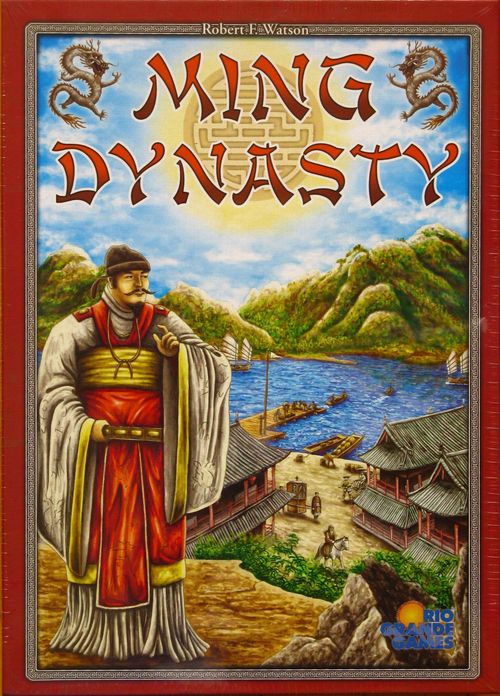
Ming Dynasty
Ming Dynasty Rulebook
Table of Contents
Table of Contents
Contents
- 1 game board
- 4 princes (1 each in 4 colors)
- 108 province tiles (18 each in 6 colors)
- 18 dragon cards (jokers)
- 1 round marker
- 4 game summaries
- 124 family members (31 each in 4 colors)
- 16 return cards (4 each in 4 colors)
- 54 movement cards
- 6 50/100 tiles
- 1 start player figure
The game board has 6 provinces in different colors. Each province is divided into 3 districts. In the center of each province is a city and each district has a monastery. Each province is assigned a corresponding province space at the edge of the game board.
Preparation
Place the game board in the middle of the table.
Shuffle the movement cards, and turn up a movement card next to each of the province spaces to form a face up display. Place the remaining movement cards nearby in a face down supply stack.
Place the dragon cards in a face up supply stack next to the board.
Sort the province tiles by color and place them next to the board as a general supply.
Set the round marker on space "1" of the round track.
Each player chooses 1 of the 4 colors and takes the following pieces in that color:
- 1 prince
- all 31 family members
- 4 return cards
- 1 dragon card, which he takes into his hand, and
- 1 rule summary
Each player places 1 of his family members on the "0" space of the scoring track. The remaining 30 make up each player's personal supply, which he places in front of him (his play area).
The players choose a starting player, who takes the starting player figure and begins the game.
The starting player places his prince in the district of his choosing and takes a province tile of the matching color.
The other players do the same, in clockwise order, placing their princes in a district that no other player has chosen and taking a corresponding province tile.
Playing the Game
The game consists of 6 rounds. Each round is divided into the following phases:
- Place family members in the province spaces
- Choose movement cards
- Move prince and deploy family members
- Scoring (only in Rounds 2, 4 and 6)
- Round end
Always play the phases in this order. In a phase, the players perform the action appropriate to the phase in clockwise order, beginning with the starting player. Only when all players have finished does the next phase begin.
The player with the most points after the final scoring at the end of the 6th round wins the game. The following provides a general overview of game play. The details are explained in the accompanying Rules Explanation.
Playing a Round
1. Place family members in the province spaces
The province spaces a player chooses determine which movement cards he can take from the open display in Phase 2 and to which provinces he can deploy family members in Phase 3.
At the start of this phase, each player takes 5 of his family members from his play area in his hand. He can place only these 5 family members during this phase. Beginning with the starting player and then in clockwise order, each player places 1 family member in a province space of his choosing. This continues until each player has placed all 5 of his family members.
2. Choose movement cards
The player needs movement cards to move his prince in Phase 3.
The movement cards, together with the dragon cards (jokers), make up a player's hand of cards. Return cards do not count as hand cards. A player may never have more than 5 cards (movement and dragon cards) in his hand.
Beginning with the starting player, each player, in turn, must take either 1 of the 6 movement cards from the display or 1 dragon card, adding it to his hand. If a player already has 5 cards in his hand, this phase is over for him. The remaining players continue until all have exactly 5 cards in their hands.
3. Move prince and deploy family members
Beginning with the starting player, each player must first move his prince. The player can move his prince as far as he likes, but for each border the prince crosses, he must play an appropriate movement card from his hand. After moving his prince, the player can move from 0 to 3 family members from the corresponding province space into the district where the prince ended his movement.
4. Scoring
Scoring takes place at the end of the 2nd, 4th and 6th rounds.
When scoring, carry out the following steps, one after the other, for all 6 provinces:
- In each district, determine which player (or players) has the majority of family members. The player with the most in each district moves 2 of his family members from the district into the city. The player with the second most family members moves 1 family member from the district into the city. For each of a player's family members in a city, he takes a province tile in the matching color from the general supply, placing it in his play area.
- Afterward, each player must decide how many family members to leave in the city and how many to return to the district. To do this, each player uses his return cards, placing the chosen number in a face down pile in his play area. The player then scores points for any family members he chose to leave in the city; after scoring, he removes these family members from the game and returns them to the box. For each family member in a cloister, a player earns 4 points.
5. Round end
At the end of each round, move the round marker 1 space forward, and pass the starting player figure 1 player to the left.
Rules Explanation: The Individual Phases in Detail
1. Place family members in the province spaces
Each of the 6 province spaces matches the color of the province on the board to which it belongs. The choice of province spaces determines which movement cards a player can take (Phase 2), and to which provinces he can deploy his family members (Phase 3). Any number of family members from any number of players may occupy the same province space.
2. Choose movement cards
Each player must select 1 of the following actions:
2.1 Take a movement card from the face up display A player may only take a card from the face up display if he has at least 1 family member in the province space next to the card. All family members stay in the province space. After a card is taken, turn up another immediately to complete the display again. If the supply stack is exhausted, shuffle the discards to form a new face down supply stack.
2.2 Take a dragon card Instead of taking a movement card, a player can choose to take 1 of the face up dragon cards. However, to do this, he must also choose 1 family member to remove from any province space. This family member goes back to the box and is out of the game.
3. Move princes and deploy family members
On his turn, a player must choose 1 of the following 3 actions:
- 3.1 move his prince,
- 3.2 leave the prince where it stands, or
- 3.3 pass.
When a player has carried out 1 of the 3 possible actions, the next player in clockwise order takes his turn. This continues until all players have passed.
3.1 Move the prince The player must move his prince 1 or more steps. Each step must take the prince over a border into a directly adjacent district.
The player must pay for each step by playing either a movement card showing the means of transport pictured on the border his prince is currently crossing or a dragon card from his hand.
Example: The prince moves across a boundary with rider symbol. The player plays a rider card to pay for the movement.
A player may move his prince into a district already containing another player's prince, but he may not end his movement there. Rather, he must move his prince again to another neighboring district. When entering and leaving a district occupied by another player's prince, the player must play an appropriate movement or dragon card as usual.
Example: Red may move his prince through the district with the green prince, but he must immediately move it into a neighbouring district. For both steps, the player must play a suitable card.
Place used movement cards onto the discard pile. Place used dragon cards on the dragon card stack.
Deploy Family Members After a player finishes moving his prince, he may deploy up to 3 family members. In so doing, he may only take family members from the province space matching the district where his prince ended his movement and place them into that same district. The player places the family members into the open area in the district except that the player can place 1 of these family members into the cloister in that district, if he chooses. To make this easier to see, it is best to lay family members flat in the cloisters. As long as a player has a family member in a district cloister, he cannot place any more family members into the district. The family member remains in the cloister until another player places 1 of his family members into the cloister, thereby ousting the existing family member, who returns to the district's open area. Players may not voluntarily return a family member to the district from a cloister or oust their own pieces in this manner.
Example: The player places two family members in the district where his prince stands. The player moves one of the transferred family members to the cloister.
3.2 Leave the prince where he stands In certain circumstances, a player may not want to move his prince, yet he also may not want to pass (3.3). In this case, the player can leave his prince in the district where he currently stands. To do so, he must play a movement card of his choosing (or a dragon card) to the discard pile. The player may still place family members in the prince's current district in the same manner as he can after moving his prince (3.1).
3.3 Pass If a player cannot or does not want to play a card, he can pass and then sit out the rest of the phase. The player does not have to play a card to pass, but he does not get to deploy any family members either.
The remaining players continue the round, taking turns and skipping any players who have already passed.
This means that players may end the phase with different numbers of cards in their hands. The players must keep these cards for the next round. Family members remaining on the province spaces must remain in place for use in the upcoming round. Players may not move or exchange family members on the province spaces.
4. Scoring (only in rounds 2, 4, and 6)
4.1 Determining majorities in the districts The cities in the provinces each contain 9 houses. These houses are divided by district, so that there is a set of 3 houses connected to each surrounding district. Family members in a given district may only be placed onto the 3 houses connected to the district. Therefore, there can be a maximum of only 3 family members in that district's city section at a time. Family members in cloisters do not count when determining majorities, and players may not move them into the city.
The player with the most family members in a district must move 2 of his family members from that district into the connected city houses. If a player has only 1 family member in a district and still wins the majority, he moves just that 1 family member into the city. The player with the second most family members must move 1 family member into the connected city. If 2 or 3 players tie for the most family members in a district, each moves 1 family member into the city. In this case, the player or players with the second most do not get to move any family members to the city, and 1 house will remain empty. Players with the second most family members may never move as many family members to the city as the player or players with the most.
If all 4 players have the same number of family members in a district, none of them gets to move any into the city, and all 3 houses in that district's city area remain empty.
If just 1 player has the most family members in a district, but multiple players tie for second, the player with the most places 2 family members into the city. The players with the second most move none, as there can be a maximum of only 3 occupied houses in a district's city area.
Examples:
- With the exclusive majority in this district with 3 family members, yellow moves 2 of his family members into the city. Green (with 2 family members in the district) moves 1 of his into the city. Blue moves none into the city.
- Yellow, green, and blue all tie with the most in the district with 2 family members each. Each moves 1 family member into the city. Red moves none into the city.
- Yellow and blue tie for the majority in the district with 2 family members. Each moves 1 family member into the city. Green moves none into the city. One house remains vacant.
- Yellow has the exclusive majority with 2 family members in the district and moves both into the city. Blue and green tie for second with 1 each and move none into the city. One house remains vacant.
In this manner, the houses in each district's city area will fill up. For each family member a player moves to the city, he takes 1 province tile of the matching province color from the general supply. Players always keep their collected province tiles visible in their play areas.
A player who has collected a complete set of 6 different-colored province tiles immediately returns them to the general supply and moves his scoring markers forward as follows:
- 28 points after the 2nd round,
- 24 points after the 4th round, and
- 20 points after the 6th round.
After the 6th round's scoring is completed, players may also turn in sets of 5 different-colored province tiles, scoring 10 points per set. Finally, players score 1 point for each remaining province tile they have.
4.2 Returning family members Players with at least 1 family member in a city may choose to return as many of them as they like to the districts. To do this, each player with family members in the city at issue places 1 or more return cards face down in front of himself. Then, all participating players turn their cards face up at the same time. The sum of the numbers of a player's return cards shows how many family members the player has chosen to return from the city to the districts connected to it. Beginning with the starting player, each player then moves this number of family members back to the districts they came from.
For each of a player's family members still in the city when the return is finished, the player scores:
- 4 points after the 2nd round,
- 3 points after the 4th round, and
- 0 points after the 6th round.
Additionally, the player with the most remaining family members in the city scores 4 points. In case of a tie, the tied player with family members in the greatest number of city districts scores the 4 points. If there is still a tie, the points get divided (rounding down where necessary). Afterward, place all family members remaining in the city back into the box; they are now out of the game.
Example: Both players have 4 family members in the city. Red moves 2 back into the province, blue moves only 1 back. For the figures remaining in the city, the players earn points: blue earns 4 points, as he has the most family members in the city.
4.3 Cloisters For each family member in a cloister, a player scores 4 points. These family members remain in the cloisters.
5. Round end
At the end of each round, move the round marker forward 1 space and pass the starting player figure 1 player to the left.
Exception: in a 4-player game, at the end of the 4th round, the player with the second fewest points chooses the starting player for the 5th round (he can choose himself as well). At the end of the 5th round, the player with the fewest overall points chooses the starting player for the 6th round (again, he can choose himself). If there is a tie, the player with the most monks chooses.
Rules for 2 Players
In addition to the family members chosen for the 2 players, you need family members of a third unused color to serve as those of a neutral player. In the following examples, green is the color of the neutral player. Before the game begins, place 1 family member of the neutral player into each district. Then, the 2 players each take 3 family members belonging to the neutral player. Beginning with the starting player, the players must, in turns, place 1 family member of the neutral player into any district they choose, except that no district may contain more than 3 neutral family members.
Play the rest of the game according to the normal rules, but with the following change: when scoring (Phase 4), the neutral player moves his family members into the city as usual. If the neutral player then has the sole majority in that city, the starting player returns only that number of family members to the district that are necessary for the neutral player to hold his majority. The starting player gets to choose which family members the neutral player returns, as long as the neutral player ends up maintaining his majority relationships. If the neutral player does not have the sole majority in the city, he will move all of his family members back into the districts in Phase 4.2. The neutral player does not collect province tiles or points, but does hinder others in their efforts to do so. Before the start of the 3rd and 5th rounds, both players again take 3 neutral family members and place them, just as at the start of the game, into districts of their choosing, bearing in mind that there can never be more than 3 neutral family members in a given district.
Examples:
- The neutral player (green) has the majority in the city with 4 family members. The two other players have 2 family members each in the city. Green will retain his majority if he keeps 3 family members in the city. The start player decides which family member green move back into the district.
- All players have 2 family members in the city. The neutral player (green) does not have the majority in the city. The two other players have 2 family members each in the city. As green does not have the majority, he moves all his family members back into the district.