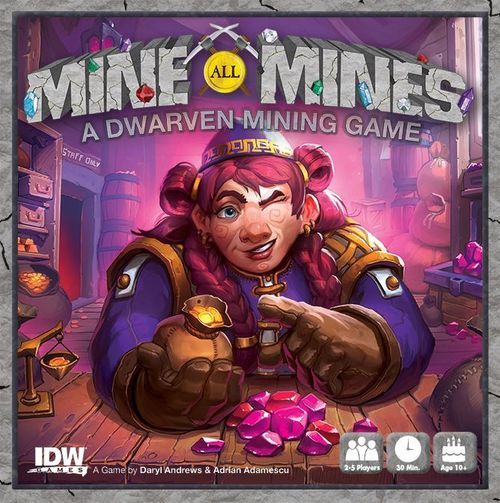
Mine All Mines
Mine All Mines Rulebook
Table of Contents
Table of Contents
Rules Updates
2.1 – Clarifies how to claim achievement cards.
Goal and Game End Conditions
Mine all Mines is played in a series of turn Rounds. The number of rounds is determined by player count:
- 3-5 players: the number of Rounds equal the number of players, giving each player a chance to be the "First Player".
- 2 players: there will be 4 Rounds, giving each player a chance to be the "First Player" twice.
| # of Players | 2 | 3 | 4 | 5 |
|---|---|---|---|---|
| # of Rounds | 4 | 3 | 4 | 5 |
At the end of the game, players count the Victory Points (VPs) they have as printed on:
- Jewelry and Support Cards purchased
- Achievement Cards fulfilled
The Winner is the player with the most points.
If there is a tie, the winner is the player with the most remaining gems. If there is still a tie, the winner is the player who purchased the most Jewelry cards.
Components
- 103 Cards:
- 35 Dwarf Cards (5 sets of 7 cards),
- 40 Jewelry Cards (Crown on the back),
- 10 Achievement Cards (Bag of Gems on the back),
- 18 Support Cards (Shovel and Pickaxe on the back):
- 10 Tool Cards, 8 Helper Cards,
- 55 Gems:
- 11 Diamond (Clear), 11 Sapphire (Blue), 11 Ruby (Ruby), 11 Emerald (Emerald), 11 Gold (Gold),
- 1 Marketplace Tile,
- 5 Mine Tiles with stands,
- 1 First Player Tile (Pickaxe),
- 1 Jewel Pouch,
- 1 Rule book.
Game Setup
- Each player takes a set of the 7 Dwarf Cards.
- Place the Marketplace Tile in the centre of the table.
- Place one Gem of each type in the Marketplace Tile in the order from left to right: Diamond, Sapphire, Ruby, Emerald, Gold.
- Place the Mine Tiles beside the Marketplace Tile in the same order as the Marketplace Tile.
- Place the remaining Gems in piles (known as the Supply) beside their respective Mine Tile.
- Shuffle the Jewelry Cards and turn over the top 3 Jewelry Cards (or 4 Jewelry Cards in a 5-person game). Place these and the draw pile above the Marketplace Tile.
- Shuffle the Support Cards and turn over the top 2 Support Cards. Place these and the draw pile above the Marketplace Tile beside the Jewelry Cards.
- Shuffle the Achievement Cards and turn over the top 5 Achievement Cards. Place above the Jewelry and Support Cards. Return the remaining Achievement cards to the box.
- Give the First Player Tile to the player that looks most like a Dwarf.
Game Round
Mine all Mines is played in a series of turn Rounds equivalent to the number of players for a 3-5 player game; 4 rounds for a 2-player game.
A Round consists of:
- All players shuffling their Dwarf cards and randomly discarding several Dwarf Cards based on the table below. The remaining cards will be the players' hands for the round.
- Starting with the player holding the First Player Tile and proceeding clockwise, each player will get to take Player Turn. The play will proceed around until each player has had a chance to play (or discard) each of the Dwarf cards in their hand.
- Once all players are out of cards, the Round ends.
| # of Players | 2 | 3 | 4 | 5 |
|---|---|---|---|---|
| # of Dwarf cards to discard | 2 | 2 | 3 | 3 |
If not all Rounds have been completed, set up for a new Round:
- The First Player Tile is passed to the player on the right (I.E.: the player who was last in the previous Round).
- Each Player reclaims all 7 of their Dwarf cards.
- A new Round can begin.
Player Turn
On a Player's turn, the player performs a series of actions:
- Play a Dwarf card (Mandatory)
- Trade Gems (Optional)
- Buy One Card (Optional)
Additionally, at any time during the player's turn, the player can:
- Check and Receive Achievements (Optional)
Note: A player may never hold more than 3 of any one type of Gem. If a player is to take a particular type of Gem but already has 3, that player does not get the Gem. Likewise, if a player is to take a Gem from another player or the supply and none are available, that player does not get the Gem.
Play a Dwarf Card
The player must play exactly 1 of their Dwarf cards.
NOTE: If, for whatever reason, a player CAN NOT play a Dwarf Card, that player must discard a Dwarf card of their choice and their turn ends IMMEDIATELY.
Amongst the player's Dwarf cards are two types of Dwarves:
- Marketplace Dwarves:
- a. Dealer: The player can play the Dealer Dwarf Card to the Marketplace Tile. The Dealer allows the player to trade any number of Gems 1 for 1 with the Gems in Marketplace.
- b. Blacksmith: The player can play the Blacksmith Dwarf Card to the Marketplace Tile. The Blacksmith allows the player to take any 1 Gem from the supply.
- Mining Dwarves (Diamond, Sapphire, Ruby, Emerald, and Gold): The player can play a Mining Dwarf card to perform 1 of 2 available actions:
- a. Mine Action: The player can place a Mining Dwarf card at the entrance of the respective mine if that mine is currently unoccupied. The player can then take 1 of that respective Gem from the Supply (if available).
- (Example #1): If there currently is no Dwarf already at the entrance to the Sapphire mine, the player could play his Sapphire Dwarf card there and then take one Sapphire Gem from the Supply.
- b. Dig Action: The player can place a Mining Dwarf card that was previously played by playing the new Dwarf card on either the Friend (+) or Foe (-) side and will then claim Gems from the supply, and/or opponent respectively. (For more details, see the sections "Friend" and "Foe" below.)
- a. Mine Action: The player can place a Mining Dwarf card at the entrance of the respective mine if that mine is currently unoccupied. The player can then take 1 of that respective Gem from the Supply (if available).
NOTE: There is a limit to the number of Dwarf cards in a line of 3. You may not play on a Dwarf card that is third in line for the Mine entrance and has 2 other Dwarf cards in front of it.
Friend
If there is already a Dwarf Card at the entrance to a mine, the player may play a Dwarf card on it that is a Friend. The player would receive 1 Gem respective to the Dwarf card they played, plus an additional Gem for each Dwarf card that is a Friend.
Note: the player will only get the "Friend" bonus if the earlier friend Dwarf cards are owned by other players.
(Example #2): Player 1 played the Gold Dwarf card at the empty entrance to the Gold Mine. Player 1 received 1 Gold Gem from the Supply.
Player 2 noticed that the Gold Dwarf is friends with Emerald Dwarves. Player 2 played their Emerald Dwarf card as a friend to the Gold Dwarf. Player 2 received 1 Emerald Gem and 1 Gold Gem, both from the supply.
Foe
If there is already a Dwarf Card at the entrance to a mine, the player may play a Dwarf card on it that is a Foe. The player would receive 1 Gem respective to the Dwarf card they played from the supply. In addition, the player would take 1 Gem of their choice from each player who owns the Dwarf card that is a Foe.
(Example #3): Player 1 played the Gold Dwarf card at the empty entrance to the Gold Mine. Player 1 received 1 Gold Gem from the Supply.
Player 2 noticed that the Gold Dwarf is foe of Ruby Dwarves. Player 2 played their Ruby Dwarf card as a foe to the Gold Dwarf. Player 2 received 1 Ruby Gem from the supply and stole 1 Gem (of Player 2's choice) from Player 1.
Trade Gems (Optional)
The Player can then choose to Trade Gems if they wish.
The player may make ONE trade of 3 Gems of theirs (they do not need to be identical) for any 1 Gem from the Supply.
Additionally: If the player played their Dealer Dwarf card, they can trade any number of Gems 1 for 1 with the Gems in Marketplace.
Buy One Card (Optional)
The player can then choose to buy ONE of the face up Jewelry or Support cards:
- Jewelry Cards cost either 2 or 3 Gems as shown along the bottom of the card. Jewelry cards have no abilities and give 2 or 3 Victory Points (VPs) as shown in the upper left corner of the card.
- Support Cards cost 2 Gems as shown along the bottom of the card. (A Rainbow Gem means "any type of Gem".) Support Cards have abilities that the player may use ONCE PER ROUND at any time during their turn. (Turn the card sideways to note that it has been used.) Support Cards also give or take Victory Points (VPs) as shown in the upper left corner of the card. The exception to this is "Mine" Support Cards; these give VPs based on the number of them a player has at the end of the game. (For more details on Support Cards, see the section "Types of Support Cards" below.)
Once a card is purchased, turn face up the next card of that type from the respective deck to take its place. This way there is always 2 Support Cards and 3 (or 4) Jewelry Cards available for purchase.
Check and Receive Achievements (Optional)
At any time during the player's turn, the player can look at the available Achievement cards.
Each Achievement card has requirements listed on the bottom. If the player meets the requirements with Support and/or Jewelry cards they already hold, the player may claim the card and put it in front of themselves. The player keeps their Support and Jewelry cards. The player may only claim ONE Achievement card per turn. Once an Achievement card is claimed, it is not replaced.
(Example #4): One of the Achievement cards has the requirement of 2 Rings. The player must have 2 Ring Jewelry cards to claim the Achievement card. The player gets the Achievement card and keeps the Jewelry cards.
(Example #5): One of the Achievement cards has the requirement of 3 Diamond Gems. The player must have 3 different Support and/or Jewelry cards with a Diamond Gem in their costs to claim the Achievement card. The player gets the Achievement card and keeps the Support and Jewelry cards.
Types of Support Cards
Support Cards have abilities that the player may use ONCE PER ROUND at any time during their turn. (Turn the card sideways to note that it has been used.)
Helpers
Helper Support cards have a picture of a hand with gems in the upper right corner.
- Goldsmith: The Player may trade any 1 Gold Gem they have with any other 1 Gem from the Supply.
- Trader x4: Depending on which Trader the player has, the player may trade any 1 of the specified Gem they have with any other 1 Gem from the Supply.
- Jeweler: When the player purchases Jewelry Cards, they may do so for one less Gem.
- Helper #1 (Trade): When the player is at the "Trade Gems" action of their turn, rather than having to trade 3 Gems to get 1, this Helper allows the player to only need to trade in 2 of their Gems to get one from the Supply.
- Helper #2 (VP): This card has no abilities during the game, but instead awards the player 1 VP for each Helper Support card (including itself).
Tools
Tool Support cards have a picture of a shovel and pickaxe in the upper right corner.
- Lamp: The player may place up to 5 of their Gems onto this card WHEN THEY GET THE CARD. These Gems are there permanently until the end of the game. Each Gem on this card will earn the player one VP at the end of the game. NOTE: Gems on this card do not count toward the limit of only being able to have at most 3 Gems of any type.
- Tools x2: With this card, when a player plays a Dwarf card for a Mine Action (IE: is the first Dwarf card at the Mine Entrance), rather than taking 1 Gem from the supply, the player can take 2 Gems of the respective type. Note: Even if the player had more than 1 Tools card, they can only use 1 per Mine Action. (The second can be used if they do the Mine action on a later turn in the round.)
- Mine Cart x2: With this card, when a player plays a Dwarf card for a Friend Dig Action, rather than taking 1 Gem from the supply, the player can take 2 Gems of the respective type, plus the Friend bonus. Note: Even if the player had more than 1 Mine Cart card, they can only use 1 per Dig Action. (The second can be used if they do the Dig action on a later turn in the round.)
- Mine x5: These cards have no abilities during the game, but they give VPs based on the number of them a player has at the end of the game.
- If a player has 1 Mine Card at the end of the game, they will get 1 VP.
- If a player has 2 Mine Cards at the end of the game, they will get 3 VPs.
- If a player has 3 Mine Cards at the end of the game, they will get 6 VPs.
- Additional Mine Cards would start a second set.
Additional Examples of Game Play
(Example #6): Looking at Example #1 again. Player 1 played the Gold Dwarf card at the empty entrance to the Gold Mine. Player 1 had a "Tools" card and decided to use it. Player 1 turned the "Tools" card sideways to note that it was used, and received 2 Gold Gems from the Supply rather than just 1.
Player 2 noticed that the Gold Dwarf is friends with Emerald Dwarves. Player 2 played their Emerald Dwarf card as a friend to the Gold Dwarf. Player 2 had a "Mine Cart" card and decided to use it. Player 2 turned the "Mine Cart" card sideways to note that it was used, and received 2 Emerald Gems and 1 Gold Gem, both from the supply.
Second Friend
When a Dwarf Card is played as a Friend, that Dwarf would also benefit from other Friends up the straight line.
(Example #7): Player 1 played the Gold Dwarf card at the empty entrance to the Gold Mine. Player 1 received 1 Gold Gem from the Supply.
Player 2 noticed that the Gold Dwarf is friends with Emerald Dwarves. Player 2 played their Emerald Dwarf card as a friend of the Gold Dwarf. Player 2 received 1 Emerald Gem and 1 Gold Gem, both from the supply.
Player 3 played their Ruby Dwarf as a Friend of Emerald Dwarf which in turn is a Friend to Gold Dwarf. Since it is straight up the line, Player 3 received 1 Ruby Gem, 1 Emerald Gem and 1 Gold Gem, all from the supply.
NOTE: A player cannot take advantage of the Friend bonus. If instead of Player 3, Player 1 had played the Ruby Dwarf, Player 1 would have received 1 Ruby Gem and 1 Emerald Gem, but not a Gold Gem as the Gold Dwarf had also been played by Player 1.
NOTE: There is a limit to the number of Dwarf cards in a line of 3. As such, a fourth Dwarf Card could not be added to this Friends line.
Second Foe
When a Dwarf Card is played as a Foe, that Dwarf would also benefit from other Foes up the straight line.
(Example #8): Player 1 played the Gold Dwarf card at the empty entrance to the Gold Mine. Player 1 received 1 Gold Gem from the Supply.
Player 2 noticed that the Gold Dwarf is foe of Ruby Dwarves. Player 2 played their Ruby Dwarf card as a foe to the Gold Dwarf. Player 2 received 1 Ruby Gem from the supply and stole 1 Gem (of Player 2's choice) from Player 1.
Player 3 played their Diamond Dwarf as a Foe of Ruby Dwarf which in turn is a Foe to Gold Dwarf. Since it is straight up the line, Player 3 received 1 Diamond Gem from the supply. Player 3 also stole 1 Gem (of Player 3's choice) from Player 2, and 1 Gem (of Player 3's choice) from Player 1.
NOTE: There is a limit to the number of Dwarf cards in a line of 3. As such, a fourth Dwarf Card could not be added to this Foes line.
Friend of a Foe
When a Dwarf Card is played as a Friend, that Dwarf would not benefit from a Foe up the line.
(Example #9): Player 1 played the Gold Dwarf card at the empty entrance to the Gold Mine. Player 1 received 1 Gold Gem from the Supply.
Player 2 noticed that the Gold Dwarf is foe of Ruby Dwarves. Player 2 played their Ruby Dwarf card as a foe to the Gold Dwarf. Player 2 received 1 Ruby Gem from the supply and stole 1 Gem (of Player 2's choice) from Player 1.
Player 3 played their Sapphire Dwarf as a Friend of Ruby Dwarf. Following up the straight up the line, Player 3 received 1 Sapphire Gem and 1 Ruby Gem, both from the supply.
NOTE: There is a limit to the number of Dwarf cards in a line of 3. As such, a fourth Dwarf Card could not be added to this Foes line.
Foe of a Friend
When a Dwarf Card is played as a Foe, that Dwarf would not benefit from a Friend up the line.
(Example #10): Player 1 played the Gold Dwarf card at the empty entrance to the Gold Mine. Player 1 received 1 Gold Gem from the Supply.
Player 2 noticed that the Gold Dwarf is friends with Emerald Dwarves. Player 2 played their Emerald Dwarf card as a friend of the Gold Dwarf. Player 2 received 1 Emerald Gem and 1 Gold Gem, both from the supply.
Player 3 played their Sapphire Dwarf as a Foe of Emerald Dwarf. Following up the straight up the line, Player 3 received 1 Sapphire Gem from the supply and stole 1 Gem (of Player 3's choice) from Player 2.
NOTE: There is a limit to the number of Dwarf cards in a line of 3. As such, a fourth Dwarf Card could not be added to this Foes line.
Hard Choices Must Be Made
When a Dwarf Card is played as a Friend and a Foe, that Dwarf would not benefit from both. The player would need to choose.
(Example #11): Player 1 played the Gold Dwarf card at the empty entrance to the Gold Mine. Player 1 received 1 Gold Gem from the Supply.
Player 2 played their Ruby Dwarf card as a foe to the Gold Dwarf. Player 2 received 1 Ruby Gem from the supply and stole 1 Gem (of Player 2's choice) from Player 1.
Player 3 played their Emerald Dwarf card as a friend of the Gold Dwarf. [Source error: the printed text says "Player 2 received 1 Emerald Gem and 1 Gold Gem"; from the context this is Player 3's action, so it is corrected here.] Player 3 received 1 Emerald Gem and 1 Gold Gem, both from the supply.
Player 1 now plays their Sapphire Dwarf as a Foe of Ruby Dwarf and Friend of Emerald Dwarf at the same time.
Player 1 needs to decide either to follow the Friend line (Red arrow) and receive 1 Sapphire Gem and 1 Ruby Gem both from the supply, OR follow the Foe line (Green arrow) and receive 1 Sapphire Gem from the supply and steal 1 Gem (of Player 1's choice) from Player 3.
NOTE: There is a limit to the number of Dwarf cards in a line of 3. As such, a fourth Dwarf Card could not be added to either of these lines.