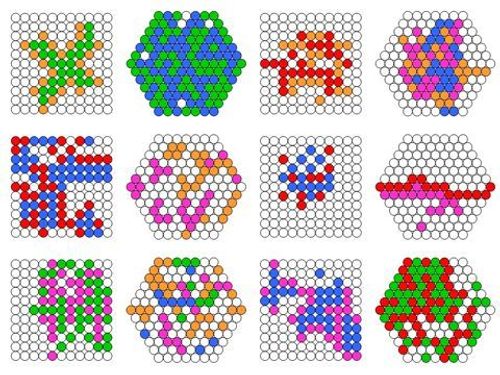
Mind Ninja
Mind Ninja Rulebook
Table of Contents
Table of Contents
The Very Most Simple Version of the Game
The board begins empty. The game proceeds in 4 steps:
- Player 1 invents a pattern, and describes it to player 2.
- Then, player 2 decides which player is the "builder", and which is the "blocker".
- Starting with the builder, the players alternate moves.
- The game ends either when the board is completely full or the pattern has been built. If the pattern has been built, the builder wins. Otherwise, the blocker wins.
Slightly More Complicated Rules, Making it Easier to Design Balanced Patterns
The board begins empty. The game proceeds in 5 steps:
- Player 1 decides three things, which he must convey to player 2: a. what the pattern will be; b. whether the builder or blocker will receive free moves in step 3; c. how many free moves that player will receive.
- Then, player 2 decides which player is the builder, and which is the blocker.
- Either the builder or blocker takes free moves as specified in step 1.
- Starting with the builder, the players alternate moves.
- The game ends either when the board is completely full or the pattern has been built. If the pattern has been built, the builder wins. Otherwise, the blocker wins.
Full Rules, For Tournament Play
The board begins empty. The game proceeds in 6 steps:
- The Bidding Phase: players begin by each bidding numbers that stand for free moves, called 'bid-moves'. Player 1 bids first, by saying a number as low as zero. His opponent must then either pass, or increase the bid by at least one. Bidding continues until a player passes. This player then takes possession of the specified number of bid-moves (but he does not take them yet).
- The player who did not pass decides 3 things, which he must convey to his opponent: a. what the pattern will be; b. whether the builder or blocker will be given additional free moves, called 'balance-moves'. c. how many balance-moves that player will receive (must be a positive number or zero).
- The player who passed in step 1 then decides which player is the "builder", and which is the "blocker".
- If one player owns both the balance-moves and bid-moves, he adds the two numbers together, and takes that number of free moves. If different players own the balance-moves and bid-moves, the player who owns the balance-moves subtracts the bid-moves from the balance-moves. If the resulting number is positive, he takes that number of free moves. If it's negative, the opponent takes the free moves.
- From then on, starting with the builder, the players alternate moves.
- The game ends either when the board is completely full or the pattern has been built. If the pattern has been built, the builder wins. Otherwise, the blocker wins.
Notes
- It will take a few games to learn how to describe patterns unambiguously, but this is part of the fun. With practice, you will discover that there is great room for creativity in concocting strange and wonderful patterns, and great pleasure in learning how to describe them. That is the beauty of the game!
- Handicapping is easy. Just choose an unbalanced pattern and give the easier role to the weaker player. Handicapping is useful, because it means that players of different skill levels can have equal chances of winning, which facilitates learning and makes each game exciting.
- The game can be played with paper and 2 differently colored pencils. Printed boards are provided at the end of this document for that purpose.
- In a tournament setting, players should be limited to patterns from an official tournament list, known to all beforehand.
History of the Game
Diagrams of the Hex board and the Hex example game are omitted. The original document's last two pages are blank printable boards (nine square grids and nine hexagonal grids) with no rules text, so they are not transcribed.
In the 1940s, two mathematicians (Piet Hein and John Nash, the Nobel-prize winner made famous in "A Beautiful Mind") independently designed a game now known as Hex. It is played with stones of two colors on a board pictured at right:
Each player owns all the stones of one color, and the players take turns placing stones, one by one, on the board. The object is to construct a chain of stones in your color that runs between two opposite sides of the board. Your opponent tries to construct a chain of his stones running between the other two sides of the board. At right is an example of a finished game, won by red:
Hex is a landmark in game design: it has simple rules, deeply strategic play (at least one book has been written on Hex strategy), and some interesting and useful mathematical properties. Specifically, the game is guaranteed to end within a fixed number of moves, and one player must win.
Hex is a game in which each player tries to form a particular kind of pattern. Its beauty lies in the fact that the patterns are mutually exclusive, so that if one player completes his, his opponent's is impossible. Moreover, when the board is full, at least one of the patterns must be formed.
In 2006, I asked myself: is it possible to construct a game like Hex, having the same nice mathematical properties, but where the players themselves determine the particular patterns needed to win, so that the patterns can change from game to game? I found that the answer was yes. In order to understand why, one must first see that there is another way to describe the goals of Hex.
The traditional way to teach Hex is to describe to each player the pattern that he must try to form. But there is another way. You can tell one player to try to form his pattern, and you can tell the other player to try to block it. The point is, you only need to describe one of the patterns, and the other will emerge naturally when one player tries to block the described pattern.
With that in mind, I realized that the pattern you describe doesn't have to be a chain between opposite sides of the board. It could be anything. If you specify almost any pattern, there will be another one that can block it, but you needn't be able to describe it in order to play.
That was the key insight, but I didn't have a game yet. In order to make a fair game, one must ensure that the goals of the two players are about equally difficult. Let's call the two players the builder and the blocker. In order to make the game interesting, the builder and blocker must have equal chances, if their skill levels are equal. There are lots of patterns that are easier to build than to block or vice versa, so whoever decides the pattern can easily win if he knows whether he's the builder or blocker beforehand.
I found an easy solution. One player should invent the pattern first, and only after that should the other player decide who is builder and who blocker. That way, the player who invents the pattern must choose a balanced one, or else his opponent will get an advantage by taking the easier role. With this rule in place I had my first version of the game, which is given in "The Very Most Simple Version of the Game" above.
The more complicated rules below it solve two additional problems that emerged later.
First, inventing a balanced pattern turned out to be hard because the set of balanced patterns is only a tiny fraction of all possible patterns. The fix I found was simple: if the player who invents the pattern is also allowed to grant a handicap, in the form of free moves, to either the builder or the blocker, then a wide range of patterns can be made balanced.
The second problem emerged when I tried to imagine what would happen if people studied the game intensively, like some study chess. I realized that a player could study intensively one particular pattern, so that he knew more about it than others did. Then, in any game in which he had the opportunity to propose a pattern, he could propose that one. Even if the pattern was balanced, his expertise in that pattern would grant him an advantage. To fix this, I added a bidding phase at the start of the game, where players bid free moves in exchange for the right to propose a pattern. With that, the game was done.
So, Mind Ninja is a generalization of the rules of Hex to any arbitrary pattern goal. But it's not only a generalization of Hex. Many other games, like Havannah, Y, Star, 5-In-a-Row, and One-Capture-Go are all contained as specific patterns in Mind Ninja. In fact, Mind Ninja contains nearly all games where players fill in spaces on a board in order to form some kind of pattern.