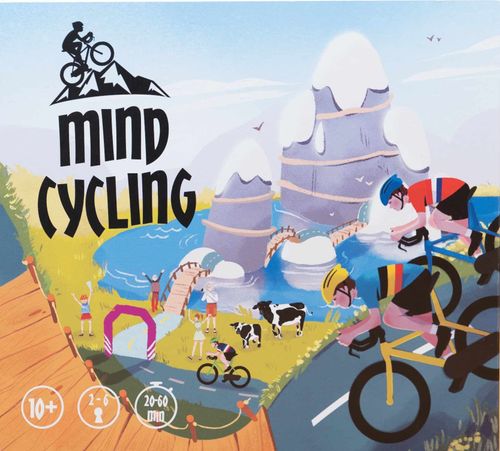
Mind Cycling
Mind Cycling Rulebook
Table of Contents
Table of Contents
Equipment
- A game board with the course
- 36 cyclists divided into 6 different teams, +1 team of 6 cyclists to customize in the colors of your choice.
- 54 bases,
- 4 medal tokens,
- 1 trophy token,
- 11 points tokens,
- 20 small wind tokens,
- 1 large wind token to determine the wind direction in the expert version,
- 2 feed zone tokens,
- 5 removable tabs (2 blue to mark the start of the plain section(s), a green to mark the start of the sprint section, a yellow to mark the start of the Mountain pass section and a double white line to mark the finish of the race),
- 6 rocky mountains,
- 4 memo cards
- 1 booklet with the rules of the game.
Goal of the Game
The aim is to become the best Mind Cycling Manager by winning the most medals with your team:
- Medals are awarded to the race winner (the cyclist who crosses the finish line first),
- The best sprinter (the cyclist who finishes the sprint section first),
- The best climber (the cyclist who finishes the mountain pass section first),
- And the best team (based on the places of the cyclists in each team in the final classification of the race).
Setup
Each player chooses a team of 3 to 6 cyclists (depending on the desired length of the game: 3 = short, 6 = long, entire course).
Each team is made up of cyclists of 3 different types:
- Sprinters (green helmets) are the fastest in the sprint section,
- Climbers (yellow helmets) are the fastest in the mountain pass section.
- Domestiques (blue helmets) are the fastest in the plain section.
Cyclists with a blue helmet should have a blue base, the others a black base.
The players agree on the length of a race and the different sections by placing the removable tabs (blue = start of the plain section, green = start of the sprint section, yellow = start of the Mountain pass section, double white line = finish of the race) between 2 rows of squares of their choice on the course.
A section ends where a new one begins. The various medals are placed in their respective slots on the board.
The first removable tab (blue, green or yellow) will be the real start of the race. Place this first tab so that there are enough squares to place all the participating cyclists between the fictitious start line (START) and this first tab (real start). Example: if you are playing with 36 cyclists (maximum number of cyclists), you must place the first tab (real start) between the row of squares 8 and 9.
Warning: The area between the fictitious start (START) and the real start (first tab) is a plain area.
Beginning of the Game
The least experienced or youngest player can start. He chooses his first cyclist and places him on a square of his choice before the actual starting line. Then it's up to the player to his left to choose and place his cyclist, and so on. In this zone, before the real start line, you cannot place your team cyclists one behind the other. When all the cyclists have been placed, you can start.
Progress of the Riders
A cyclist moves diagonally and/or straight ahead when the road is clear (i.e., when there is at least one adjacent empty space in front of them).
They cannot move sideways or backward to reach their final destination.
If there are no more empty spaces, the cyclist cannot pass. A moving cyclist cannot leave the road to reach their final destination.
A cyclist must advance a minimum of 1 space (unless there are no empty spaces in front of them).
Each type of cyclist has a different movement capacity (number of steps) depending on the section they are in at the beginning of their turn. 1 step = 1 space.
The sprinter (green helmet) will advance a maximum of 5 steps in the "plain" section, 7 steps in the "sprint" section, and 3 steps in the "mountain pass" section.
The domestique (blue helmet) will advance a maximum of 7 steps in the "plain" section, 5 steps in the "sprint" section and 5 steps in the "mountain pass" section.
The climber (yellow helmet) will advance a maximum of 5 steps in the "plain" section, 3 steps in the "sprint" section, and 7 steps in the "mountain pass" section.
Cyclists' Movement Order
At the beginning of each turn, it's the cyclist at the head of the race who takes their turn. The cyclist at the head of the race is the one who is the furthest advanced on the course.
In case of a tie, it's always the cyclist on the left who goes first. Then it's the second most advanced cyclist's turn, and so on (see diagram 1). Once all cyclists have moved, it's again the cyclist at the head of the race's turn for a second round of play, and so forth.
Warning: There is an exception in the movement order in the case of the Wheel or Relay strategy (see further below).
Wind
In the basic version of the game, it is always assumed that the wind is coming from the front. A cyclist rides against the wind when there is no cyclist directly in front of them. A cyclist riding against the wind will lose 1 step compared to their normal movement.
Before each turn, we place the wind tokens as a reminder just in front of the cyclists who are riding against the wind (see diagram 2).
Strategy
There are two strategies to improve the normal movement of the cyclists.
1. Wheel / Relay
A cyclist who is in a train can follow this strategy and move with priority compared to others. Train = two or more cyclists, one behind the other (see diagram 3).
When a cyclist in a train moves, the cyclist immediately behind them can either follow closely behind = Wheel, or move to the front of the train = Relay (see diagram 4).
Warning: You can take the relay from a train of up to 3 cyclists. Beyond 3 cyclists, you can only follow the train but not take the relay (see diagram 4).
Warning: A cyclist using the Wheel / Relay strategy must remain in the train they are in. You can only join another train through your normal movement.
Warning: In the mountain section, sprinters (green helmets) cannot use the Wheel / Relay strategy.
2. Attack
There are two colours of bases. The colour of the bases determines whether a cyclist has a bottle or not (no bottle = black base, 1 bottle = blue base). Bases can be exchanged between teammates. Each domestique (blue helmet) starts with 1 bidon in the race. They can either keep their bidon or give it to a teammate. To do this, their teammate must be positioned in a space directly behind them. It does not cost a turn to pass the bottle to a teammate. A cyclist who gives or receives a bottle must change their base.
A sprinter with a bottle (blue base) can attack by using their bottle in the sprint section and make an additional 3 steps compared to their normal movement.
A climber with a bottle (blue base) can attack by using their bottle in the mountain pass section and make an additional 3 steps compared to their normal movement.
A domestique with a bottle (blue base) can attack by using their bottle in the plain section and make an additional 3 steps compared to their normal movement. One bottle = 1 attack.
Warning: When a rider attacks, he must throw his bottle and therefore change base.
Warning: It is not possible to follow the wheel nor to relay an attacking rider. No Wheel / Relay strategy (see diagram 5).
Fatigue of a Domestique
A domestique who has no more bottle has finished his work as a team member, he is exhausted and loses 1 step until the end of the stage. He can no longer follow the wheel of the rider in front of him nor take any relay. No Wheel / Relay strategy (see diagram 6).
Important! The situation of the cyclists (sections, wind, strategies, bidons, fatigue) is always assessed before the start of each turn.
Feed Zone
Before the game begins, players decide to place one or more feed zone tokens on chosen spaces along the course. If a domestique without bottle (black base) passes through a feed zone space, they can take a bottle and, thus change his base to a blue base.
Rocky Mountains
At the beginning of the game, players can place the rocky mountains on chosen spaces to cause road narrowing. Cyclists will neither be able to stop nor pass through these spaces.
End of the Game
The rider who crosses the finish line first wins the stage, the rider who crosses the line second will be in second place, and so on.
Warning: It is not possible to follow the wheel nor to relay a rider who crosses the finish line. This means that a cyclist who crosses the finish line breaks the train he was in. No Wheel / Relay strategy (see diagram 7).
There are 4 classifications:
- A Best Cyclist medal for the race winner, worth 12 points, and tokens for the following cyclists that respectively award 11, 10, 9, 8, 7, 6, 5, 4, 3, 2, 1 points.
- A "Best Sprinter" medal for the cyclist who finishes the sprint section first.
- A "Best Climber" medal for the cyclist who finishes the mountain section first.
- A "Best Team" medal for the player who has earned the most points (classification 1).
The player who accumulates the most medals will win the "Best Mind Cycling Manager" trophy. In case of a tie, we look at who won the medal for the best team "Best Mind Team" (classification 4).
Expert Version
Players can decide the direction of the wind by placing the large wind token the board.
For example: Wind 3/4 from the left (see diagram 8). A cyclist rides against the wind 3/4 from the left when there are no cyclists on the space just in front of them to the left.
There is no possibility to use the Wheel/Relay strategy when a cyclist is riding against the wind. The last three cyclists in diagram 8 are not riding against the wind; they are sheltered by the first one. Therefore, they can use the Wheel/Relay strategy diagonally in the opposite direction of the wind (black arrow).
Enjoy Mind Cycling!