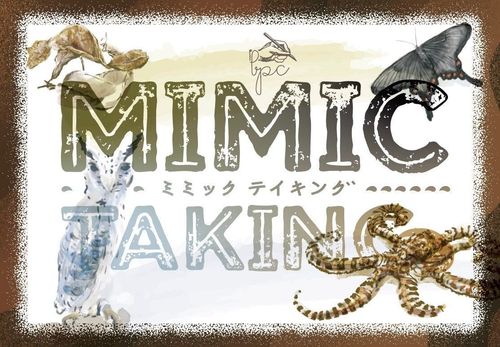
Mimic Taking
Mimic Taking Rulebook
Table of Contents
Table of Contents
Overview
Each player stands for a creature that mimics. The goal is to use your ability of mimicry to "mimic" more and more. At the end of the game, the player with the highest score will be able to defend themselves from their natural enemies as the superior mimicry creature. This game is a must-follow trick-taking game. In each round, players perform tricks until only one card is left in each player's hand. The goal is to score points by eliminating the difference in the number of colored cards you get. The winner is the player who scores the most points by playing rounds according to the number of players.
Contents
36 number cards 9 cards, numbered 1 through 9, each of 4 mimics (colors).
- Mimic octopus (Orange)
- Epicopeia hainesii (Brown)
- Uroplatus phantasticus (Purple)
- Northern white-faced owl (Gray)
4 mimic cards 1 point chart card 1 lead card 1 rule book
In addition to the above, you need a piece of paper and writing utensils to record your scores.
Before the games
This game can be played by 3 or 4 players. The number of cards to be used depends on the number of players. Prepare the cards as follows.
3 Players
Play with a total of 36 cards, including 4 mimic cards, excluding the number-9 cards of each color from the game. Each player has 12 cards in a hand.
4 Players
All number cards are used. Play with a total of 40 cards, including 4 mimic cards. Each player has 10 cards in a hand.
Game Set-Up
Shuffle the cards to be used well and deal them face down to each player equally. Keep the cards in your hand so that only you can see them. The best "mimicking" person among the players may be the lead player (the one who plays a card first). If none of the players is mimicking, choose the first lead player in any way and then start the game.
Playing the Game
In this game, several rounds (see below) are played depending on the number of players. A round consists of several turns, called "tricks". Tricks are played in accordance with the following rules.
- Starting with the lead player, each player plays one card in clockwise order.
- The lead player plays a card of their choice from the hand.
- Every player after that must play a card of the same color as the card played by the lead player, as long as they have one. (Must Follow)
- If you have multiple cards of the same color as indicated by the lead player, you can play any of them.
- If you don't have a card of the same color as the one played by the lead player, you can play any card you want.
- After everyone has played one card each, the winner of the trick is determined.
Winning Conditions
If the trump card (see below) is not on the field, the player who plays the card of the same color as the lead player's card and whose number is closest to the lead player's card wins. If there are more than one closest numbers, the player who plays the card later wins.
Example 1 (lead player's card: 4): the difference (from the number-4) of the number-6 is 2, an even gap. The number-2 wins since it was played later than the number-6.
The card with the same number as the card played by the lead player becomes the trump card.
If there is more than one player who played a trump card, the player who played it later wins. (Example 2)
Example 2 (lead player's card: 4): this card wins, because this trump card was played later than the other trump card.
If no trump card is on the field and no one plays the same color as the card played by the lead player, the lead player wins. The winner takes all the cards on the field, turns them face down, and puts them in a stack close at hand.
Point
If you win a trick with a trump card, you can select any number of cards on the field, and stack them face down close at hand. The cards that are not selected are removed from the game during the round, by turning them face down and setting them aside.
Note: Do not look at the contents of the cards in the stack close at hand that you have already won.
The player on the left of the winning player becomes the new lead player and starts playing the next trick.
This is repeated until all players have one card left in their hands. Then the round ends, and the score calculation starts.
Scoring
Before starting the score calculation, you should choose whether you want to add the one card left in your hand to the cards in the stack you took in the winning tricks. If you choose to add the card, it is now considered as a card in your stack. If not, you should set aside the card, and it is not considered in the scoring.
Next, each player reveals the face-down cards in the stack, separates them by color, and arranges them so that the number of cards is clear. If you have a mimic (see below), add it to one of the colors you have in your card stack.
Count the number of cards of the color you have the most and that of the color you have the least.
Compare the two and the difference is your negative score.
Memo: The smaller the difference between the two colors can be, the better your mimicry is.
The winner of the last trick in the current round becomes the first lead player in the next round.
Scoring Examples
The examples in the rulebook show the stacks as card figures, with these notes:
- Example A: "The color you have the most of" and "The color you have the least of"; 4 - 1 = 3, minus 3 points.
- Example B: "The color you have the most of" and "The color you have the least of (zero)"; 4 - 0 = 4, minus 4 points.
- Example C: 4 - 4 = 0; 3 colors, 0 difference, plus 10 points.
- Example D: No cards taken in the stack; 0 color, 0 difference, 0 points.
Mimic
"Mimic" is a special card. It can be played on the field even if the card of the same color as the card played by the lead player is in the hand.
- Mimics are not considered in trick's winning conditions. It is treated as if there are no numbers. When calculating the score, it is treated as one of the colors in the stack you took in the winning tricks.
- When a trick is started with a mimic, the next player can play any card they want. The subsequent players must play a card of the same color as that one.
- If all players play mimics, the player who plays the last card wins.
- When calculating the score, the score is zero if there are only mimic cards in your stack that you won in the tricks.
Game End
The game ends when the rounds corresponding to the number of one player are over.
- 3 players: 5 rounds
- 4 players: 4 rounds
Total the points scored, and the player with the most points is the winner of the game. If there are more than one players with the most points, share the victory.
Perfect Mimicry Bonus
Compare the number of cards of each color, and if all of them have the same number of cards, score the following points.
- 0 colors (no cards taken): 0 pt
- 2 colors: 5 pt
- 3 colors: 10 pt
- 4 colors: 15 pt
Variant
For clearer mimicry, you may change the rules as follows by common consent.
The winner of the trick takes cards on the field and places them face up, not face down, in a row by color on the table.