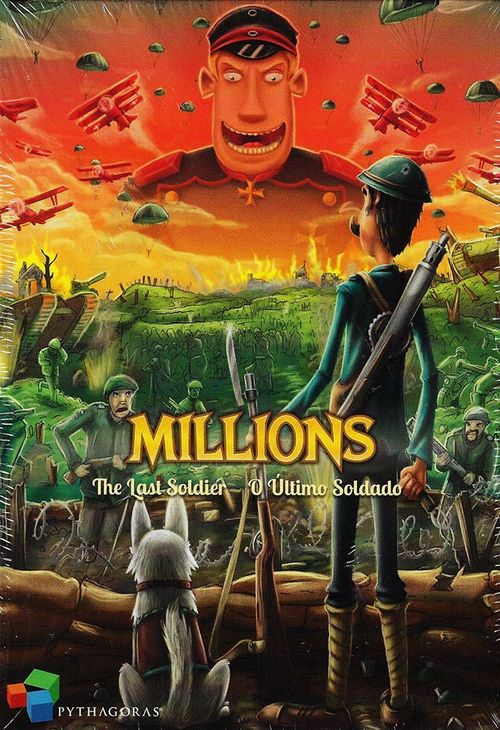
Millions: The Last Soldier
Millions: The Last Soldier Rulebook
Table of Contents
Table of Contents
Contents
- 1 Game Rules
- 72 Cards, divided as such: 60 Power Cards | 12 Points Cards
Goal
In this game you will take on the role of a General in charge of leading Soldier Millions.
Use your Power Cards at the most appropriate time so as to win the Battles. Stay clear from the Red Baron, a brilliant acrobat and pilot, who will not hesitate to fire negative points towards you.
The player with the Most Number of points after 12 rounds is the winner.
Layout of the Cards
Power Cards
- Power of the card
- Illustration (see curious facts on pages 21 and 22)
Points Cards
There are two types of Points Cards:
- 8 Battles (awarding the player with positive points);
- 4 Red Barons (awarding the player with negative points).
Battle Card
- Points
- For information purposes only
- Illustration
Red Baron Card
- Points
- Illustration
Preparing the Game
Setup
Each player selects one colour and gets the corresponding 12 Power Cards with scores from 1 to 12.
When there are less than five players the remaining Power Cards are kept inside the box.
All Points Cards must be shuffled and piled together face downward on the table.
The Points Cards are then placed in the area marked with the blue colour.
During the Game
The competition takes place in rounds and each round is divided into 4 parts: sunrise, attack, sunset and night. All players play at the same time during 12 rounds. Each part is described hereinafter.
1. Sunrise
In the beginning of each round a Points Card must be turned over. This card may turn out to be a Battle Card or a Red Baron Card.
The players will compete for a Battle Card.
2. Attack
Each player selects one Power Card from his own hand of cards and places it face downward in front.
When all players have selected their cards these are revealed at the same time.
3. Sunset
At this stage of the game the winner of the Points Card is checked and revealed.
Battle Cards (Positive Points)
These cards are attributed to the player who deals the Power Card with the HIGHEST score.
Carol has dealt the Power Card with the HIGHEST score. She wins the Battle Card which is worth 2 points.
Red Baron Cards (Negative Points)
These cards are attributed to the player who deals the Power Card with the LOWEST score.
Peter has dealt the Power Card with the LOWEST score. He is attributed the Red Baron Card which is worth -3 points.
Partial Tie
Whenever two or more players deal Power Cards with the SAME SCORE these are not taken into account.
Competing for a Battle Card
Jack and Carol have dealt the Power Cards with the HIGHEST score. As they are now tied their cards are not considered. Mary wins because she played the second card with the HIGHEST score.
Competing for a Red Baron Card
Jack and Mary have both dealt the Power Cards with the LOWEST score. As they are now tied their cards are not considered. Peter wins because he played the second card with the LOWEST score.
Overall Tie
When there is an overall tie amongst all the players their cards are kept on the table and the game fasts forward to the next round. A new Points Card is turned over and the players start competing for the 2 cards.
The players are competing for a Battle Card (7 - 2 = 5). During the second attack, Carol has dealt the Power Card with the HIGHEST score. She wins both Points Cards on the table.
Attention
When the sum of the two Points Cards:
- IS POSITIVE – the players compete for a Battle Card;
- IS NEGATIVE – the players compete for a Red Baron Card;
- IS EQUAL TO 0 – the players compete for a Battle Card.
NOTE: when an overall Tie occurs during the last round the Points Card is not attributed.
4. Night
At the end of each round all the players collect their Power Cards (which are not used again) and place them face upward in a pile in front. The only visible side belongs to the last card used in the previous round. The procedure is the same for the Points Cards.
A new round begins...
Pay attention to the way Mary organises her game.
The diagram shows Mary's arrangement: the Points Cards area, the area where she places her Power Cards during the attack at sunset, and the arrangement of her Power Cards and Points Cards.
End of the Game
After 12 rounds there are no more cards to play. Each player is then responsible for ADDING UP the positive points (Battle Cards) from which the negative points must be SUBTRACTED (Red Baron Cards). The player with the HIGHEST score wins.
Carol got 3 Points Cards: 2 Battle Cards and 1 Red Baron Card. Scoring: 8 + 3 - 2 = 9 points.
Important
When the game ends and two or more players have the same final score the winner is the one whose Battle Card indicates the HIGHEST score.
Historical Notes
The printed rulebook closes with background notes on the setting and the historical figures referenced by the cards. They are transcribed here for completeness.
World War I
This was the very first global conflict and lasted for four years (1914 – 1918). The spark which ignited the war was the assassination of Archduke Franz Ferdinand, the heir to the Austro-Hungarian throne.
The signing of the Treaty of Versailles (1919) represented the official end of the conflict and brought about the League of Nations.
The Imperial War
World War I was a conflict of empires which were mainly fighting for control of the Asian and African markets.
- Russian Empire – Nicholas II
- British Empire – George V
- German Empire – Wilhelm II
- Austro-Hungarian Empire – Francis Joseph I
- Ottoman Empire – Mehmed V
Sargent Stubby
Sargent Stubby was a war dog promoted to Sargent that received several military decorations in recognition for services rendered.
Pigeons and horses were also frequently used in several tasks especially in carrying and distributing messages or in pulling pieces of weaponry.
Trench Warfare
Trenches are a type of excavation about two meters deep (6.6 ft) and several kilometres wide where mice and rats often accumulated to feed from the bodies of dead soldiers.
As food was very scarce soldiers depended upon their resourcefulness to reprocess and avoid starvation. The bread that came in hard and stale was soaked into cold water and then roasted. Fed up with eating corned beef the Portuguese soldiers started stealing produce and farm animals such as chickens from neighbouring communities.
Valongo de Milhais – Aníbal Augusto Milhais (Soldier Millions), 1895 – 1970
This soldier, of humble origin, fought in World War I as he was drafted into the Portuguese Expeditionary Corps.
His name would forever be remembered for his deeds during the Battle of La Lys, in April 1918. Armed only with a Lewis machine gun he fought alone against several regiments of German soldiers.
His bravery allowed the retreat of Portuguese and Scots. He also saved a doctor from the swamps. In fact, it was this officer who reported the Portuguese Soldier's brave actions to the headquarters.
He was the only Portuguese soldier to have been awarded the Military Order of the Tower and of the Sword and of Valour, Loyalty and Merit on the battlefield. His captain, Ferreira do Amaral, would immortalise the soldier by describing him as so: "Your name is Milhais, but you are worth millions".
Breslau – Manfred Albrecht von Richthofen (The Red Baron), 1892 – 1918
Manfred Albrecht von Richthofen, of noble origin, fought during World War I with the cavalry and, from 1915, with the Luftstreitkräfte (German Army Air Service).
The beginning of his career as a pilot was not easy. However, through experience and study he adopted a fight tactic that made him the pilot with the most number of victories in the History of Aviation. He is still called "the Ace of Aces". His most renowned victory was over the dreaded British pilot, Lanoe Hawker.
The Red Baron died in April 1918 near Amiens.