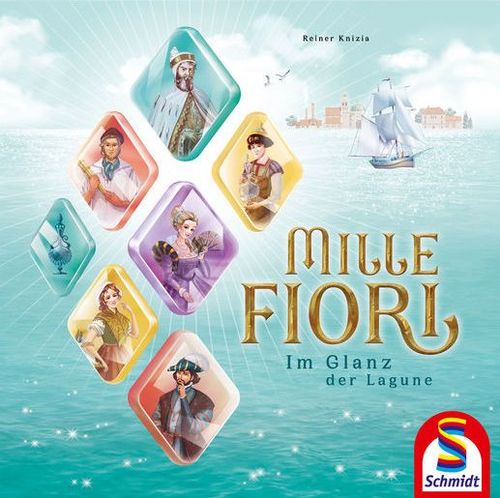
Mille Fiori
Mille Fiori Rulebook
Table of Contents
Table of Contents
Game Setup
-
Lay the playing board out in the middle of the table.
-
First, find the Doge card among the 110 cards and remove it from the pack. Then shuffle the remaining cards and place them face down next to the playing board as a draw pile.
Depending on the number of players, turn over the number of cards indicated and place them face up next to the playing board:
- 2 and 4 players: 9 cards
- 3 players: 4 cards
-
Each player chooses a color and takes the following materials in their chosen color:
a. 30 transparent diamonds (per color). Place 27 of these diamonds in front of you as your personal supply. Return the three remaining diamonds in each color to the box (you may need these at the end of the game).
b. 1 ship (per color). Place your ship on the starting space for the trade route.
c. 1 points marker (per color). Place your points marker on space 0 (100) of the points bar.
-
The player with the fullest glass is the starting player and takes the Doge card.
You're now ready to start playing.
Card Features
- Card color: Shows which area of the playing board you may fill one space in.
- Number in the ship's wheel: Indicates how far you're allowed to sail with your ship when you use the card to navigate the sea route. (Alternative move — see below.)
- Symbol: Determines which spaces you're allowed to fill on the playing board.
- Points: The symbols at the bottom of the card reveal how many points you earn for filling a space.
- Points for your fellow players: Some of the cards feature this symbol. It means that when you earn instant points, not only the active player but also fellow players earn points.
The Areas on the Playing Board
- Workshops
- Residences
- Trade
- Townspeople
- Harbor
How to Play the Game
You play several rounds.
At the start of each round, the starting player deals five cards to each player turned face down.
Now all players pick up their face down cards and select one card to keep in their hand. Place the remaining cards face down in front of your left-hand neighbor.
The starting player begins and plays their hand card, face up.
In most cases, you place one of your diamonds on an empty space in the color of the card you just played. You immediately earn points for this in return (which you use to move your points marker forward on the points bar) and possibly also additional bonuses (a point bonus and/or an extra card).
Where exactly you can place your diamond, how many points you will earn for it, and when you earn a bonus is described in the following pages (The areas).
When you've finished your turn, put your card face up on the discard pile. If there is no discard pile, build one. It is then your left-hand neighbor's turn.
Once each of you has played your chosen card in turn, pick up the cards in front of you. Select one card again from among these cards, exactly as described previously. Pass the remaining cards again to your left-hand neighbor and play your chosen card again in turn, beginning with the starting player.
Repeat this procedure in turn until you only have one card left to pass on to your left-hand neighbor. Do not pass this last card on! Instead place it face up next to the playing board together with the other cards once all of the players have finished making their turns.
The round has now ended. The starting player passes the Doge card on to the next player (clockwise direction). This player then becomes the new starting player and begins a new round as described.
The game ends
- at the end of the round in which the draw pile is used up
- or at the end of the round when a player places the last of their diamonds from their personal supply on the playing board during their turn.
See "End of the Game" for more details.
Special Rule for the 2-Player Game
If you're just two players, you only play three out of five cards in each round. So you place the last two cards face up next to the playing board.
The Areas
Workshops
This is where you'll find the raw materials for the glass manufacture: Quartz, Ash, Lime, and Pigments.
Placement: In this area, place one of your diamonds on one free space featuring the symbol on your card. You're always free to choose from all of the free spaces featuring the symbol played. So you can place your diamonds next to free spaces or other diamonds (your own or of fellow players).
Instant points: After placing a diamond, you immediately earn one point for the space you've just filled and one point for each of your diamonds that are connected to each other.
If you fill a pigment space with the card you've just placed, you even earn two points per space!
Example: Blue has 3 connected diamonds and earns 3 points for this. Example: Blue has 4 connected diamonds and the space they just filled is a pigment space. So Blue earns 8 points for this.
Point bonus: As soon as you've filled spaces featuring each of the four different raw materials at least once, place one of your diamonds on the space featuring the highest available number of this area on the playing board to earn a point bonus. Immediately move your points marker forward by as many spaces as indicated on the space you just filled. The sooner you achieve this bonus, the more points you earn. You can only receive this bonus once per game.
Extra card: Whenever you fill the third and last space around one of these symbols, you may immediately play an extra card. To do this, select one of the cards lying face up next to the playing board and play it exactly as if you had played it from your hand. So place one more diamond on the playing board, earn points and possibly other bonuses, and then place the card on the discard pile. You can perform whole series of turns in this way.
Beware! The extra card is always awarded to the player to fill the last free space. It doesn't matter who filled the other two spaces.
Residences
This area shows the islanders' residences.
Placement: In this area, place one of your diamonds on the next free space of the residence bar. Start at the very beginning of the residence bar (on the space above the arrow) and gradually fill the spaces in the direction of the arrow. You're not allowed to skip any spaces.
Instant points: You immediately earn the number of points indicated on the respective space. If the new diamond is directly connected to one or more diamonds of your color, you earn all of the points indicated on the other connected diamonds of your color, too.
Example: You've just filled a space worth 5 points and you also filled the two spaces ahead of this with diamonds in your color. So you earn a total of 12 points (4 + 3 + 5).
Point bonus: As soon as you've filled spaces featuring four different numbers (connected or not), place one of your diamonds on the space featuring the highest available number of this area on the playing board to earn the point bonus. Immediately move your points marker forward by as many spaces as indicated on the space you just filled. The sooner you achieve this bonus, the more points you earn. You can only receive this bonus once per game.
Extra card: As soon as you've filled spaces featuring three different numbers (connected or not), you may immediately play an extra card. To do this, select one of the cards lying face up next to the playing board and play it exactly as if you had played it from your hand. So place one more diamond on the playing board, earn points and possibly other bonuses, and place the card on the discard pile. You can perform whole series of turns in this way.
You earn an extra card one more time when you've filled spaces featuring five different numbers.
Townspeople
The different townspeople are represented in this area. The townspeople are divided into two groups, the Nobili and the Populi. The two groups are arranged in their own pyramid, each of which features three different symbols (Lion, Coin, Cross for one; Fish, Shell, Crab for the other).
Placement: Place one of your diamonds on one free space in the pyramid in the color of the card you played. You're not limited to the symbol shown on the card you're playing. So you may also place your diamond on another symbol in this pyramid. You'll earn more points if they match though — see the "Instant points" section below for details.
Every pyramid consists of three levels and must always be built from the bottom up. So you can only place your diamond in the next level up if the two spaces directly below it have already been filled.
Example: The two spaces in the bottom level have already been filled. So Red can place their diamond on the cross in the second level. Red can place their diamond on the cross although they played a card featuring a coin.
Instant points: You immediately earn one point for filling a space on the bottom level, three points on the second level, and six points on the third level. If you fill a space featuring the symbol on the card, you receive double the number of points.
In addition, if the just placed diamond forms a triangle (of 2 or 3 levels), all players who have filled spaces in this triangle earn points for their diamonds, i.e., one point for each diamond on the bottom level and three points for each diamond on the second level. These additional points are never doubled though.
Example: Red has filled the space on the third level featuring a coin. They used a matching card (coin) for this and so receive double the points for this space. Red therefore earns 12 points (2× 6). The just placed diamond forms a triangle, so all players also receive points for their diamonds within the triangle. Red and Green therefore earn 4 additional points each (3 + 1) and Yellow earns 1 additional point. Blue doesn't earn any additional points because the diamond just placed doesn't build a triangle featuring the blue diamond.
Point bonus: As soon as you've filled each of the three different symbols on a pyramid at least once, place one of your diamonds on the space featuring the highest available number of this area on the playing board to earn the point bonus. Immediately move your points marker forward by as many spaces as indicated on the space you just filled. The sooner you achieve this bonus, the more points you earn. You can receive this bonus once for each of the two pyramids.
Extra card: Whenever you fill one of the spaces on the top row of a pyramid, you may immediately play an extra card. To do this, select one of the cards lying face up next to the playing board and play it exactly as if you had played it from your hand. So place one more diamond on the playing board, earn points and possibly other bonuses, and place the card on the discard pile. You can perform whole series of turns in this way.
Trade
This area shows four different commodities: Glasses, Carafes, Jewelry, and Swans.
Placement: You may place one of your diamonds on one free commodities space featuring the symbol on your card.
Instant points: After placing a diamond, you must first determine the value of this commodity. To do this, count how many spaces featuring this commodity have already been filled. It is irrelevant which player has filled the spaces. This sum is the commodity value and indicates how many points each individual diamond is worth.
All players who have diamonds on this commodity earn as many points for each of their diamonds as the commodity is worth.
Example: Red fills a space featuring a carafe. The carafe is worth 3 points. Red has filled 2 spaces featuring carafes, so earns 6 points. Yellow has filled 1, so earns 3 points.
Point bonus: As soon as you've filled spaces featuring each of the four different commodities at least once, place one of your diamonds on the space featuring the highest available number of this area on the playing board to earn the point bonus. Immediately move your points marker forward by as many spaces as indicated on the space you just filled. The sooner you achieve this bonus, the more points you earn. You can only receive this bonus once per game.
Example: Red has filled spaces featuring all of the different commodities. Yellow has already filled the space featuring the number 20, so Red puts one of their diamonds on the space featuring the number 15.
Extra card: Whenever you help one of your fellow players to get a "good deal", you may immediately play an extra card. A deal is deemed good if at least one of your fellow players has more diamonds on this commodity than you do after you've placed your diamond (a tie is not sufficient here). Your fellow player therefore earns more points from your move than you do. You may immediately play an extra card by way of reward. To do this, select one of the cards lying face up next to the playing board and play it exactly as if you had played it from your hand. So place one more diamond on the playing board, earn points and possibly other bonuses, and place the card on the discard pile. You can perform whole series of turns in this way.
Example: Red fills a space featuring a swan. Blue has already filled two spaces featuring a swan, but Red only one. Red may therefore play an extra card.
Harbor
This area stands for the transport of glassware to the rest of Europe.
Placement: You may place one of your diamonds on one free ship space. In addition, you may move your ship forward on the sea route by as many spaces as the number indicated on the card.
Example: Green plays a ship card featuring the number 4. Green first places a diamond on a free ship space in the harbor, then moves their ship forward four spaces on the sea route.
Instant points — Ship spaces: You do not always earn points immediately for filling a ship space. Only when the fleet is complete — so when all three spaces in a line have been filled — do the ships depart and earn the players involved points. Each involved player receives points for every diamond of their color in the fleet.
How many points each diamond in the fleet is worth depends on how many commodities spaces (in the trade area) are filled in the same line. It is irrelevant which player has filled the commodities spaces.
- 1 commodity: 1 point per diamond
- 2 commodities: 3 points per diamond
- 3 commodities: 6 points per diamond
- 4 commodities: 10 points per diamond
Example: Green fills the last free ship space in a fleet. Three commodities spaces have now been filled in this line. The fleet departs and transports three different commodities. Green has filled two of the ship spaces so earns 12 points (2× 6). Red has filled one of the ship spaces so earns 6 points (1× 6).
Instant points — Sea route: If your ship lands on a space featuring a number, you also earn as many points as the number on the space. You do not earn points or bonuses for spaces that your ship passes.
Example: Green lands their ship on a space featuring a number 5 and earns 5 points for this.
Extra card: Whenever your ship lands on a space featuring the bonus symbol, you may immediately play an extra card. To do this, select one of the cards lying face up next to the playing board and play it exactly as if you had played it from your hand. So place one more diamond on the playing board, earn points and possibly other bonuses, and place the card on the discard pile. You can perform whole series of moves in this way.
Example: Blue lands their ship on a space featuring a bonus symbol and may immediately play an extra card.
Last space: On the last space of the ship's route, you earn points and an extra card. You cannot move beyond the last space; any remaining spaces are forfeited.
If you're already on the last space, you may continue to play ship cards, but you do not move your ship any further and therefore do not earn any more points or extra cards on the sea route.
Alternative Move
In addition to a symbol, each card also features a value from 1 to 5 in the top corners.
Instead of using the card as described previously, you may use any card to move forward on the sea route. In this case, you only use the number indicated and move your ship forward as many spaces on the sea route.
Note: The card's color and symbol are irrelevant in this case. You also cannot use this alternative move to fill any ship spaces.
You then earn points immediately or may play an extra card, as described above. Discard the card as usual afterwards.
Example: Blue plays a townspeople card, but then doesn't use it to place a diamond into the pyramid, but rather to move their ship forward. Blue moves their ship forward three spaces. They land on the space featuring the number 10 and earn 10 points. Then they discard the card. Since this card is now out of the game, it is no longer possible to fill all the spaces in the pyramid.
Note: Each card is available exactly as many times as there are corresponding spaces on the playing board. If you use a card for an alternative move, the card is out of the game and the corresponding area can no longer be filled completely.
Note on the Extra Cards
The cards placed face up next to the playing board are replenished over the course of the game. The last cards in each round are placed face up. So you'll need some space here! If there are no face up cards, you cannot play an extra card.
Play Variations
If you'd like more of a tactical game, you can also agree before the start of the game not to decide which card to keep in your hand at the same time, but rather only when it's your turn. This gives you more of an opportunity to react to your fellow players' moves. Bear in mind, however, that this can significantly increase the play time!
End of the Game
The game can end in one of two different ways.
- When the starting player deals the last cards in the draw pile at the beginning of the round, you still play the round to the end. The game then ends after that.
- When you place your last diamond on the playing board during your turn, you finish your turn first. If you're allowed to play one or more extra cards, you may do so using the diamonds that you returned to the box at the start of the game. After this, all of the players who have not yet played their last selected card may still make their turn as usual.
The game then ends and the player with the most points is the winner.
Should there be a tie, you can rejoice together at having established the most successful glass dynasties in the lagoon.
This game edition has been revised by the publisher and therefore differs in parts from the original version by Reiner Knizia.