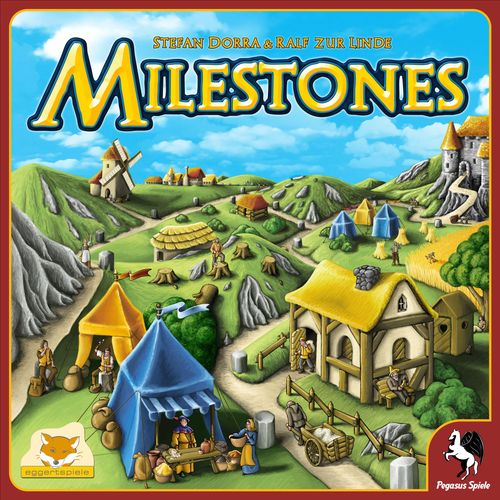
Milestones
Milestones Rulebook
Table of Contents
Table of Contents
Object of the Game
The object of the game is to gain the most victory points. You get victory points by building streets, houses, and marketplaces on the main game board, by delivering flour sacks to the marketplaces, and by collecting bonus tiles. Each player counts his victory points by moving his own marking piece up the score track on the main board.
Components
- 1 game board
- 4 player boards
- 35 worker tiles
- 21 cover tiles
- 4 playing pieces, 1 of each player color
- 4 marking pieces, 1 of each player color
- 12 flour sack tiles
- 24 coins
- 48 goods cubes — 12 each of stone, wood, sand, and grain
- 48 street pieces
- 24 milestones
- 12 marketplaces
- 12 houses
- 15 bonus tiles
The Player Boards
The player boards are the heart of Milestones. Each player has his own board. The spaces of each player board form a loop along which the player moves his playing piece.
The loop consists of 2 parts:
-
On the 8 upper employment spaces you may employ workers that give you goods:
- Quarryman = stone
- Lumberjack = wood
- Sand worker = sand
- Grain grower = grain
- Coiner = coin
-
The 4 lower building spaces allow you to take actions such as hiring new workers, building on the main game board, or delivering grain.
Building spaces: castle, mill, board of works, trading house.
Note: Each worker shows a number between 1 and 8. If you manage to arrange your workers in an ascending sequence of numbers from left to right, you receive additional income during the game. But it is not mandatory to comply with an ascending sequence of numbers!
Setup
-
Put the game board in the middle of the table.
-
Form separate supplies for each of the 5 kinds of goods: stone, wood, sand, grain, and coins.
-
Form separate supplies for the houses, street pieces, milestones, marketplaces, and flour sack tiles.
-
Take one of the marketplaces and place it onto the white market stall above the grainfield on the game board. This is the starting point of your colonization.
-
Shuffle the 15 bonus tiles face down and put a random tile onto each triangle space of the board that shows a bush. Then turn all bonus tiles face up.
-
Give each player a player board.
-
Each player chooses a color and receives the corresponding playing piece, which he places onto the castle on the left side of his player board.
-
Take the marking pieces of each player's color and stack them on the "0" space of the score track.
-
Give each player 1 coin from the supply as starting capital. Place your coin below your player board.
-
Place the 20 cover tiles nearby as a general supply.
-
Shuffle the 35 worker tiles and place them face down in a draw pile. Then turn 5 tiles face up and place them in a row. These form the general worker tile display.
-
According to the number of players, uncover additional worker tiles from the pile and display them in a separate row.
- in a 2-player-game: 5 tiles
Tips on selecting tiles in the first game: For now, only consider the numbers on the tiles! Try to choose and place them in an ascending sequence of numbers from left to right (equal numbers in succession are also considered ascending). Also pay attention to the following: the lower the numbers on a tile are, the farther to the left it should be placed, the higher the numbers are, the farther to the right the tile should go.
Playing the Game
The starting player (the player who was last to choose his starting tiles) begins. Then play continues in a clockwise direction.
When it is your turn, you must move your playing piece twice along the spaces of the loop on your player board. Each move must be in a clockwise direction and end on a space of your choice. Depending on the kind of space, you get goods or are allowed to perform certain actions. You may end a move on a space without performing any action there. After your second move, your playing piece simply remains on the last space visited.
To keep track of whether you already moved twice in your turn, we recommend the following: after your first move leave your playing piece upright. After your second move lay it down, since it is "tired".
Usually you are allowed to move your playing piece as many spaces forward as you want.
STOP! There is one exception: On the castle you must always stop!
The Spaces of the Player Board
The Worker Spaces
When moving your playing piece to a worker space, you get goods from the general supply. Each time you move you can only get one kind of good. The kind depends on the worker space you stop on. Of this good, you get a number equal to the number of workers of the same kind that you visited during your move. This means, you get 1 good for:
a) the worker, on which you stop, and
b) every worker of the same kind, that you pass in that same move.
You can store your goods below your player board.
Example: First, Philipp moves his playing piece from the castle to the quarryman with the 5. This gives him 2 stone cubes (1 stone for the quarryman he passed and 1 stone for the one where he stops). Second, he moves to the coiner with the 5, which gives him 1 coin. (He does not get a coin for the coiner with the 3, since he did not pass him in the same move.)
The Trading House
When you move your playing piece to the trading house, first check to see if you receive income: If the numbers on your workers form an ascending sequence from left to right, you get 1 coin from the supply. (Equal numbers in succession are also considered ascending!) If the sequence of numbers is not ascending, you get nothing.
Example of an ascending sequence: 3, 3, 6, 7 → 1 coin.
Example of a non ascending sequence: 8, 8, 6, 7 → no coin.
You may then perform one or more of the following actions in the order of your choice:
1. Hire workers (1x)
You may buy one of the 5 worker tiles from the general display. Each tile shows 2 workers and costs exactly 2 coins. Return the 2 coins to the supply and place the tile you bought onto 2 employment spaces of your choice on your player board. You may cover other workers and empty employment spaces. Differences in height can be leveled out by using cover tiles. You may not place workers left or right of the 8 employment spaces. Once the tile is placed, it may not be moved later.
After you bought the tile, take the top tile from the draw pile and place it face up in the general display, so that there are always 5 tiles displayed. When the draw pile is exhausted, no more tiles are added to the display.
Example: Philipp pays 2 coins and buys the double lumberjack tile from the display. He chooses to place it to the left of the lumberjack that he already has. To level out the difference in height, he puts a cover tile underneath and then places the acquired worker tile on top of it and the quarryman with the 5.
2. Buy goods
You may take as many goods cubes from the supply as you want. For each goods cube you take, you must pay 2 coins.
3. Sell goods
You may take as many coins from the supply as you want. For each coin you take, you must return any 2 goods cubes to the supply.
The Board of Works
When you move your playing piece to the board of works, you may perform as many construction actions as you want (you may take the same action more than once). For each construction action, you must return the requested goods to the supply.
There are 3 construction actions:
1. Build a street section
By returning 1 stone cube and 1 sand cube to the supply, you can build a street section.
Each street section consists of exactly 2 street pieces that are placed onto the lines of the game board, as well as 1 milestone that is put onto the number between them. This immediately gives you victory points equal to the number that the milestone is placed on.
The very first street must begin at the marketplace above the grainfield on the game board. Each newly built street section must either continue at the end of an existing street (the number between the existing street and the newly built street section stays empty) or begin at a marketplace (streets can only branch off at marketplaces). A street section may not be built to intersect an existing street and thereby form a loop. Loops are not allowed!
Example: Philipp returns 1 stone cube and 1 sand cube to the supply and builds a street section (red framed). He continues at the end of the existing street by placing 2 new street pieces and 1 milestone between them. This gives him 2 victory points on the score track. He would have been allowed to let the street section branch off from the marketplace but neither from the upper "2" nor from the milestones. Placing the street pieces to create a loop would not have been allowed either.
2. Build a house
By returning 1 stone cube and 1 wood cube to the supply you can build a house. A house must always be placed within a free triangle lot which has a street on at least one of its edges.
Each triangle can only accommodate one house.
Building a house immediately gives you victory points equal to the sum of all uncovered numbers at the corners of the triangle.
It is allowed to build houses within triangles showing a bush.
Example: Philipp returns 1 stone cube and 1 wood cube to the supply and builds a house within the red-marked triangle. This gives him victory points equal to the sum of the 2 uncovered numbers at the triangle's corners (2+1=3). If he built the house into the blue-marked triangle, he would not get any victory points, since there is no uncovered number left at its corners.
3. Build a marketplace
By returning 1 wood cube and 1 sand cube to the supply you can build a marketplace. A marketplace is always placed onto a free number that is either located at the end of a street or between 2 street sections. This immediately gives you victory points equal to the number that the marketplace is placed on.
Example: Philipp returns 1 wood cube and 1 sand cube to the supply and builds a marketplace onto the free number between the 2 street sections. This gives him 2 victory points on the score track. If he built the marketplace at the end of the street, he would only gain 1 victory point (blue circle).
Note: When you perform several construction actions, you can choose in which order to perform them. In this way, for example, you can start by building a house and gain victory points for a free number, which you then cover by building a marketplace or milestone (also giving you victory points, of course).
The Bonus Tiles
There are bonus tiles on some of the triangle lots. You can pick up a bonus tile by building in the triangle or at one of the corners of the triangle.
To pick up a bonus tile, you have to meet the following conditions:
- The bonus tile must be placed onto a worker of the same kind on your player board.
- On each worker there can be only one bonus tile.
- If you do not have a free worker of the same kind as the bonus tile, you are not allowed to pick up the bonus tile!
If you meet those conditions, you may pick up the bonus tile when you place a milestone or a marketplace onto one of the 3 corners of the triangle or build a house within the triangle with the bonus tile.
Important: If you do not meet the conditions, you are not allowed to build a house within a triangle with a bonus tile. Milestones, marketplaces, and street pieces, however, may be built at the edges and corners of the triangle. The bonus tile then simply remains in place and may be picked up during a later construction action.
Bonus tiles give additional victory points and count for the final scoring (they never give additional goods):
- When you pick up a bonus tile and place it onto a worker on your player board, you immediately gain 1 victory point on the score track.
- Every time a worker with a bonus tile produces a good, you receive that good and in addition 1 victory point.
Example: Philipp moves his playing piece from the quarryman with the 1 to the lumberjack with the 5. This gives him as usual 3 wood cubes. He also gains 1 victory point for the lumberjack bonus tile he passed in his move.
- At the end of the game, a final scoring takes place in which victory points are awarded for majorities in the different worker categories (quarrymen, lumberjacks, etc.). During this scoring, the bonus tile increases the value of the worker on which it is placed (see section "End of the Game").
Important: If you cover a worker space on which a bonus tile is placed, the bonus tile is removed from the game!
The Mill
When moving your playing piece to the mill, you may supply any number of free marketplaces with 1 flour sack each.
To supply a marketplace, you must return 2 grain cubes to the general supply. This gives you 1 flour sack tile that you must immediately put onto a free marketplace of your choice.
Important: Marketplaces on which there is already a flour sack may not be supplied again for the rest of the game.
Supplying a marketplace gives you immediately:
a) victory points equal to the sum of 2 uncovered numbers of your choice that are directly adjacent to the supplied marketplace and
b) 1 coin from the general supply.
Example: Philipp returns 2 grain cubes to the supply. He then takes a flour sack tile and puts it onto a free marketplace of his choice. There are 4 uncovered numbers directly adjacent to the marketplace. Philipp may choose 2 of them. He chooses the "3" and the "4". Therefore, Philipp gains 7 victory points. He also receives 1 coin from the supply.
The Castle
You must always stop on the castle.
If you have accumulated too many goods, you must hand one or more of them over to the lord of the castle. He also demands that you place one of your workers into his service.
So, on the castle you always have to do 2 things:
1. Reduce goods to a maximum of 3
If you have more than 3 goods (including coins), you must reduce their number to a total of 3 and return the rest to the supply.
2. Cover 1 worker
You must cover one of your worker spaces with a cover tile. (It must be a worker — not an empty employment space and not another cover tile!)
Exception: If you have only a total of 2 worker spaces left, you do not have to cover any of them.
End of the Game
The end of the game is triggered as soon as the marking piece of a player reaches or passes the target space on the score track.
The target space depends on the number of players:
- in a 2-player-game: space 67
- in a 3-player-game: space 59
- in a 4-player-game: space 51
The player who triggered the end must finish his turn in full. It was his last turn of the game. Then each of the other players has one more turn. (On their turn, all players must move their playing piece twice.)
Special case: When a player buys the last worker tile from the general display, he triggers the end of the game in the same way as if he had reached the target space.
Final Scoring
Once the game is finished, the final scoring takes place. Victory points are awarded for majorities in the 5 worker categories.
Each of the 5 worker categories is scored separately: quarrymen, lumberjacks, sand workers, grain growers, and coiners.
For each category check which player has the highest total value on his player board:
Each worker of that kind has a value of 1.
Each worker of that kind on which a bonus tile is placed has a value of 2.
The player with the highest total value in a category gains 5 victory points. In the case of a tie, each of the tied players gains 2 victory points. If all players have the same total value in a category, that category is not scored.
Example: Final scoring for the quarrymen
Martina has 1 quarryman with a bonus tile (total value = 2).
Dirk has 2 quarrymen (total value = 2).
Philipp has 1 quarryman (total value = 1).
Since Martina and Dirk have the same total value in the quarryman category, they both gain 2 victory points.
The other worker categories are scored in the same manner.
After the final scoring, the player with the most victory points wins the game.
In the case of a tie, the tied player with the most goods left wins.
If there is still a tie, the victory is shared.
General Notes and Special Cases
- The 5 kinds of goods (including coins) are not limited: If there are not enough goods of that kind in the supply, use other components as a substitute.
- Due to covering worker spaces, several layers of worker tiles and cover tiles pile up on the player boards. Towards the end of the game, the supply may run out of cover tiles. In that case, try to reduce the layers on your player boards without changing the spaces that can be seen from above. Return any covered worker tiles that you remove to the box.
The rest of the components are limited:
- You may only build as many street sections, houses, and marketplaces as there are in the supply.
- As soon as all 12 marketplaces are built and supplied with flour sacks, no player can supply another marketplace for the rest of the game.
- When the last worker tile is bought from the general display, the game ends (see section "End of the game").