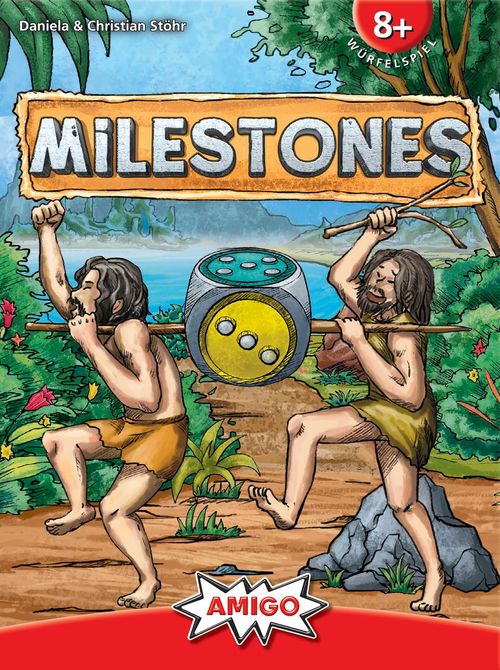
Milestones (AMIGO 2021)
Milestones (AMIGO 2021) Rulebook
Table of Contents
Table of Contents
Components
- 55 task cards
- 51 task cards in three difficulty levels: 23 easy, 19 medium and 9 hard
- 4 special tasks (used only for the variants)
- 6 dice
- 1 hourglass
Each task card shows its difficulty on the back (easy, medium or hard), and the victory points on the bottom right of the front.
Players: 2–5. Age: 8 and up. Duration: 3 minutes per game.
Game Idea and Object of the Game
Stick together! Otherwise nothing will come of the early-age milestones you want to roll as a group. Everyone knows their own goals, but the dice must be used together. Discussing is not allowed, and time runs out relentlessly. How significant will your joint success be?
In front of you lie card stacks of tasks of various difficulties. To complete as many of these tasks as possible, you share the six different dice. In turn you re-roll any number of dice, always hoping that everyone will benefit. One thing applies throughout the whole game: you may not discuss your plans! After three minutes the score is tallied. The more points you reach together with the completed tasks, the better you have played together.
Try to keep increasing your high score. And once you have got to know each other well, various variants make the game a little more demanding.
Setup
Sort the task cards by their backs, that is by difficulty: easy (symbol), medium (symbol) and hard (symbol). Shuffle each stack and place them as three face-down draw piles in the middle of the table.
Note: The four special tasks are only needed for the variants. Put them back in the box for now.
Each player takes one task into their hand. You may choose from which pile you draw your card. Keep your hand card secret at all times: do not show it to the others and do not talk about it.
The most unkempt person takes all six dice and will begin the game. Get the hourglass ready, and you can start.
The original shows a setup diagram for 4 players, with the seats labelled Barney (start player), Betty, Wilma and Fred around the three draw piles of task cards in the middle of the table, plus the hourglass and the dice.
Playing the Game
A single game lasts exactly three minutes. During this time you roll in turn, clockwise, and try to complete as many of the tasks on your hand cards as possible. At the end, you add up all the victory points you have won and determine your joint result.
To start, turn the hourglass over. At the first roll of the game, all six dice must be rolled. When it is your turn after that, you may take any number of dice, but at least one. Roll the chosen dice once more. Leave the other dice unchanged.
Communication: What Is Allowed?
Throughout the whole game you must follow these rules on communication:
- You are not allowed to talk about the task on your hand card, or to signal the others by gestures which dice result would help you, for example.
- You may not show your task card to the others.
- Only the person whose turn it is may touch the dice.
When and How Do You Complete the Tasks on Your Hand Cards?
You can complete the task on your hand at any time, even when it is not your turn. Does the dice result fully fulfil the task on your hand card? Then briefly show your card to the others and place it on your joint scoring pile. The victory points at the bottom right of the card count towards your final result.
Note: In general, a task is also fulfilled when more dice than necessary are showing. For example, the task "Three blue" is also fulfilled when four or more blue die faces have been rolled.
The following symbols appear in the tasks (examples):
- Neutral die: colour and number are arbitrary. (neutraler Würfel – Farbe und Zahl sind beliebig)
- Yellow die: number is arbitrary. (gelber Würfel – Zahl ist beliebig)
- The number 2: colour is arbitrary. (die Zahl 2 – Farbe ist beliebig)
- Same numbers within a task: colours are arbitrary. (gleiche Zahlen innerhalb einer Aufgabe – Farben sind beliebig)
- Same colours within a task: numbers are arbitrary. (gleiche Farben innerhalb einer Aufgabe – Zahlen sind beliebig)
- Consecutive numbers: colours are arbitrary. (aufeinanderfolgende Zahlen – Farben sind beliebig)
- All dice must show the depicted numbers or colours. The distribution is arbitrary; not all of the depicted numbers or colours have to be visible.
- No die may show the depicted numbers or colours.
- The task has two or more sub-tasks. Each of these sub-tasks must be fulfilled on its own. Each die may be used for only one of the sub-tasks. In addition, the sub-tasks must be fulfilled differently, for example by different colours or numbers.
Note: At the end of these rules you will find a detailed description of the individual tasks with concrete examples.
How Do You Get New Hand Cards?
When the task on your hand is fulfilled and you have placed the card on your scoring pile, you immediately draw a new hand card. You may choose freely from which draw pile you take the card. If you fulfil the new task immediately with the dice lying out, you may also place this card on the scoring pile straight away and draw another. Throughout the game you always have exactly one hand card.
Warning: Once all draw piles are used up, you can no longer draw a card. You still keep rolling for the rest of the game when it is your turn.
End of the Game
The game ends immediately when the hourglass has run out. Set aside the cards you still have in your hand. Then count the victory points on the cards of your scoring pile. The more points you have, the more successfully you have played together.
To classify your Milestones result, look at the following table:
| Points | Result |
|---|---|
| 0–9 points | That was nothing. Another game straight away – you cannot let this stand! |
| 10–19 points | A good start, but there is room for improvement. |
| 20–29 points | Respectable – you are on the best way. |
| 30–39 points | Really good. Obviously your teamwork works. |
| 40–49 points | Outstanding – that is more than worth seeing! |
| 50–59 points | Very impressive – it hardly gets any better! |
| 60 and more points | Madness! The future belongs to you! |
Variants for a More Demanding Game
With the variants described here you make Milestones more demanding bit by bit. You can play the variants individually or combine them as you like. The rules of the basic game remain in force unless described otherwise.
Variant 1: One Large Draw Pile and Discarding Tasks
Setup: Shuffle all task cards into one large draw pile, and in turn each player draws one card into their hand.
Gameplay: Play Milestones as usual. In addition, you may discard your hand card unused at any time. This card leaves the game, and you draw a new card from the draw pile into your hand for it. The task on a newly drawn card may only be fulfilled once at least one die has been re-rolled.
Variant 2: Special Tasks – Mandatory Tasks Lying Face Up
Setup: Set up the game as usual. Also place one to three of the special tasks marked with an exclamation mark (= mandatory tasks) face up in the middle of the table. You may choose which cards and card sides you use.
Gameplay: Play Milestones as usual. During the game you must fulfil every mandatory task lying out. Once the dice fulfil a task completely, remove the corresponding card and set it aside.
End of the game: If mandatory tasks are still lying out unfulfilled when the time has run out, all tasks count as not fulfilled.
Variant 3: Special Tasks – Hourglass Card for More Time
Setup: Set up the game as usual. Also place the special task with the hourglass (= hourglass card) face up in the middle of the table. You may choose which card side you use.
Gameplay: Play Milestones as usual. During the game you may fulfil the hourglass card. If the dice fulfil the task completely, you may remove the card and turn the hourglass over at that moment. You can also choose not to, and instead try to fulfil the hourglass card again later in the game in order to turn the hourglass over then.
End of the game: If the hourglass card is still lying out when the time has run out, this has no effect on your result.
Further variants and small missions can be found on the AMIGO homepage: www.amigo-spiele.de/spiel/milestones
The Milestones Tasks (Examples)
The example dice in the original rulebook are pictures; they are described here in words where they are needed.
The original shows one or more example dice sets for each of the following task types (the dice pictures themselves are not reproduced here):
- Required number of dice in the depicted colour or number (Beispiel: bzw.). You need the depicted number of dice with the corresponding colour or number. Two alternative example sets are shown, linked by "bzw." (respectively / or).
- Required number of dice with the same numbers or the same colours. You need the depicted number of dice with equal numbers or equal colours. Two alternative example sets are shown, linked by "bzw.".
- Required number of dice with consecutive numbers. You need the depicted number of dice with consecutive numbers. Two alternative example sets are shown, linked by "bzw.".
- All depicted sub-tasks, fulfilled differently. You need all the depicted sub-tasks. The sub-tasks must be fulfilled differently. Example sets are shown, including one alternative linked by "bzw.".
- All depicted sub-tasks, each die used for only one sub-task. You need all the depicted sub-tasks, and each die may be used for only one sub-task. An example set is shown.
- Only the depicted numbers may be visible. On all dice only the depicted numbers may be visible. The distribution is arbitrary; not all of the depicted numbers have to appear. An example set is shown.
- None of the depicted colours may be visible. On none of the dice may one of the depicted colours be visible. An example set is shown.
- Two number pairs with consecutive numbers. You need two pairs of consecutive numbers. An example set is shown.
- Twice two consecutive numbers, each in the same colour. You need twice two consecutive numbers, each pair in the same colour. Each sub-task must be fulfilled in a different colour. An example set is shown.