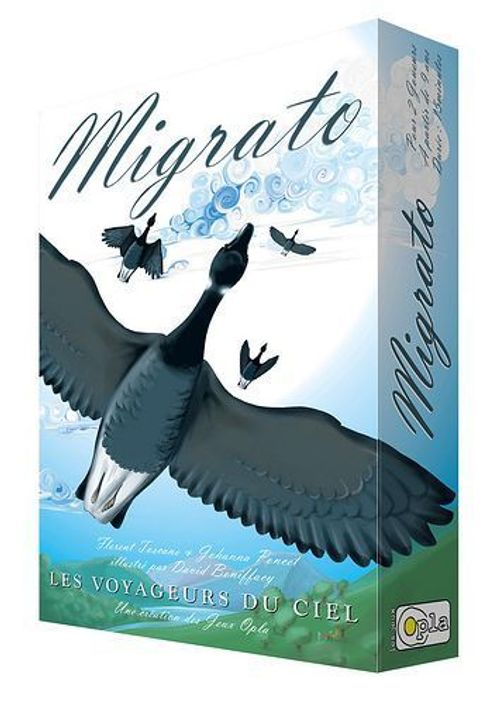
Migrato
Migrato Rulebook
Table of Contents
Table of Contents
The Contents of the Box
The game consists of this booklet and 55 cards:
49 Birds cards:
- 14 Brant cards (day and night, Objective 5)
- 11 black Milan cards (day, Objective 4)
- 11 Stilt cards (night, Objective 4)
- 8 European Bee-eater cards (day, Objective 3)
- 5 Teal cards (day and night, Objective 2)
5 Danger cards:
- 2 Hunter cards: day.
- 2 Middle-Destruction cards: day / night.
- 1 Light Pollution card: night.
1 Bird distribution card.
Card Anatomy
Type and number of birds during this phase of flight. Here, 5 Brant geese.
Migration: only diurnal birds, night only, or day and night. Here, migration day and night, night flight phase.
Number of birds possible on the cards of this type of bird. Here, the Brant geese flying at 3, 4 or 5.
Objective for this type of bird. Here, Objective 5, so it will take 5 Brant cards to reach the settlement.
How to Play
Goal of the Game
Each player must make arrive the more birds possible for different types of birds.
Placing
Mix all the Birds and Danger cards together. Distribute 3 cards to each of the two players and put the rest face down in the center of the table; this will be the pick. The players look at their 3 cards.
Playing the Game
The last player to have seen a bird in the sky begins the game. On his turn, the player chooses between the following actions (detailed on the following pages):
- Play a Birds card in his game.
- or
- Play a Danger card.
- or
- Dissociate a colony in two.
- or
- Associate two colonies into one.
After performing only one of these actions, the player must discard from his hand one of its remaining cards face up. Then he completes its hand to 3 cards by picking (1 or 2 cards). You always finish your turn with 3 cards in your hand. When the deck is empty, shuffle the cards from the discard pile that is turned to form a new deck, face down. Players take turns as well.
If desired, a player may pass his turn and he:
- Discards the 3 cards from his hand to draw 3 new ones;
- or
- Discards an entire colony he has in his game, in front of him.
Play a Birds Card
You can play a Birds card in 2 ways:
- Start a new colony. You put the card on the table, in your game;
- Complement an existing colony: you put the card over a Birds card previously played in your game, leaving only visible the number of birds on the previous card. You can only play a Birds card with a number of birds equal or less than the previous.
OR
Please note that while the cards corresponding to daytime flight phases are played face up, whereas cards corresponding to night flight phases are played face down and will no longer be viewed. It is further forbidden to have more than 4 colonies simultaneously in your game.
Example: here, the player has in his hand 1 Stilt, 3 Milans and 1 Hunter. It can start a new colony of Kites, daytime, with his card "3 Kites", or complete its night colony of Stilts with his card "1 Stilt". The colony far left (Stilts) is nocturnal. The second (Geese) is day and night.
If playing a Birds card allows the player to achieve the goal (goal = number of cards to make arrive these birds at destination) for this type of bird, it makes a lot of its colony in the laying order (higher values below and small, put at last, above) that next to his game. At that moment, the number of birds of the card on that pile is the number of points that this settlement will bring him at the end of the game. In his game, the player will no more make fly this kind of bird. If he still has on the table, in his game, cards of this kind of bird, he must discard them. Nevertheless, the other player can make fly and arrive this kind of bird in his game. If the goal of a partially or only nocturnal colony is reached, the player puts all the cards face up to ensure they are all well in good order values (descending from the first to the last card put). If there is any mistake, the entire colony is discarded.
Example: here, the addition of a winged Stilt (1) allows the player to achieve the goal of Stilts (4 cards). He reveals the 4 cards (2) of the colony (night) to make sure there are no errors, and made a pile (3), according to the order of installation of cards, he poses next to his game. He can no longer make migrate Stilts.
Play a Danger Card
The player who plays a Danger card face up in the discard pile can steal a Birds card from the other player; he puts the stolen card in his hand. Hunter cards and Light Pollution cards permit stealing cards corresponding to phases of flight during day and night, respectively. Middle-Destruction cards act on cards of the day or night. With a Danger card, you can only steal from the other player one of the latest played cards (current phase of flight).
Dissociate a Colony
A player may choose not to play a Birds or a Danger card but to dissociate one colony he has in front of him into two, in the order of installation of cards. There can be a dissociation even if you have fewer than 4 colonies flying at the same time in your game (you cannot have more than 4 colonies ahead).
Reassociate Two Colonies Into One
Similarly, a player can choose not to play a card but relink two colonies he has in his game to make one, on condition that you respect the order in which the cards were played.
End of the Game
The players are masters of the endgame, as it arrives as soon as the fifth type of bird reaches its goal, the 2 players mingled. Attention: ending the game does not mean the win!
Scoring
Each player totals the number of birds on the top cards of all settlements it did happen. Whoever has the highest total wins.
Example: here, only the Sarcelles lacked, that player 2 has made arrive, ending the game:
Player 1: 3 pts + 2 pts + 1 pt + 3 pts = 9 points for player 1
Player 2: 4 pts + 3 pts + 4 pts = 11 points for player 2
>>> Player 2 Winner!