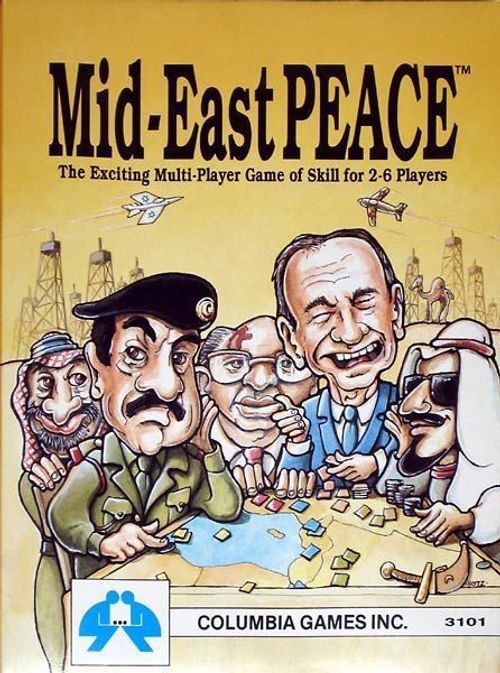
Mid-East Peace
Mid-East Peace Rulebook
Table of Contents
Table of Contents
Author's Preface
The following is the revision author's preface, transcribed as printed. It describes which optional Chrome Rules the author has integrated into the body of the rules.
The rule book contains a number of individually-usable optional rules called "Chrome Rules". The main task of this re-write is to integrate the chrome rules into the main body of the rules. For the purposes of this re-write I will be incorporating only some of the chrome rules, based on personal preference:
- Rule 9.1 Two and three Player Games: No
- Rule 9.2 OPEC: Yes
- Rule 9.3 Random Oil Set-up: No
- Rule 9.4 Oil Drilling: yes but modified to reduce luck
- Rule 9.5 Oil Exports: No
- Rule 9.6 Arms Black Market: Yes
- Rule 9.7 Non-Player Country Defense: Yes
- Rule 9.8 UN chrome: Yes, but only rule 9.8.2 "Security Council Veto".
- Rule 9.9 Changing the rules: No
[House rule, author's addition:] To these I shall add my own optional rule: Non-Elimination. This rule says that, should a player ever have no land areas, instead of being totally eliminated they retain half their stock of oil and will derive an end-game score from it as normal. This preserves their interest in the game, and helps prevent an oil glut making the game interminably long by keeping that player's oil out of circulation.
Game-End
The game can end either in Peace, or in War. Whichever it is will determine the scoring method.
The game ends immediately in "War" if the Oil Supply is completely drained.
The game ends immediately in "Peace" in any one of three ways:
- The UN Assembly passes a Cease-Fire Resolution;
- All players are allied to the same Superpower;
- Only one player controls any land. (Important concept: you only control a land area if you currently have a force there; land areas containing no forces are neutral, regardless of which player was the last to occupy it).
Scoring
Land areas and their economic numbers have no value!
WAR and PEACE: +1 point for each oil in hand.
WAR: +1 point for each military force point in play. +2 point if there is a Superpower force in your Homeland.
PEACE: -1 point for each military force point in play. -2 point if there is a Superpower force in your Homeland.
In the event of a tie, players who don't own their Homeland lose ties to those who do. If still tied then the lesser Homeland value wins (after taking "Oil Drilling" into account).
Set-Up
- Put the UN Peacekeeping force (1) in Cyprus.
- Make an oil supply from all 72 orange-colored oil chips (total oil value of 228).
- Set aside an area for the "OPEC Oil Reserve" (empty at the start of the game).
- Line up the Oil Drilling tokens in numerical order (these have an oil derrick on a black background).
- Each player takes a set of 11 Homeland Forces, one player marker, one Red block Superpower Alliance counter, one Blue block Superpower Alliance counter, and one Superpower Intervention Force (tan).
- Randomly determine a first player. Turn order is clockwise from the first player.
- In reverse turn order each player selects a country to be their Homeland (Sinai and Cyprus may not be chosen). Homelands never change, even if you lose control of it.
- Each player takes oil and forces equal to the economic value of his/her Homeland, placing the forces therein.
- The random production markers (oil derrick on white background) will not be needed.
- The Gavel, "UN Peace" and the UN oil embargo counters are not needed. The UN oil embargo counter looks almost exactly like the Peacekeepers; it doesn't matter if you get them mixed up so long as you only use a single UN Peacekeeper counter.
Initial Negotiation Phase
See Negotiation Phase Rules section for details.
Game Round
Each Round comprises a Turn for each player, followed by a Negotiation Phase (exactly like the Initial Negotiation Phase).
Player Turn
The active player first decides which two of the three possible phases to use. The three possible combinations of two phases are:
- Economic Phase followed by a Military Phase
- Military Phase followed by a Diplomatic Phase
- Economic Phase followed by a Diplomatic Phase
Each Phase must be completed before the next is started, there is no going back.
Each type of Phase permits more than one kind of "Function", but these functions must be taken in the order shown, or can be skipped. Note that other players could be involved in all three types of Phase.
Economic Phase
-
Function: Take Oil Revenue a) Active player takes oil equal to, or less than, the economic value of all their friendly countries. The presence of a Superpower Intervention Force reduces the economic value of its area to half (round up in player's favor). b) This is the only way to get revenue. c) The player may take it either entirely from the Oil Supply, or entirely from the OPEC Oil Reserve. d) If taking from the Oil Supply, and this leaves the Oil Supply empty, then the game ends instantly in WAR. e) If taking from the OPEC Oil Reserve, there must be at least as much oil left in the Reserve as was taken. OPEC gets upset, and an amount equal to the oil taken is then withdrawn from the OPEC Oil Reserve and removed permanently from the game. f) It is OK to "make change" at any time in the game, so treat oil chips like bank notes. g) If you take less than your maximum entitlement of oil, the unclaimed portion is forfeit.
-
Function: Oil Drilling a) The economic value of each area can be increased once per game by drilling more oil wells. b) The Drilling tokens have values from 1 to 4. c) The increase remains in effect for the rest of the game. d) The active player must control their own Homeland. e) If the Active player chooses this Function then they host a Drilling Auction in which all players may participate. See later section for Auction Mechanics. f) The winner of the Auction pays an amount of oil equal to the winning bid into the OPEC Oil Reserve. g) The winner then takes the lowest-valued unclaimed Drilling token and places it in any land area that does not have one. [House rule, author's adaptation: in the written rules the token is taken at random.]
Military Phase
Important concept: All players have identical force pools comprising 11 tokens. There are five tokens of value 1, three of value 2, and one each of value 3, 4 and 5 making a total available of 23 force points. Forces in the same area before movement may be divided and combined at will within the limitation of the 11 playable tokens.
Important concept: Only the sixteen named areas are in play, thirteen land areas and three sea areas. Forces treat sea areas exactly the same as land areas. The only ways in which Sea areas differ from land areas is that you can't drill in them, can't deploy new forces to them, and controlling them doesn't get you any UN or OPEC votes.
Important concept: Land and sea areas are "Friendly" if they contained at least one of your forces before any movement takes place. A sea area is also friendly if empty. Note that alliances do not cause your allies' areas to be friendly! Also note that the presence of the UN Peacekeepers does not deprive a player of control.
-
Function: Demobilize a) You may simply remove any of your forces and return them to your force pool.
-
Function: Move There are three kinds of movement, distinguished by the control status of the area moved to. They can be used in any order and any number of times each provided that no force point moves more than once, and never further than to an adjacent area:
a) Redeployment A move to a "Friendly" area is a redeployment. There is no cost.
b) Annexation A move to an empty land area is an Annexation. Annexation moves cannot be made either into or out of an area containing the UN Peacekeepers. The number of force points moved must be at least one more than the economic value of the land area. The forces used don't need to originate in the same area as each other. Pay oil from hand into the OPEC Oil Reserve equal to the number of forces used. There is no point using any more forces than the minimum because, having gained control of the land via Annexation, you can then move more forces in to it using a free "Redeployment".
c) Attack A move to an area occupied by another player is an Attack. Attacks cannot be made either into or out of an area containing the UN Peacekeepers. Nor can you attack players allied to the same Superpower as you.
Attacking forces are placed on the border that they are intending to cross.
-
Forces that enter the same enemy area from different starting areas cannot be combined with each other, they will have to make separate attacks.
-
Hence there can be multiple attacks on the same area in one player's turn.
-
No forces may ever enter an area containing the UN Peacekeepers, not even forces of the player controlling such an area can move in.
-
Superpower intervention forces never move and never attack, they only affect Defense.
-
Player Elimination [house rule, author's addition: Non-Elimination]
If any player now controls zero land areas (sea areas don't count) they are out of the game. They retain half their stock of oil (round up, and return the other half to the supply) for end-game scoring, but remove all remaining forces from the board (i.e. those in sea areas), and no long have a player turn each round.
The game ends instantly in PEACE if there is now only one player who controls any land areas, or if all remaining players are allies of the same Superpower.
Diplomatic Phase
-
Function: Arms Auction a) This is the only way to add player-forces. b) This function is optional, but to use it the active player must control their own Homeland. c) All players may participate in the auction. d) Determine the winner of the Auction by the Auction Mechanics given later. e) The winning bid becomes the price per force point. f) The winner of the auction must buy at least one force point. g) The winner of the auction may buy as many force points from their force pool as they wish. h) Nobody else may buy force points. i) Payment is made in oil to the OPEC Oil Reserve. j) Bought forces are deployed to any friendly land areas.
-
Function: United Nations a) Calling for a meeting of the UN Assembly is optional. b) The active player may propose one, and only one, Resolution to the UN Assembly. c) The proposed resolution is voted on. d) Each player has one vote per friendly country, plus one if they are allied to a Superpower. Players are permitted to abstain. e) There are three types of Resolution: a) Resolution to deploy UN Peacekeepers. The resolution must name the area to which the UN Peacekeepers will be deployed. A simple majority is needed, and if gained then the UN Peacekeeper unit is immediately moved from where-ever it is to the proposed location named in the Resolution unless the Resolution is Vetoed (in which case it remains where it is). b) A Cease-Fire Resolution. If such a Resolution gains 12 votes and is not vetoed then the game ends immediately in PEACE. [House rule: For a shorter game the players can decide before commencing play to set a lower number of votes to pass a Cease Fire Resolution.] c) Any other Resolution can be proposed, but is non-binding. It is passed by simply majority, and can be vetoed.
- Vetoing a Resolution that the UN Assembly has passed:
- A Resolution to Deploy UN Peacekeepers can be vetoed by the player who controls the proposed location for the deployment. The controller of the Peacekeepers' old location cannot veto the Resolution.
- Any Resolution can be vetoed by either of the Superpower blocks; this needs a majority of the players in the block to back a veto - notice that the block members decide this based on "one ally, one vote" not the number of UN votes they each have. Consequently if a Superpower block only has one player in it, that player wields a UN Veto.
- Vetoing a Resolution that the UN Assembly has passed:
Auction Mechanics
These are used for only two purposes, Drilling Auctions (Economic Phases) and Arms Auctions (Diplomatic Phases). Each auction has a "host", the active player. The Host must have control of their own Homeland. All players may participate in auctions hosted by other players, only the Host is required to have control of their Homeland.
The Host decides that bidding will either be "Open" or "Sealed". Bids are made in oil chips.
Open-Bidding Auctions: The Host opens the bidding with a bid of at least 1 oil. After that any player may call out a higher bid. All players may bid as many times as they wish provided that the high-bid always increases. The Host may bid too, and also acts as Auctioneer, ending the Auction once there are no more bids.
If the winner of the Auction has less oil than the high bid then the high-bidder is ejected from the auction, and the Auction is redone.
Sealed-Bid Auctions: All bidders put their bids in their closed fist and reveal them simultaneously. If there is a tie for high-bid, and the Host is one of the tied players then the Host is declared the winner. If the Host is not one of the high-bidders then the high-bidders (only) repeat the Sealed Bid Auction, but their previous high bid is now the minimum bid. If all players bid zero there is no winner.
Negotiation Phase Rules
Players can negotiate with each other during Negotiation Phases.
- Negotiation Phases will occur before the first Game Round, and at the end of every game Round.
- Anything can be agreed but NOTHING is binding. Common subjects include what Phases and Functions to trigger, non-aggression pacts, deals for UN votes, agreeing to ally with Superpowers, attacks in the coming Round, Arms Auction bid deals, etc etc.
- Negotiations can be in secret if desired.
- Oil can change hands at this time.
- Control of areas cannot be traded.
- Any player possessing at least one OPEC vote can call an OPEC meeting.
- Players having control of neighboring land areas can make Arms Black Market deals.
Arms Black Market
Arms Black Market deals can only be struck during Negotiation Phases; in this type of deal a military Force(s) can be given to another player provided that the force only has to cross a single land border to get to its new owner's land - it is then replaced with the recipient's force. This is not a "move" as such, it happens in the Negotiation Phase. If an Arms Black Market deal involves an oil payment then the payment and the transfer of the force(s) happen simultaneously, however any other aspect of the deal is non-binding. Superpower Alliances of the players have no effect on these deals. Note that it is technically possible for the game to end in PEACE as a consequence of Arms Black Market deals, so check for it after all the deals are implemented.
OPEC Meetings
- OPEC meetings can only happen during Negotiation Phases.
- OPEC meetings will happen only if called for by a voting member of OPEC.
- Each player has one OPEC vote per oil-producing Country that they control.
- Cyprus has no vote unless somebody Drills there;
- Sinai has no vote because it isn't a Country.
- Allying with a Superpower has no effect on OPEC votes.
- Votes are successful on a simple majority.
- Players may make speeches condemning or praising other players, the UN, the Superpowers, etc., to add to the occasion, but these have no impact on the game.
Important Concept: Regardless of the amount of oil in the OPEC Oil Reserve, the game ends instantly in WAR the moment that the Oil Supply is empty. Hence OPEC has a way to significantly impact the game by both regulating the amount drawn from the Oil Supply as revenue, and also by adding oil to the Oil Supply from the OPEC Oil Reserve.
As such there are really only two things that OPEC meetings can meaningfully vote on:
- Production Quotas may be set.
- This is an agreement to reduce oil revenue taken from the Oil Supply.
- Even if agreed, the Quotas are non-binding - there is no point in 5 players setting the other player's quota to zero. Their power is in preventing War, and in striking a deal that everybody else thinks everybody will uphold.
- An amount of oil may be moved from the OPEC Oil Reserve to the Oil Supply.
- Moving oil from the OPEC Reserve to the Oil Supply is binding and is done immediately.
- If a bribe has been agreed to secure a player's vote(s), the agreement is non-binding; if the bribe is paid before the voting, then the bribed player is free to vote as desired; and if a player casts their vote(s) on the expectation of receiving a bribe, the bribing player is free to not pay.