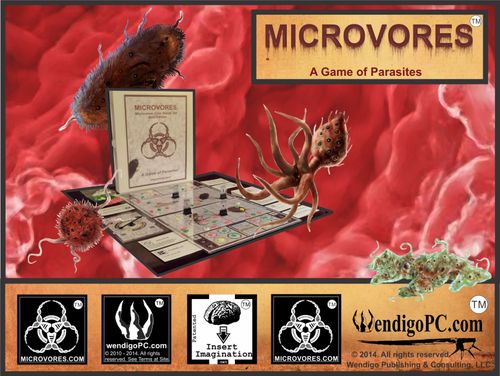
Microvores
Microvores Rulebook
Table of Contents
Table of Contents
Contents
Microvores has been designed to be compatible with Insert Imagination (TM) (also referred to as "{ii}"), which is a patented modular scalable system of pocket based components (or transparent vesicals capable of receiving media/graphic inserts). As such, some or all of the physical components of Microvores may be reused for other games which are also compatible with Insert Imagination (TM) by merely exchanging out the graphic inserts between the {ii} components. For more information on Insert Imagination (TM), its components, and compatible games, please visit insertimagination.net and/or WendigoPC.com.
CONTENTS* (Micro-Sized Edition): 2 {ii} Game Board Boxes/Tiles (with 5x7 Inserts), 1 {ii} Pocket Spinner (with 2.5x3.5 Insert), 3 Six Sided Dice (Yellow, Blue, Black), (20) Microbe/Subdivision Square Tokens, (40) Evolution Tokens, Label Sheet, Approximately (60) green arrow Food Tokens, (60) red arrow Toxin Tokens, (10) yellow square Special Tokens, and Quick Play Rules Insert w/QR codes to Website (to download Full Game Play Rules) and to FB Page (contain links to Tutorial Videos).
CONTENTS* (Standard Edition): 2 {ii} Game Board Tiles (with 8.5 x 11 Inserts), 1 {ii} Pocket Spinner (with 4x6 Insert), 3 Six Sided Dice (Yellow, Blue, Black), 4 {ii} Pawns (with Microbe Card Inserts), 16 round Subdivisions Tokens, (40) Evolution Cards, Approximately (60) green arrow Food Tokens, (60) red arrow Toxin Tokens, (10) yellow square Special Tokens, and Quick Play Rules Insert w/QR codes to Website (to download Full Game Play Rules) and to FB Page (contain links to Tutorial Videos).
CONTENTS* (Collector Edition): 4 {ii} Game Board Tiles (with 8.5 x 11 Inserts), 1 {ii} Pocket Spinner (with 4x6 Insert), 3 Six Sided Dice (Yellow, Blue, Black), 4 {ii} Pawns (with Microbe Card Inserts) OR 4 Microbe Miniatures, 16 round {ii} Subdivision Tokens w/Inserts, (40) Evolution Cards, Approximately (60) green arrow Food Tokens, (60) red arrow Toxin Tokens), (10) yellow square Special Tokens, and Quick Play Rules Insert w/QR codes to Website (download Full Game Play Rules) and to FB Page (contain links to Tutorial Videos).
*Some assembly is required. Some components may vary in size and/or color.
Game Setup
(1) Assembly of Board: The Microvores Game Board is assembled by aligning the 2 Game Board Tiles (with Inserts) (or 4 Tiles for the Collector Edition) so that the red border surrounds the four quadrants (Q1-Q4) containing the numbered spaces. As such, the Quadrants will be aligned as follows: Q1 will be upper left, Q2 upper right, Q3 lower right, and Q4 lower left.
(2) Evolution Cards ("EVOs"): The EVO cards are shuffled, and the stack is placed face down.
(3) Starting Food (6), Damage (0), and Mutation Level (1):
(a) **Food:** Each player places a Food Particle ("FD") (a green arrow token) on the FD Dias in front of them (so that it points to indicate 6 FD).

(b) **Damage:** Each player places a Toxin Particle ("TOX") (a red arrow token) on the Damage ("DMG") Dias in front of them (so that it points to 0 DMG).

(c) **Mutation Level:** Each player places a Special Particle (a yellow token) on the Mutation Level indicator in front of them (so that it indicates Mutation Level ("ML") of 1 ML). Each Player starts at LV 1.

Remaining Particles (the green, yellow, and red tokens) are set nearby for convenient access.
(4) Placement of Microbes/Turn Order: To determine which player will place their Microbe first, each player rolls a dice, and the highest roll (1d6) determines which player will first choose a Microbe and place it on any space in its corresponding quadrant (Virus, Bacteria, Paramecium, Amoeba). Re-roll any ties between players. After the first Player places their Microbe, the next Player to their left (going clockwise) places their Microbe, and so on. When all Players have placed their Microbes (in any square in their corresponding quadrant), then Player 1 proceeds with a SETUP DRIFT PHASE specifically for the Game Setup, and then Player 1 will take their turn. Turn order for Players proceeds in a clockwise fashion (the same order as placement of the Microbes occurred).
NOTE: If the spinner ever lands on a line, the number/result to the right of the line (clockwise) is the result.
(5) Review of Win & Loss Conditions:
(a) **Proliferation:** A Player with 5 or more Units (4 or more Subdivisions and their Microbe) in Play (on the Game Board) at the start of their Action Phase automatically wins the game due to Proliferation.

(b) **Extinction:** A Player with no Microbe nor Subdivisions in Play at any time looses the game immediately due to Extinction. Additionally, any Player who deals the killing blow that Destroys an opponent's last Unit, wins the game due to Extinction/Eradication.

(c) **Time Constraints:** If a game must cease due to time constraints, after each Player has had an equal number of Turns, the Player with the highest Life Total wins. To determine a Player's Life Total, add 10 Life for each of their Unit(s) in Play less any DMG on their DMG Dias. If the Life Totals are tied, then the Player with the most Food wins.

(d) **Other:** In cases of cheating, interference, product malfunction, unsportsmanlike conduct, etc..., a game judge may determine a Winner or Loser in their absolute discretion.
Game Play
During each Player's turn, they will go through the following 3 Phases, all describe in detail below, and also referenced on the Game Board:
(1) Drift Phase (2) Metabolism/Cannibalism Phase (3) Action Phase
(1) The Drift Phase
Various sources of protein, fats, sugars, trace elements, and other molecules drift their way into your Microbe's vicinity. Be careful of what you eat.
Some game effects (as specified elsewhere) may take place during this phase.
The active Player rolls the 3 dice and spins the {ii} Pocket Spinner:
- Yellow/Red Dice = indicates the Quadrant(s): Q1-4, 5= Choice, 6= All Quadrants).
- Blue Dice = indicates a Ten's Place (10s)
- Black Dice = indicates a One's Place (1's).
- Spin Result = indicates the Particle(s) (Foods/Toxins/Special), or Pattern of Particles.
Together, the Blue and Black Dice will produce a range of numbers from 11 to 66, the result of which is the Tile # in the indicated Quadrant(s), on which the Particle(s)/Pattern of Particles will be deployed on, or relative thereto.
Note: When distributing Particles shown in a single square on the spinner, place "all" the indicated particle(s) in the Tile # in the correct Quadrant(s) as determined by the dice.
Note: When distributing Particles shown in multiple squares on the spinner (usually a 3x3 grid), then place each indicated Particle in relation to the center square of the grid, with the center square being the Tile # as determined by the dice.
Note: The color of the dice may change depending on supplier availability. As long as Players use (3) different d6, color of the dice is irrelevant.
ARROW DIRECTION: The direction that arrow tokens are facing determines how many particles of FD/TOX/Special a single arrow token represents. Arrows are placed diagonally within a Tile #, and whichever corner they point to (Q1, Q2, Q3, Q4) indicates the value of the arrow token.
- Q1 = 1 particle.
- Q2 = 2 particles.
- Q3 = 3 particles.
- Q4 = 4 particles.
So for example, if Tile # 9 had one green arrow token pointing to Q2, and a Microbe moved onto Tile # 9 during its H&G action, that Microbe would eat 2 FD particles, and remove the green arrow from the Game Board. That Player would also increase their FD Dias by 2 FD.
Similarly, if Tile #9 had one green arrow pointing to Q2 on it, and a subsequent Drift Phase indicated that 3 additional Food was to be placed on Tile #9, that would bring the Food Particle total to 5 FD on Tile #9. To represent the 5 FD on Tile #9, the player would "turn" the existing green arrow from pointing to Q2 to Q4 (indicating 4 Food), and then add one additional green arrow pointing to Q1 (indicating 1 Food). In sum, the two green arrows would represent 5 FD on Tile #9. If a subsequent Drift required 3 more FD to be placed on Tile #9 bringing the total to 8 FD, then that Player would just turn the Q1 facing green arrow to point to Q4, so that both green arrows on Tile #9 now point to Q4, which indicates 8 FD Particles in total.
PARTICLE TYPES:
(a) Food (FD): FD may be generated during the Drift Phase and remains on the Game Board until they are automatically "eaten/absorbed" by a Microbe within the same space, during its H&G Action. FD Particles are represented by a green arrow token. Whenever, a Unit automatically eats/absorbs a FD Particle, the particle is removed from the Game Board and the Player increases their FD Dias by the indicated amount. In general, FD is a resource for Players and can be used to pay the costs associated with their Metabolism Phase (1 FD p/Unit), Evolving (3 FD), Mutating (4 FD), and Subdividing (5 FD).
(b) Toxins (TOX): Toxins, like FD, may be generated during the Drift Phase and remain on the Game Board until they are automatically "eaten/absorbed" by a Microbe within the same space, during its H&G Action. Toxin Particles are represented by a red arrow token. Whenever, a Unit automatically eats/absorbs a Toxin Particle, the particle is removed from the Game Board and the Player takes DMG equal to the total number of Toxins removed. To reflect the DMG taken, the Player increases the DMG on their DMG Dias by the indicated amount.
(c) Special: Special Particles may be generated during the Drift Phase and remain on the Game Board until they are automatically "eaten/absorbed" by Microbes within the same space, during its H&G Action. Special Particles are represented by a yellow square or arrow token. Whenever, a Unit automatically eats/absorbs a Special Particle, the particle is removed from the Game Board and the Player immediately spins to determine the effect (the yellow ring on the spinner) which takes place immediately (may include a free Evolution, Mutation, or Subdivision). The resulting effect of the Special Particle does not require the Player to pay the normal FD costs associated with the special action, however other aspects of the special action still apply (for example Mutation still requires discarding one EVO; EVOs are still subject to limits, etc...).
(2) Metabolism/Cannibalism Phase ("Metabolism Phase")
Microbes need food to convert to energy in order to live. If they do not have adequate food, they will cannibalize parts of themselves until they die. The active Player "may" pay 1 FD, or if they do not, then they take 1 DMG instead, for each Unit (Microbe/Subdivision) they have in play. To indicate whether FD was paid, or DMG was taken, the Player must turn the arrow token on appropriate FD or DMG Dias on the Game Board. Note: Once a Player has taken 10 DMG, their Microbe is Destroyed (removed from the Game Board) and they loose the game, unless that Player has Subdivision in play.
(3) The Action Phase (Choose 1 Action)
The active Player may choose one of the following actions: (a) Hunting & Gathering ("H&G"), (b) Evolving, (c) Mutating, OR (d) Subdividing.
(a) Hunting & Gathering: If the Player chooses H&G, then they may Move, Eat, and/or Attack with one of their Microbes/Subdivisions. Upon Choosing to H&G, the Player must immediately designate which of their Units they are activating. Then the Player rolls a dice (1d6) to determine their base Movement ("MV") for the turn. The Player then adds or subtracts MV modifiers caused by any other effects (such as Mutation Levels and/or EVOs) to arrive at the Unit's MV total for the turn. Note: For ease of manipulation, a Player may always swap their Microbe pawn with their chosen subdivision.
(i) **Moving:** Once the Player chooses which Unit to activate, and determines their total MV, they "may" move their chosen Unit any number of spaces up to their MV total, expending 1 MV per space. Units may NOT move diagonally. Units may NOT move through a space occupied by another Unit. Moving may be performed all at once either before or after making an Attack, or Moving may be performed both before and after making an Attack, as long as the Player has enough MV.

(ii) **Eating:** During H&G, only the active Unit automatically "Eats" any FD/TOX/SPECIAL Particles that occupy the same space as it, whether it begins in the same space as the Particle(s), or moves into a space with the Particle(s). Whenever a Unit automatically Eats a Particle, such Particle(s) (arrow tokens) is/are removed from the Game Board, and such Player is required to make corresponding adjustments to their FD and DMG Dias, and/or immediately spin to determine the effect of the Special Particle should one be consumed. Note: Microbes/Subdivisions do not "eat" any Particles in their space if the Player is performing an Action other than H&G. Similarly, they do not "eat" any Particles if they are not the selected active Unit for Movement at the beginning of the H&G, nor do they "eat" during another Player's Turn.

(iii) **Attacking:** During H&G, the active Unit may make a single Attack at any point during its Movement, against an adjacent Microbe/Subdivision, in order to deal its Base Damage, plus any DMG modifications (from effects/EVOs) to another Player's Microbe/Subdivision. In order to make the single Attack, the Unit must expend one (1) MV.
(b) Evolving (3 FD): The active Player may forfeit taking any other Actions (H&G, Mutating, and Subdividing) for their turn and may Evolve any number of times by paying 3 FD in exchange for being able to draw 2 Evolution Cards ("EVOs") at random from the Gene Pool (the deck of EVOs), selecting one EVO to keep and discarding the other EVO card. Each instance of Evolving may be sequential, allowing the Player to decide whether to continue to Evolve or not. Depending on the Mutation Level of the Player, they can have only a certain number of EVOs in Play at any time. Any EVOs in excess of the Player's EVO Limit must be discarded. For Example, if a Player has a starting Mutation Level of 1, and they already have 2 EVOs in play, and they choose to Evolve, they would pay the cost, draw 2 EVOs, select one to keep and one to discard, and then have to discard (Player's Choice) another one of their now 3 EVOs to remain at their EVO Limit of (2). EVOs grant a Player's Units special abilities and/or modify their Unit's statistics (such as MV, DMG, etc...). EVOs remain in Play until the Player is required to Discard them. When an EVO is discarded it is placed face-up next to the Gene Pool. When the Gene Pool is exhausted of EVOs, shuffle the discarded EVOs back into the Gene Pool.
(c) Mutating (4 FD): The active Player may forfeit taking any other action (H&G, Evolving, and Subdividing) for their turn, and may Mutate (up to three times during the Game) by paying 4 FD per Mutation. A Player may Mutate any number of times during their Action Phase as long as they pay the costs. Each Player starts at a Mutation Level of 1, as indicated on their Mutation Level Indicator, and increases their Mutation Level whenever they Mutate. In general, Mutating allows the Player to increase their EVO Limit (the number of EVOs they may have in play at any one time), increase their MV, and increase their Base DMG for Attacking. Specifically, whenever a Player Mutates, the Player:
(a) Must increase their Mutation Level by 1 (up to LV 4), and
(b) Must discard 1 EVO of their choice (if they have any).

- Level 1 (Starting): +1 MV; EVO Limit (2); 1 Base DMG;
- Mutation Level 2: +2 MV; EVO Limit (4); 2 Base DMG;
- Mutation Level 3: +3 MV; EVO Limit (6); 3 Base DMG;
- Mutation Level 4: +4 MV; EVO Limit (8); 4 Base DMG;
(d) Subdividing (5 FD): The active Player may forfeit taking any other action (H&G, Evolving, and Mutating) for their Turn and may Subdivide up to 2 times sequentially, by paying 5 FD per Subdivision. When a Player Subdivides, that Player deploys a Subdivision in an adjacent unoccupied space (relative to any of their Units on the Game Board).
A Player's Subdivisions are treated as exact copies of their Microbe for all intents and purposes of the rules. As such, each Subdivision benefits from all of the Player's EVOS, their Mutation Level, and shares access to the Player's communal FD and DMG Dias. Unless otherwise specified, anytime the term "Microbe" is used, "Subdivision" may be interchanged and the rule/effect would still apply. However, if a rule/effect specifically uses the term "Subdivision," one could not automatically interchange "Microbe." "Unit and Units" refer to a Player's Microbe and/or Subdivision(s) in Play. Subdivisions may be Attacked and/or take DMG, which results in adjusting the Player's communal DMG total (the DMG Dias). Remember, each Subdivision will increase its Player's Metabolism Phase Costs.
Destroying Units
In general, whenever a Player has accumulated 10 DMG (or more), they must Destroy (remove from the Game Board) one of their Microbes/Subdivisions ("Unit(s)"), and then reset their DMG Dias to zero (0). Damage in excess of the 10th DMG does not carry over once the DMG Dias is reset. Subsequent DMG though will increase the DMG Dias once again. If a Player has no remaining Units on the Game Board at any time, then they Lose the game. If a Player's actual Microbe is destroyed, and they have any remaining Subdivisions in play, they must immediately replace one of their Subdivisions with their Microbe. Which Unit is actually Destroyed from the 10th DMG, depends on the circumstances resulting in the final 10th DMG, as follows:
(a) Destroy The Attacked/Targeted Unit: Whenever a Player accumulates 10 DMG (or more), that would cause the Player to Destroy a Unit, then the Player must Destroy the Unit that suffered the most recent DMG from the Attack or effect that targeted the particular Unit.
(b) Destroy The Active Unit: Whenever a Player accumulates 10 DMG (or more) during their own H&G Action (while Moving, Eating, and/or Attacking), the Player must Destroy their active Unit.
(c) Destroy Unit of Player's Choice: Whenever a Player accumulates 10 DMG (or more) for any reason not in (a) or (b) above, then the Player may choose which Unit to Destroy. (For Example, DMG taken during the Metabolism/Cannibalism Phase).