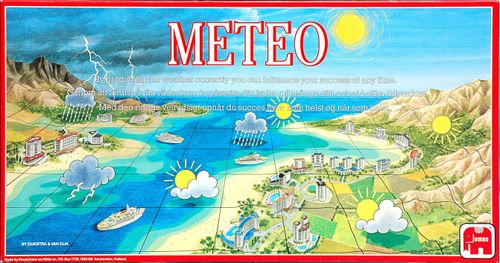
Meteo
Meteo Rulebook
Table of Contents
Table of Contents
Components
- Game board
- 30 weather markers
- 9 figures each in 4 colours
- 3 weather witches (black figures)
- 1 die
- 1 wind marker
Weather markers:
- Ice
- Sun
- Fire
- Rain
- Thunderstorm
- Fog
Landscapes:
- Plain (yellow)
- Forest (green)
- Mountains (grey)
- Lake (blue)
Setup
The game board is spread out on the table. The three black weather witches are placed on the edge of the game board in the middle of the three white paths (grey dot). The weather markers are shuffled face down and placed beside the game board.
- With 2 players, two opposite colours are played, with 9 figures each.
- With 3 players, red, dark yellow (orange) and blue, or light yellow, light blue and green are played, with 6 figures each.
- With 4 players, two opposite colours are not used; each player plays with 5 figures.
Each player chooses a colour and places his figures in the village that faces his colour. Red thus starts from the yellow village, green from the blue village, yellow from the red village, and so on. (Players first move onto one of the coloured spaces in front of the village, which counts as one move, and from there on later.)
Each player draws three weather markers, looks at them, but keeps them secret from the other players. Two weather markers are placed face up next to the supply. The wind marker is placed on the start space in the wind circle (grey dot). One player becomes the wind player and receives the die. This player starts.
Course of Play
The goal is to bring as many of one's figures as possible into one's own village or at least onto one's own side. Figures are moved step by step from one space to the next.
The spaces with the landscapes "Plain" (yellow), "Forest" (green) and "Mountains" (grey) are normally passable for figures; the "Lakes" (blue) normally are not. This changes depending on the weather.
Players take turns in clockwise order. A player's turn consists of the following steps:
- Place weather markers
- Move figures
- Draw weather markers
- (Wind player only) Make wind
1. Place Weather Markers
The player may play at most two of his weather markers, but may also forgo placing weather markers. Weather markers are:
- placed on a certain landscape, making passable spaces impassable or impassable spaces passable again, or
- placed on weather markers that are already lying down, cancelling them. Both markers are removed at once and shuffled face down back into the supply.
Not every combination of weather marker and landscape, or of a weather marker and a marker already lying, is possible. The table on the next page shows which weather markers may be placed on which spaces, or on which markers already lying, and what effect this has. Only the combinations marked in colour in the table are allowed. These permitted combinations are also shown on the game board.
Weather markers may also be placed on spaces on which a figure already stands. If this creates an impassable space on which figures stand, the active player must move those figures onto a passable neighbouring space (a fog space is also permitted). If this is not possible, the figure must start again in the village.
If figures stand on fog spaces, they are held there until the fog disappears.
The two coloured spaces lying in front of the villages may not be covered with weather markers.
Sidebar: Placing weather markers
- Maximum 2 per turn
- In landscapes: passability changes
- On other weather markers: they cancel each other out
- Not every combination is possible
Sidebar: Impassable spaces Moving figures:
- Active player
- To passable neighbouring spaces
- If not possible, back to the start
Placement Table
Example (printed with a picture in the German rulebook): Red plays a "Rain" weather marker onto the plain space in the middle of the picture. Now the red figure and the blue figure stand on a space that has become impassable, and both must be moved. Red moves the blue figure into the mountains, which is backwards for blue, and fog also prevails there, so the blue figure is held for the moment. Red naturally moves its own figure forwards, onto the free coloured space directly in front of its own village, so that afterwards only one step is needed to reach its own village. (Red may not move its figure onto the other coloured space, because on the coloured spaces only one figure may ever remain standing, and that space is occupied here by yellow.)
1. How the weather markers are placed:
Each marker below is placed either on a space with a landscape (columns Plain, Forest, Mountains, Water) or on a marker already lying (columns Sun, Rain, Fog, Thunderstorm, Fire, Ice). The entry shows the effect; a blank cell means the combination is not allowed.
| Weather marker placed | Plain | Forest | Mountains | Water | Sun (on marker) | Rain (on marker) | Fog (on marker) | Thunderstorm (on marker) | Fire (on marker) | Ice (on marker) |
|---|---|---|---|---|---|---|---|---|---|---|
| Sun | makes space impassable | makes space passable | cancelled | cancelled | cancelled | |||||
| Rain | makes space impassable | makes space impassable | cancelled |
Colour key of the original table: red = makes space impassable; green = makes space passable; grey = holds figures; blue = cancelled (the two markers are removed).
Example below the table: If a "Sun" weather marker is placed on a "Plain" space, no figure may be moved onto or over this space any more. If a figure already stands on it, it must be moved. The effect of the "Sun" can be cancelled again by placing "Ice" or "Rain" on it, and then both markers are removed.
2. Move Figures
With each turn a player may move 6 steps, which he may distribute freely among his figures and one weather witch.
Per step the chosen figure moves one space further. It may be moved in any direction, as long as the following rules are kept:
- At most 2 figures may be on one space, including while passing through it.
- On the coloured spaces in front of the villages at most one figure may stand, so that passing through is always possible.
- Movement may only go through or into passable spaces. The wind space in the middle is always impassable.
- One may not move out of or through fog spaces. Moving into a fog space is allowed, but the figure is then held there.
- One may not move into foreign villages.
Sidebar: Movement: 6 steps
- Any own figures, maximum 1 weather witch
- 1 step = 1 figure moves 1 space
- 2 figures per space, standing or passing through
- In front of the villages: maximum 1 figure standing
- Only through passable spaces
- Fog holds figures fast
- Not into foreign villages
The weather witch may likewise move one space per step. At the end of your turn she may remove one weather marker from one of the rows she can now see into (white arrows). The player takes one weather marker of his choice from one of the relevant rows and returns it face down to the supply.
Sidebar: Weather witch
- 1 step = 1 space
- Remove 1 weather marker from a row in view
3. Draw Weather Markers
To conclude his turn, the player draws as many weather markers again as he has placed. In doing so he may take at most one of the markers lying face up (and then turns over a new one).
Sidebar: Draw weather markers
- Draw back up to 3 weather markers
4. Make Wind
This step is carried out only by the current wind player. The other players carry out only steps 1 to 3.
If the wind marker stands on a grey space, the wind player moves it one space further in clockwise direction and ends his turn.
If the wind marker stands on a blue space, the wind blows across the land.
The wind player rolls the die to determine the current wind. The wind rose in the middle of the game board shows the direction in which the wind blows across the whole game board for the corresponding number. Now all weather markers, beginning with the markers on the side facing away from the wind, are shifted one space in the wind direction (the figures naturally remain standing). In doing so:
- If a weather marker is pushed off the game board, it comes back on from the opposite side.
- If a weather marker is pushed into a landscape on which it may not lie (see the table under "Place weather markers"), it is shuffled back into the supply.
- Since the weather markers theoretically move at the same time, none of them can move onto another one.
If impassable spaces arise in this process on which figures stand, the respective owners must move these figures after the wind, beginning with the starting player, onto a passable neighbouring space. If this is not possible, the figure must start again in the starting village.
Afterwards the wind player moves the wind marker one space further around the wind circle in clockwise direction and hands the die to his right-hand neighbour. This player is now the wind player until he has once triggered a wind.
Sidebar: Make wind
- Only the wind player
- White space: marker one space further
- Blue space: roll for the wind
- The wind rose gives the direction
- All weather markers move 1 space "simultaneously"
- "The earth is round" (markers pushed off the board re-enter on the opposite side)
- Impossible placements leave the board (shuffled into the supply)
- Figures on impassable spaces: the owner moves them to a passable neighbouring space, or one step further toward the start marker
- Die: the wind player passes it one player further
End of the Game and Scoring
As soon as the first player has drawn all his figures into his own half (marked by a border in his player colour), the game ends. The round is still played to the end.
The player with the most points wins.
Scoring:
| Position of a figure | Points |
|---|---|
| Figure in own village | 3 points |
| Figure in own half | 1 point |
| Figure not in own half | 1 minus point |
| Figure still in the starting village | 3 minus points |