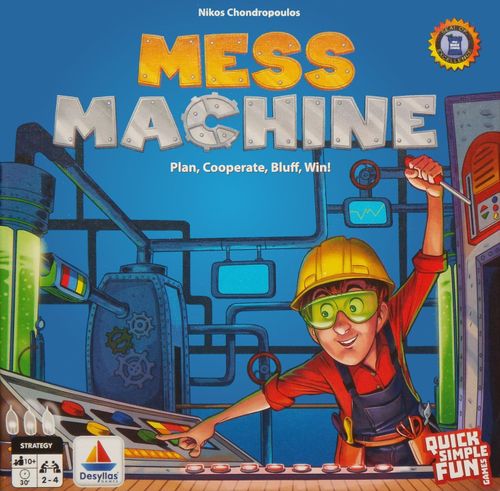
Mess Machine
Mess Machine Rulebook
Table of Contents
Table of Contents
Components
- 1 Game board
- 16 Players’ Button Indicators in 4 colors
- 40 Button tokens: 10 red, 10 blue, 10 yellow, 10 green
- 4 Scoring markers
- 4 Direct Button markers
- 64 tiles with puzzle pieces, forming 4 different images
- 1 Die
- 1 Rulebook
Game Setup
Choose one of the game’s images to play with. Take the ziplock bag with its tiles, shuffle them face down and form a 4x4 grid with them. Then turn the tiles face up, making sure they all have the same orientation (you can use the star on the bottom right corner of each tile as a guide).
Place the board on the table where everyone can reach it and place on each button its 10 corresponding Button tokens.
Each player chooses a color and gets the 4 corresponding Player’s Button Indicators, a Scoring marker of the same color and a Direct Button marker.
Place the die next to the board.
Choose the difficulty level for this game: Easy, Medium or Hard (for more information see Malfunctions on page 5).
Place each player’s Scoring marker on the board, next to the controller’s switch, as shown in the image.
Study the puzzle and depending on the Buttons you think you will all have to push, (see Buttons below), choose 2 of your Player’s Button Indicators, place them face down in front of you and set aside the other two - they will not be used during the game but they will have to remain hidden from the other players. Choose then one of the two Button Indicators in front of you and put on top of it your Direct Button marker. This will be your “Direct” button while the other one will be your “Indirect” button (for more information see Game End on page 6). Note that you can look at your face down Button Indicators at any time.
You are now ready to play! The younger player goes first and turn proceeds clockwise.
Game Overview
Buttons
You try to fix the puzzle by using the 4 buttons on the board. Each button, when used, exchanges two puzzle tiles on the same row or column.
More specifically:
- Button A: Exchanges the 1st with the 3rd tile OR the 2nd with the 4th tile on the same row.
- Button B: Exchanges the 1st with the 2nd tile OR the 3rd with the 4th tile on the same row.
- Button C: Exchanges the 1st with the 3rd tile OR the 2nd with the 4th tile on the same column.
- Button D: Exchanges the 1st with the 2nd tile OR the 3rd with the 4th tile on the same column.
Turn Overview
When your turn comes up, you choose one of the buttons to press and you exchange two of the puzzle’s tiles accordingly. You then take one of the button’s tokens from the board and place it in front of you. If there are no remaining tokens of a button on the board, it cannot be pressed for the rest of the game and you must choose a different button.
If after pressing a button for your turn, one or both of the exchanged tiles are in their correct final place, you gain 1 Victory Point (VP) and move your scoring marker on the board accordingly. However, if at some point one of the four buttons has no remaining button tokens on it, VP are no longer gained from correct placement for the rest of the game.
Your turn is then over and play goes to the player on your left. That player may use any one of the buttons but is not allowed to exchange the exact same two tiles that you just exchanged.
Example: Maria uses button A and exchanges the 2nd with the 4th tiles of the 3rd row. She takes one red button token from the board and it is now Thomas’s turn. He uses button D and exchanges the 4th tile of the 3rd row with the 4th tile of 4th row. He takes one green button token from the board and since the 4th tile of the 4th row is now on its correct final place, he scores 1 VP.
Malfunctions
Depending on the difficulty level at which you are playing, the machine you are using to fix the toy may malfunction after a player’s turn.
When the machine malfunctions, roll the die twice and exchange two tiles according to the results. The result of the first roll determines which of the upper tiles will be exchanged and the result of the second roll, which of the lower ones, according to the image below.
Note on the image: the diagram on page 5 numbers the candidate tile positions. For the first roll, the numbers 1 to 4 mark the 1st to 4th tiles of the top row and 5 and 6 mark the 1st and 2nd tiles of the second row. For the second roll, 1 and 2 mark the 3rd and 4th tiles of the third row and 3 to 6 mark the 1st to 4th tiles of the last row. The worked example below uses these positions.
The number of malfunctions that will occur, differs based on the difficulty level, according to the following table:
| Difficulty Level | Malfunction |
|---|---|
| Easy | None |
| Medium | The first time a button is left with 5 button tokens. |
| Hard | The first time a button is left with 5 button tokens. AND The first time a button is left with 2 button tokens. |
Example: Filippa, during her turn, presses button A and exchanges two tiles accordingly. She then takes one red button token from the board and now there are only 5 left. Since they are playing at Medium difficulty, this triggers a malfunction. She rolls the die twice and gets a 3 and a 4. This means that she has to exchange the 3rd tile in the first row with the 2nd tile in the last row.
Panos, who plays after her, presses button C and takes one yellow button token from the board. This was the 5th time button C was pressed but a malfunction only triggers the first time a button is left with 5 tokens, so nothing happens.
Game End
The game ends when one of the following conditions is met:
- The last 2 tiles are placed on their correct final places and the image is fully formed. You are successful in fixing the toy.
- One or more buttons have no more button tokens on them and you all agree that there is no possible solution for the puzzle. You are unsuccessful in fixing the toy.
If you are successful in fixing the toy, you reveal your Direct and Indirect buttons and you score additional VP:
- For every button token you have in front of you of the same color as your Direct button, you get 1 VP.
- For every button token the other players have in front of them of the same color as your Indirect button, you get 2 VP.
Example: The game has just ended successfully and Maria calculates her additional VP. She had chosen button A (the red one) as her Direct button at the beginning of the game, and button D (the green one) as her Indirect button. During the game she got 4 red button tokens (by pressing the red button 4 times) so she gets 4 additional VP from it. She then counts all the green tokens the other players have collected and they are 8. As a result she gets 16 additional points from her Indirect button prediction.
If you are unsuccessful in fixing the toy, you only reveal your Indirect button and you get 1 VP for every button that the other players have in front of them that is of the same color.
Note: Since the scoring method changes like this, it is important to end the game if the players realize that no solution is actually possible. Otherwise, every move made from that point onwards will offer VP to the other players and not to the one making it.
The winner is the player with the most VP. In case of a tie, all tied players count the button tokens they collected, other than those corresponding to their Direct button. The one who has the most is the winner. If there is still a tie, all tied players share the victory.
Strategy Tips
- In order to solve the puzzle you will have to cooperate with the other players. You are encouraged to talk and discuss your moves so that you can find the best combination and effectively move the tiles to their correct places. However, keep in mind that you secretly want the other players to push your Indirect button, since that is what gives you the most VP in the game. If you have good bluffing skills, now is the time to use them!
- A good way to solve the puzzle is to virtually sort the pieces, depending on their correct final place, into “left” and “right” ones or “upper” and “lower” ones. This way, if for example you manage to bring all the “left” ones on the left side of the grid and all the “right” ones on the right, it will only take a few moves to place everything in its final place.
Variants
Family Game
If you want to play the game with children, in order for them to understand the rules more easily, play at the Easy level and choose the image with the numbers from 1 to 16.
Consecutive Games
You may choose to play 3 games in a row with different images, keeping the score from one game to the next. The player with the highest score at the end of the 3rd game is the winner. In case of a tie, you may play one more game with another image.
Cooperative Game
In this variant all the players are working together to solve the puzzle and you win or lose as a team. Do not use the Players’ Button Indicators and the Direct Button markers since you won’t be choosing Direct or Indirect buttons. Also, place 8 button tokens (instead of 10) on each button on the board and choose either the Medium or the Hard difficulty level - you can’t play at the Easy level with this variant. You win the game if you manage to complete the puzzle and fully form the image with the moves available.